
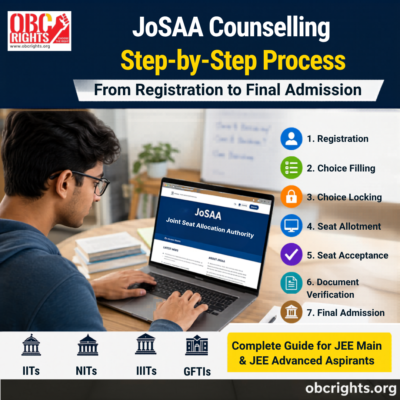
After JEE Main and JEE Advanced results, the real challenge for students begins—not the exam, but the counselling process. Every year, thousands of students miss better colleges not because of their rank, but because they do not fully understand how JoSAA Counselling works.
JoSAA Counselling is the centralized admission system for IITs, NITs, IIITs, and GFTIs. Your rank alone does not guarantee a college; your decisions during counselling determine your final seat.
This guide explains JoSAA Counselling 2026 in a simple, practical, and decision-focused way so that students can avoid mistakes and make informed choices.
JoSAA Counselling 2026: Key Points Every Student Should Know
Before participating in JoSAA Counselling 2026, here are the most important facts you should understand:
- JoSAA is the centralized counselling system for IITs, NITs, IIITs, and GFTIs.
- IIT admission requires JEE Advanced qualification, while NITs, IIITs, and GFTIs are based on JEE Main rank.
- Your final college depends not only on rank but also on choice order and strategy.
- A single mistake in preference order can change your entire admission outcome.
- Multiple counselling rounds allow upgrades depending on seat availability.
- Previous year cutoffs are only reference points, not fixed guarantees.
- CSAB rounds provide additional opportunities after JoSAA.
- Freeze, Float, and Slide options directly impact your future upgrade chances.
Key takeaway: JoSAA is not just a form-filling process – it is a strategic decision system.
JoSAA Counselling 2026 – Important Dates
| Date | Event |
| 20 April 2026 | JEE Main 2026 Rank Declaration |
| 1 June 2026 | JEE Advanced 2026 Result |
| 2 June 2026 | JoSAA Registration & Choice Filling Starts |
| 8 June 2026 | Mock Seat Allocation Round 1 |
| 10 June 2026 | Mock Seat Allocation Round 2 |
| 11 June 2026 | Last Date for Choice Filling (Auto Lock) |
| 13 June 2026 | Round 1 Seat Allotment |
| 26 June 2026 | Last Date for Round 1 Fee Payment |
| 30 June 2026 | Round 2 Seat Allotment |
| 3 July 2026 | Last Date for Round 2 Fee Payment |
| 6 July 2026 | Round 3 Seat Allotment |
| 8 July 2026 | Last Date for Round 3 Fee Payment |
| 10 July 2026 | Round 4 Seat Allotment |
| 13 July 2026 | Last Date for Round 4 Fee Payment |
| 16 July 2026 | Final Round Seat Allotment (IIT/IISc) |
| 20 July 2026 | Final Fee Payment Deadline |
| 22–24 July 2026 | CSAB Counselling Begins |
What is JoSAA Counselling?
JoSAA (Joint Seat Allocation Authority) is the centralized body responsible for managing admissions into India’s top engineering institutions.
Through JoSAA, students can apply for seats in:
- Indian Institutes of Technology (IITs)
- National Institutes of Technology (NITs)
- Indian Institutes of Information Technology (IIITs)
- Government Funded Technical Institutes (GFTIs)
Students do not apply to each institute individually; instead, they complete one common application and take part in a centralized counselling system for seat allocation.
Who is Eligible for JoSAA Counselling?
Eligibility depends on the exam you have qualified:
For IIT Admissions:
- Must qualify JEE Advanced
- Must meet minimum Class 12 eligibility criteria
For NIT, IIIT, and GFTI Admissions:
- Must have a valid JEE Main rank
- Must meet Class 12 eligibility requirements
Only students with valid ranks in JEE exams can participate.
Complete Step-by-Step Journey: JEE → JoSAA → Admission
Step 1: JEE Examination Stage (Before Everything Starts)
Students first appear for:
- JEE Main (for NITs, IIITs, GFTIs + IIT eligibility)
- JEE Advanced (only for IIT admission)
What actually matters here:
- Your performance decides your rank
- Rank later decides your eligibility range
Step 2: Result Declaration & Rank Release
After exams:
- JEE Main rank list is published by NTA
- JEE Advanced rank is released for qualified students
Why this step is important:
- Rank is not admission – it is only your counselling entry key
- It defines which colleges are realistically available to you
At this point, students should NOT think about admission yet – only about counselling strategy.
Step 3: JoSAA Registration Opens (Admission System Begins)
After results:
Students must log in to the JoSAA portal: https://josaa.nic.in/
- Register using JEE credentials
- Verify personal details carefully
- Confirm eligibility (Main or Advanced)
Important reality:
- This is NOT automatic – students must actively participate
- Missing registration means losing the admission opportunity completely
Step 4: Choice Filling (Most Critical Decision Stage)
This is where real admission control begins.
Students must select:
- IITs, NITs, IIITs, and GFTIs
- Branches (CSE, ECE, Mechanical, etc.)
- Ordered preference list (highest to lowest priority)
What students must understand:
This is NOT random selection
This is a priority system that decides your final seat
Smart behaviour:
- Research colleges before adding
- Prioritize branch + institute combination
- Create structured list (Dream → Target → Safe)
Step 5: Choice Locking (Final Submission Point)
Once choices are finalized:
- Students must manually lock preferences before deadline
What actually happens after locking:
- System freezes your list
- No further edits allowed
- This becomes your official counselling input
Risk factor:
- Many students forget to lock → the system auto-locks the last saved version
- Some lock too early without checking mock results
Step 6: Mock Allotment (Strategy Testing Phase)
JoSAA releases mock seat results before actual rounds.
Purpose:
- Simulate possible seat based on current choices
- Show whether your list is realistic or not
How smart students use it:
- If result is too low → improve preference order
- If result is good → maintain strategy
- If mismatch → restructure list before final rounds
Mock allotment is NOT final, but it is a strategy correction tool
Step 7: Seat Allotment Rounds (How You Actually Get a College)
JoSAA assigns seats in multiple rounds based on your rank and choices.
How seat allocation works
Your seat is decided using three things:
- Your JEE rank (higher rank gets priority)
- Reservation category like General, OBC, SC, ST, or EWS
- Your choice list order (college + branch preference)
Step-by-step what actually happens
- JoSAA first checks your highest preference choice
- It compares your rank with other students
- If seat is available for your rank → you get it
- If not → it moves to your next preference
- This continues until a suitable seat is found
What you get in each round
In every round, you will get only one of these results:
- A new seat is allotted
- Your previous seat is upgraded
- No change in seat
Step 8: What to Do After Seat Allotment (Freeze, Float, Slide)
After getting a seat, students must choose one action:
1. Freeze
Accept the seat permanently
→ No further participation in upgrades
2. Float
Accept seat but remain eligible for better options
→ Used when a student wants upgrade possibility
3. Slide
Stay in the same college, but try for a better branch
→ The institute remains the same; the branch may improve
Strategic insight:
Wrong selection here can:
- Lock you into a lower-preference college
- Or block better upgrade opportunities
Step 9: Reporting & Document Verification
Once the seat is accepted:
Students must complete verification:
- Upload documents online
- Pay the seat acceptance fee
- Confirm eligibility details
Documents checked:
- JEE Admit Card & Rank Card
- Class 10 & 12 Marksheet
- ID Proof
- Category / PwD certificates (if applicable)
Real-world issue:
- Even small mismatch = seat rejection risk
Step 10: Final Admission Confirmation
After verification:
- The seat becomes officially confirmed
- The student is enrolled in allotted institute
- The academic joining process begins
At this point, the JoSAA process is completed.
Step 11: CSAB Counselling (Final Backup System)
If:
- No seat received in JoSAA OR
- Student wants better option
Then CSAB rounds begin.
What CSAB does:
- Fills remaining vacant seats
- Offers second chance in NITs/IIITs/GFTIs
Reality:
- Fewer seats available
- Higher competition for remaining options
Final Understanding
JoSAA is not a simple admission process.
It works like a multi-decision system:
- JEE → eligibility creation
- Rank → opportunity range
- Choice filling → control point
- Locking → final input
- Allotment → outcome
- Freeze/Float/Slide → final direction
Your college is decided more by strategy than by rank alone.
Understanding Choice Filling Strategy
Choice filling is where most students lose opportunities.
A strong strategy includes:
1. Dream, Target, and Safe Categories
- Dream: Top IITs and branches
- Target: Realistic NIT/IIIT options
- Safe: Colleges where admission is highly likely
2. Correct Order Matters
Your list must reflect true preference, not fear of rejection.
3. Fill Maximum Choices
More options increase chances of getting a better allocation.
4. Avoid Emotional Decisions
Do not choose colleges based only on peer pressure or last year trends.
Understanding Opening and Closing Ranks
Each college and branch has:
- Opening Rank: First seat allotted
- Closing Rank: Last seat allotted
However, these change every year depending on:
- Difficulty level of exam
- Number of applicants
- Seat availability
Do not rely blindly on previous year cutoffs.
IIT vs NIT vs IIIT vs GFTI: What Should You Choose?
IIT vs NIT vs IIIT vs GFTI Comparison
| Factor | IIT | NIT | IIIT | GFTI |
| Brand Value | Highest | High | Growing | Moderate |
| Coding Exposure | Strong | Good | Very Strong | Medium |
| Research | Excellent | Good | Good | Low–Medium |
| Placement | Top Tier | Good | IT-Focused | Varies |
How to choose?
- IIT → Research + Top career opportunities
- NIT → Balanced engineering career
- IIIT → Coding + IT jobs
- GFTI → Depends on branch and location
Choose based on career goals, not just brand name.
Freeze, Float, and Slide Explained
These options decide whether you keep or upgrade your seat.
1. Freeze
You accept the allotted seat permanently.
2. Float
You accept the seat but remain open to better options in future rounds.
3. Slide
You stay in the same institute but try for a better branch.
Choosing incorrectly can either limit or improve your final outcome.
Documents Required for JoSAA Counselling
Students must prepare:
- JEE Main/Advanced Admit Card
- Rank Card
- Class 10 Marksheet
- Class 12 Marksheet
- Photo ID proof
- Category certificate (if applicable)
- Passport-size photographs
- PwD certificate (if applicable)
Incorrect or incomplete documents can lead to cancellation of admission.
Common Mistakes Students Make
1. Limited Choice Filling
Many students fill only a few colleges, reducing chances of better allocation.
2. Wrong Preference Order
Ordering colleges incorrectly can block better opportunities.
3. Early Freezing
Students freeze seats too early without waiting for better rounds.
4. Ignoring Mock Allotment
Mock results help optimize choices but are often ignored.
5. Lack of Research
Many students choose branches or colleges without understanding long-term outcomes.
After JoSAA: What Happens Next?
If you do not get a seat or want better options:
1. CSAB Counselling
Special rounds conducted for vacant seats in NITs, IIITs, and GFTIs.
2. Private Colleges Option
Students can also explore private engineering institutions.
3. Drop or Improvement Year
Some students choose to improve their rank and reattempt.
Final Advice for Students
- JoSAA Counselling is not just a technical process – it is a decision-making phase that shapes your engineering career.
- A good rank gives you options, but a smart counselling strategy gives you the best outcome.
- Take time to research, compare, and fill choices carefully. Do not rush this process.
- Your final college depends more on your decisions than your rank.
Conclusion
JoSAA Counselling 2026 is a critical stage for every engineering aspirant in India. Understanding how the system works, how choices are evaluated, and how decisions affect outcomes is essential for securing the best possible seat.
This guide is designed to help students make informed, confident, and strategic decisions during counselling.
‘obcrights’ is a unique organisation dedicated to the services for OBC – Communities
For all useful information on education, jobs, government administration, scholarships, etc.,
visit our robust website: “www.obcrights.org”
and our social media platforms:
IG: https://www.instagram.com/obcrights_org
YT: https://www.youtube.com/@OBCRights
FB: https://www.facebook.com/obcrights.org
X.com: https://x.com/obcrights_org
For direct contact: either visit our OBC Centres or Toll-Free Number: 1800 8900 403