

Choosing a college in India is not just an admission step – it is a decision that can influence your career direction, earning potential, and even your confidence for the next 10–20 years. Yet most students make this decision based on cutoff ranks, peer pressure, or reputation alone.
This guide is designed to help you make a structured, real-world decision, not an emotional one.
Why Choosing the Right College Matters More Than You Think?
A college is not just a place where you attend classes – it directly shapes your career outcomes, salary level, and opportunities available after graduation.
| Earlier Reality | Today’s Reality |
| Degree = job security | Skills = job security |
| Theory-based learning | Practical + project-based learning |
| Limited competition | High competition + global hiring |
| College name alone mattered | College + skills both matter |
Real-World Reality: Same Degree, Different Outcomes
In India, students with the same degree (B.Tech / B.Com / B.Sc) often end up with very different career results.
This is mainly due to differences in:
- Industry exposure
- Internship availability
- Outdated syllabus
- Campus recruitment strength
- Peer competition level
- Alumni network influence
Simple Comparison Snapshot
| Factor | Top Tier Colleges (IITs / NITs / Top State Colleges) | Average Private Colleges |
| Internship access | High (often 2–3 opportunities) | Limited or self-searched |
| Campus placements | Multiple top companies | Few companies or mass hiring |
| Average starting package | ₹6–20 LPA (varies by branch) | ₹2–5 LPA |
| Peer group competition | Highly competitive | Mixed or weak |
| Alumni network | Strong global presence | Limited reach |
This is why two students with the same degree can have completely different career paths.
For example:
- One student gets strong internships and placement support
- Another student graduates with minimal exposure and low confidence
The difference is not always talent – it is institution quality and ecosystem.
Step 1: Be Clear About Your Career Direction First
Before looking at college names, you must answer one question: What do I want after 4 years?
Your answer changes everything.
Common paths:
- Engineering → Tech roles, startups, government exams
- Medicine → Clinical practice, specialization
- Commerce → CA, MBA, finance careers
- Arts → UPSC, media, teaching, civil services
Many students make a mistake here: they choose a “top college” but not the right course. That leads to dissatisfaction later.
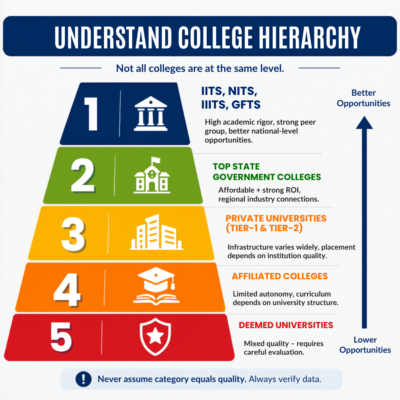
Step 2: Understand the Real Hierarchy of Colleges in India
Not all colleges function at the same level, even if they offer the same degree.
Broad categories:
1. IITs, NITs, IIITs, GFTIs
- High academic rigor
- Strong peer group
- Better national-level placement opportunities
2. Top State Government Colleges
- Affordable + strong ROI
- Regional industry connections
3. Private Universities (Tier-1 & Tier-2)
- Infrastructure varies widely
- Placement depends heavily on institution quality
4. Affiliated Colleges
- Limited autonomy
- Curriculum depends on university structure
5. Deemed Universities
- Mixed quality-requires careful evaluation
Never assume category equals quality. Always verify data.
Step 3: Course Quality Matters More Than College Name
A strong college with a weak course is still a weak outcome.
Check:
- Is the syllabus updated with industry needs?
- Are modern subjects included (AI, Data Science, Cybersecurity, etc.)?
- Are students doing real projects or only theory exams?
In 2026 job markets, outdated curriculum is one of the biggest hidden risks.
Step 4: Placement Data – Learn to Read It Correctly
Placement statistics are often misunderstood.
You should always check:
1. Median Salary (not just average)
Average salary can be misleading due to a few high packages.
2. Type of Companies
- Core companies (real engineering roles)
- Service-based companies (mass recruitment)
- Startups (growth exposure)
3. Placement Percentage Reality
“100% placement” often includes low-paying or irrelevant roles.
A practical truth:
A college with 70% strong placements is often better than 100% weak placements.
Step 5: Accreditation & Approval – Non-Negotiable Check
Before applying, verify:
- UGC approval
- NAAC grade
- NIRF ranking
- NBA accreditation (for engineering courses)
Why this matters:
Unapproved colleges can lead to:
- Invalid degrees
- Poor placement credibility
- Higher rejection in jobs or higher studies
This is one of the most ignored but critical steps.
Step 6: ROI (Return on Investment) – The Smart Decision Filter
College is also a financial investment.
Calculate: Total cost of education ÷ Expected starting salary
Consider:
- Tuition fees
- Hostel + food
- Travel + living expenses
A ₹20 lakh degree is not automatically better than a ₹4 lakh degree if the output is similar.
Smart students choose ROI, not just brand value.
Step 7: Faculty & Learning Environment
Good colleges don’t just have buildings – they have strong academic systems.
Check:
- Faculty qualifications and experience
- Student-to-teacher ratio
- Research and lab facilities
- Project-based learning culture
If teaching is purely exam-oriented, skill development becomes weak.
Step 8: Final Decision Scorecard (Use This Before Selecting Any College)
Use this simple scoring model before final admission:
- Academic Quality → 30%
- Placements → 25%
- ROI → 20%
- Infrastructure → 10%
- Location & Exposure → 10%
- Student Feedback → 5%
If a college scores below 65/100, reconsider your choice.
This removes emotional bias and forces logical decision-making.
Common Mistakes Students Must Avoid
Many students lose opportunities due to avoidable mistakes:
- Choosing college only based on cutoff rank
- Following friends instead of research
- Ignoring ROI completely
- Believing fake placement promises
- Not checking accreditation
These mistakes cost years of career growth.
Avoid These Colleges Immediately
Be cautious if you see:
- No UGC/NAAC/NIRF recognition
- Guaranteed placement promises
- No transparent placement reports
- No internship culture
- Very low faculty transparency
These are early warning signs of weak institutions.
Final Checklist Before Confirming Admission
Before paying fees, ensure:
- Course matches career goal
- Accreditation is verified
- Placement data is realistic
- ROI is acceptable
- Student reviews are consistent
- You are choosing logically, not emotionally
Conclusion: The Smart Way to Choose College in 2026
The best college is not always the most famous one.
It is the one that:
- Matches your career direction
- Offers real skill development
- Provides reasonable ROI
- Gives exposure to opportunities
If you treat college selection like a structured decision—not an emotional one—you dramatically increase your chances of long-term success.
‘obcrights’ is a unique organisation dedicated to the services for OBC – Communities
For all useful information on education, jobs, government administration, scholarships, etc.,
visit our robust website: “www.obcrights.org” and
our social media platforms:
IG: https://www.instagram.com/obcrights_org
YT: https://www.youtube.com/@OBCRights
FB: https://www.facebook.com/obcrights.org
X.com: https://x.com/obcrights_org
For direct contact: either visit our OBC Centres or Toll-Free Number: 1800 8900 403

