Choosing the right course after Class 12 is no longer just about personal interest. In today’s rapidly evolving job market, students must also consider industry demand, salary potential, future growth, and technological changes shaping careers.
Artificial Intelligence, data analytics, cloud computing, automation, and digital transformation are creating new opportunities while also changing traditional career paths. As a result, courses aligned with these trends are seeing significantly higher demand from employers across India and globally.
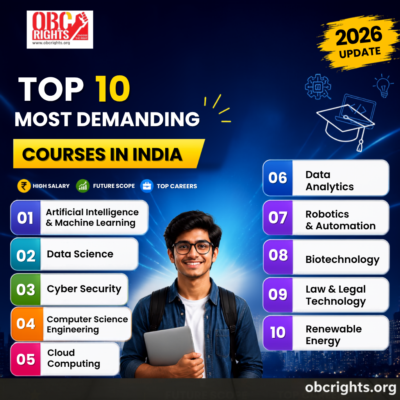
This guide ranks the top 10 most demanding courses in India for 2026 based on hiring demand, salary potential, future relevance, industry growth, and long-term career opportunities.
Quick overview
| Rank | Course | Why Demand Is Rising |
| 1 | Artificial Intelligence & Machine Learning | AI adoption across industries |
| 2 | Data Science | Data-driven decision making |
| 3 | Cyber Security | Growing cyber threats |
| 4 | Computer Science Engineering | Software and AI ecosystem |
| 5 | Cloud Computing | Enterprise cloud migration |
| 6 | Business Analytics | Data-led business growth |
| 7 | Full Stack Development | Startup and product hiring |
| 8 | Robotics & Automation | Industry 4.0 transformation |
| 9 | Semiconductor & VLSI Engineering | India’s chip manufacturing push |
| 10 | Law & Legal Technology | Growing need for digital law, data privacy, and technology governance |
How We Selected These Courses?
Unlike generic rankings that simply list popular programs, this ranking is based on measurable factors that directly influence career success.
The courses were evaluated using:
- Industry hiring demand
- Salary potential
- Future relevance till 2030
- Global career opportunities
- Industry growth rate
- Resistance to automation and AI disruption
Courses that scored highly across multiple factors were ranked higher.
Why Technology Courses Dominate India’s Job Market?
Technology-focused courses occupy most positions in this ranking because India’s employment landscape is being shaped by four major trends.
According to reports from NASSCOM and the India Skills Report 2026, employers are increasingly prioritizing digital, analytical, cybersecurity, and AI-related skills. Organizations across sectors are investing heavily in automation, cloud infrastructure, data analytics, and intelligent technologies to improve efficiency and remain competitive.
Four major trends are driving demand:
1. Artificial Intelligence Expansion
Businesses across healthcare, banking, education, retail, and manufacturing are actively integrating AI solutions, increasing demand for skilled professionals.
2. Growth of Global Capability Centres (GCCs)
India continues to attract Global Capability Centres from multinational companies, creating thousands of technology-focused jobs.
3. Cloud-First Business Models
Organizations are increasingly migrating applications, databases, and infrastructure to cloud platforms, driving demand for cloud specialists.
4. Rising Cybersecurity Challenges
As digital adoption grows, protecting data and systems has become a business priority, leading to strong hiring in cybersecurity.
Top 10 Most Demanding Courses in India
1. Artificial Intelligence & Machine Learning
Artificial Intelligence & Machine Learning ranks first because it is transforming nearly every major industry. From AI-powered healthcare diagnostics and fraud detection systems to autonomous technologies and generative AI applications, organizations are investing heavily in AI talent.
What You’ll Learn: Python, Machine Learning, Deep Learning, Neural Networks, NLP, Computer Vision, Generative AI.
Career Opportunities: AI Engineer, Machine Learning Engineer, NLP Specialist, AI Consultant, AI Researcher.
Average Salary: ₹8–25 LPA+
Future Scope: Expected to remain one of the fastest-growing technology sectors globally through 2030 and beyond.
Top Institutes: IIT Hyderabad, IIT Madras, IIIT Hyderabad.
Industry Insight: Demand for AI professionals continues to exceed the available talent pool in India.
Best For: Students who enjoy mathematics, programming, problem-solving, and emerging technologies.
2. Data Science
In today’s digital economy, organizations increasingly depend on data to improve operations, understand customers, and gain a competitive advantage. Businesses rely on data science professionals to identify trends, optimize operations, improve customer experiences, and make strategic decisions.
What You’ll Learn: Statistics, Python, SQL, Machine Learning, Data Visualization, Predictive Analytics.
Career Opportunities: Data Scientist, Data Analyst, Business Intelligence Analyst, Analytics Consultant.
Average Salary: ₹7–22 LPA.
Future Scope: Strong demand across finance, healthcare, e-commerce, consulting, and technology sectors.
Top Institutes: IIT Madras, IISc Bangalore, IIIT Hyderabad.
Industry Insight: Organizations increasingly treat data as a strategic business asset.
Best For: Students with analytical thinking and strong problem-solving skills.
If you want to understand the course structure, eligibility, career paths, and future opportunities in detail, read our complete guide on AI and Data Science Course: Future Jobs, Scope & Career Guidance.
3. Cyber Security
As cyberattacks become more sophisticated, organizations are investing heavily in digital security. Cybersecurity professionals help protect sensitive information, secure networks, and manage cyber risks.
What You’ll Learn: Ethical Hacking, Cryptography, Threat Detection, Digital Forensics, Network Security.
Career Opportunities: Cyber Security Analyst, Ethical Hacker, Security Consultant, Security Architect.
Average Salary: ₹6–20 LPA.
Future Scope: One of the most stable and future-resistant career paths.
Top Institutes: IIT Kanpur, IIIT Delhi, NIT Trichy.
Industry Insight: Cybersecurity talent shortages remain a major challenge globally.
Best For: Students interested in technology, digital systems, and security.
4. Computer Science Engineering (CSE)
Computer Science Engineering continues to be the foundation of India’s software industry. It offers broad career flexibility and provides the base knowledge required for AI, cloud computing, software development, and cybersecurity careers.
What You’ll Learn: Programming, Algorithms, Data Structures, Databases, Operating Systems, Software Engineering.
Career Opportunities: Software Engineer, Product Developer, Systems Analyst, Technical Architect.
Average Salary: ₹6–20 LPA.
Future Scope: Continues to offer strong placements and diverse career opportunities.
Top Institutes: Leading institutions offering this program include IIT Bombay, IIT Delhi, and IIT Madras.
Industry Insight: Many emerging technology roles still prefer candidates with a CSE background.
Best For: Students seeking broad technology career options.
Students considering CSE, AI, Data Science, or related specializations should also explore the Best Engineering Colleges in India to identify institutions with strong placements, faculty, and industry exposure.
5. Cloud Computing
Cloud technology now powers a significant portion of the applications, services, and digital operations used by businesses worldwide. Businesses are increasingly moving applications and services to cloud platforms, creating strong demand for cloud specialists.
What You’ll Learn: AWS, Microsoft Azure, Google Cloud, DevOps, Kubernetes, Cloud Security.
Career Opportunities: Cloud Engineer, DevOps Engineer, Cloud Consultant, Cloud Architect.
Average Salary: ₹6–18 LPA.
Future Scope: Cloud adoption is expected to continue growing across industries.
Top Institutes: IITs, NITs, IIITs.
Industry Insight: Cloud expertise is becoming a core requirement for many technology roles.
Best For: Students interested in infrastructure and enterprise technology.
6. Business Analytics
Business Analytics combines data analysis with business strategy. Organizations use analytics to improve decision-making, optimize operations, and identify growth opportunities.
What You’ll Learn: SQL, Power BI, Tableau, Business Intelligence, Predictive Analytics.
Career Opportunities: Business Analyst, Analytics Consultant, Strategy Analyst, Product Analyst.
Average Salary: ₹6–18 LPA.
Future Scope: Strong growth across consulting, finance, healthcare, and technology industries.
Top Institutes: IIMs, IIT Madras, ISB.
Industry Insight: Data-driven decision-making is becoming standard practice for organizations.
Best For: Students interested in both business and technology.
7. Full Stack Development
Many employers value developers who can build and manage both the user-facing interface and the server-side functionality of applications. Full stack developers help build complete software products, making them highly valuable for startups and product companies.
What You’ll Learn: HTML, CSS, JavaScript, React, Node.js, Databases, APIs.
Career Opportunities: Full Stack Developer, Software Engineer, Product Engineer.
Average Salary: ₹5–18 LPA.
Future Scope: Continues to grow due to increasing software product development.
Top Institutes: IIITs, NITs, Coding Academies.
Industry Insight: Full stack developers are valued for their versatility and ability to manage complete projects.
Best For: Ideal for students who enjoy building software applications and exploring modern web development technologies.
8. Robotics & Automation
Industry 4.0 is accelerating the adoption of robotics, automation, and smart manufacturing systems. Companies are investing in technologies that improve efficiency and reduce operational costs.
What You’ll Learn: Robotics, Automation Systems, Mechatronics, Sensors, Control Engineering.
Career Opportunities: Robotics Engineer, Automation Specialist, Systems Engineer.
Average Salary: ₹6–22 LPA.
Future Scope: Expected to expand significantly in manufacturing, logistics, and healthcare.
Top Institutes: IIT Kanpur, IIT Madras, BITS Pilani.
Industry Insight: Automation is becoming a major competitive advantage across industries.
Best For: Students interested in engineering innovation and intelligent systems.
9. Semiconductor & VLSI Engineering
India’s growing focus on semiconductor manufacturing and chip design is creating new opportunities in electronics and hardware engineering. Government incentives and industry investments are accelerating growth in this sector.
What You’ll Learn: VLSI Design, Embedded Systems, Chip Architecture, Electronics Engineering.
Career Opportunities: VLSI Engineer, Chip Design Engineer, Embedded Systems Engineer.
Average Salary: ₹7–20 LPA.
Future Scope: Expected to be one of India’s fastest-growing engineering specializations.
Top Institutes: IIT Madras, IIT Hyderabad, IISc Bangalore.
Industry Insight: Semiconductor talent demand is expected to increase substantially over the next decade.
Best For: Students interested in electronics, hardware, and chip technologies.
10. Law & Legal Technology
The rapid growth of digital technologies has created new legal challenges around data privacy, cybersecurity, intellectual property, and AI regulation. This has increased demand for legal professionals with technology expertise.
What You’ll Learn: Cyber Law, Intellectual Property Rights, Technology Regulation, Legal Research.
Career Opportunities: Corporate Attorney, Regulatory Consultant, Compliance Specialist, Public Policy Advisor.
Average Salary: ₹5–18 LPA.
Future Scope: Growing demand due to expanding regulatory requirements and technology governance.
Top Institutes: NLSIU Bangalore, NALSAR Hyderabad, NLU Delhi.
Industry Insight: Technology-related legal expertise is becoming increasingly valuable worldwide.
Best For: Students interested in law, policy, governance, and technology.
AI vs Data Science vs Cyber Security: Which Is Better?
| Factor | AI & ML | Data Science | Cyber Security |
| Salary Potential | Very High | High | High |
| Future Scope | Very High | Very High | Very High |
| Job Security | High | High | Very High |
| Global Demand | Very High | High | Very High |
| Competition | High | High | Medium |
Highest Salary Courses Among the Top 10
- Artificial Intelligence & Machine Learning
- Data Science
- Semiconductor & VLSI Engineering
- Cyber Security
- Computer Science Engineering
Best Courses Based on Student Goals
Best for Highest Salary
- Artificial Intelligence & Machine Learning
- Data Science
- Semiconductor & VLSI Engineering
Best for Job Security
- Cyber Security
- Computer Science Engineering
- Law & Legal Technology
Best for Future Jobs Till 2030
- Artificial Intelligence & Machine Learning
- Robotics & Automation
- Semiconductor & VLSI Engineering
Best Non-Engineering Courses
- Business Analytics
- Law & Legal Technology
Best Institutes for High-Demand Courses in India
| Course | Top Institutes |
| AI & ML | IIT Hyderabad, IIT Madras, IIIT Hyderabad |
| Data Science | IIT Madras, IISc Bangalore |
| Cyber Security | IIT Kanpur, IIIT Delhi |
| Computer Science Engineering | IIT Bombay, IIT Delhi |
| Semiconductor & VLSI | IIT Madras, IIT Hyderabad |
| Law & Legal Technology | NLSIU Bangalore, NALSAR Hyderabad |
Students should also compare colleges based on faculty quality, placement records, infrastructure, and academic reputation. Our detailed NIRF Ranking 2025 College List can help you evaluate India’s top-ranked institutions across different disciplines.
Frequently Asked Questions
1. Which course has the highest demand in India in 2026?
Artificial Intelligence & Machine Learning continues to be one of the fastest-growing fields, driven by increasing adoption of AI-powered technologies across multiple industries.
2. Which course offers the highest salary?
AI & ML and Data Science generally offer the highest salary potential among emerging fields.
3. Is AI better than Data Science?
AI focuses on building intelligent systems, while Data Science focuses on extracting insights from data. Both offer strong career opportunities.
4. Which engineering branch has the best future?
Computer Science Engineering, Artificial Intelligence & Machine Learning, and Semiconductor Engineering continue to offer some of the most promising career opportunities for the future.
5. Which course is most resistant to AI?
Cyber Security and Legal Technology are generally considered more resilient to automation because they depend on human expertise, critical thinking, and complex decision-making.
6. What are the most demanding courses after 12th?
AI & ML, Data Science, Cyber Security, Computer Science Engineering, Cloud Computing, and Robotics are among the most sought-after options.
Conclusion
The most demanding courses in India are increasingly linked to technology, innovation, and digital transformation. Artificial Intelligence & Machine Learning, Data Science, Cyber Security, and Computer Science Engineering remain at the forefront due to their expanding career opportunities, competitive salaries, and sustained industry demand.
However, students should not choose a course solely based on trends. The best career outcomes come from aligning industry demand with personal interests, strengths, and long-term goals.
Looking for guidance? Visit our OBC Rights Help Centre near you or call our Toll-Free Helpline: 1800 8900 403.