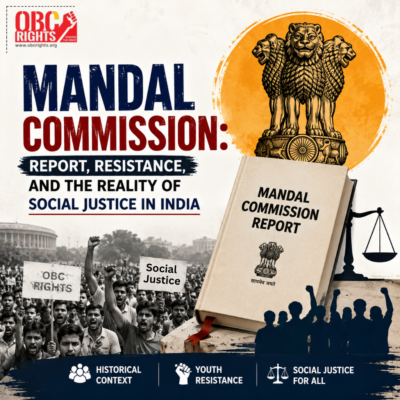
The Mandal Commission was not just a government report – it was a turning point that exposed long-standing inequalities within Indian society. Introduced to correct deep-rooted imbalances in education and employment, it sparked nationwide protests and permanent political shifts. Decades later, discussions on reservation and social justice still echo the questions raised by the Mandal Commission. This blog unpacks its purpose, impact, and continuing relevance.
What Was the Mandal Commission?
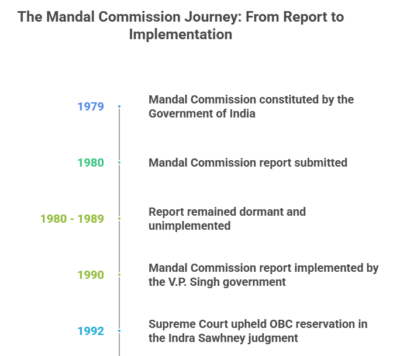
The Mandal Commission, officially called the Second Backward Classes Commission, was constituted in 1979 under Article 340 of the Indian Constitution. It was chaired by B.P. Mandal, a former Member of Parliament.
Purpose of the Mandal Commission
The commission was tasked to:
- Identify socially and educationally backward classes (OBCs)
- Examine their level of representation in education and public employment
- Recommend measures to ensure equal opportunity and social justice
The core idea behind the Mandal Commission was simple but powerful: democracy cannot survive if power structures remain monopolized by a few social groups.
How Did the Mandal Commission Identify OBCs?
The Mandal Commission adopted a data-driven and multi-dimensional approach. Instead of relying only on income, it used 11 indicators divided into:
- Social indicators (caste status, nature of work, women’s status)
- Educational indicators (literacy rates, dropout levels)
- Economic indicators (housing, assets, access to basic services)
Caste groups scoring above a defined threshold were classified as OBCs. This method acknowledged that social backwardness in India is deeply structural, not merely economic.
Key Findings of the Mandal Commission
- One of the most significant conclusions was demographic:
- OBCs constituted around 52% of India’s population
Yet their presence in government services and higher education was severely limited
This gap between population share and representation exposed a systemic imbalance, challenging the idea that India was already a level playing field.
Recommendations of the Mandal Commission
- A 27% reservation should be extended to OBCs in all Central Government services and public sector employment to correct long-standing underrepresentation.
- The same 27% quota should apply to career advancement, ensuring OBC representation at higher levels of public services through promotion.
- Unfilled reserved vacancies must not lapse immediately and should be carried forward for up to three consecutive recruitment cycles to prevent loss of opportunity.
- Age relaxation benefits should be granted to OBC candidates, on par with those available to Scheduled Castes and Scheduled Tribes, to ensure fair competition.
- Reservation policies should cover all government-controlled and government-supported institutions, including:
- Public Sector Undertakings (PSUs)
- Nationalized banks and financial institutions
- Private enterprises receiving government assistance
- Colleges and universities funded or aided by the State
- The Union Government should enact appropriate legal and administrative measures to ensure effective and uniform implementation of these recommendations across sectors.
Mandal Commission Report: Submission and Delay
The Mandal Commission report submitted its findings in 1980, but the political system hesitated. For nearly a decade, the report remained unimplemented due to fear of backlash from dominant social groups.
This delay itself reveals a critical truth: social justice reforms often face resistance not because they are wrong, but because they threaten existing privileges.
Mandal Commission Report Implemented: A Turning Point
In 1990, Prime Minister V.P. Singh announced the implementation of the recommendations. When the Mandal Commission report implemented, it fundamentally altered India’s political and social landscape.
However, this moment also triggered widespread unrest.
Why Did People React Strongly to Mandal Commission Report?
Understanding why did people react strongly to Mandal Commission report requires honest analysis:
- Elite groups feared loss of monopoly over government jobs
- Reservation was falsely portrayed as anti-merit
- Media narratives largely reflected upper-caste anxieties
- Students from privileged backgrounds dominated protest spaces
Notably, those who stood to benefit from the Mandal Commission were largely absent from mainstream media coverage, exposing an imbalance even in public discourse.
Supreme Court Judgment (Indra Sawhney Case, 1992)
The Supreme Court upheld Mandal Commission reservations with key conditions:
Important Rulings:
- 27% OBC reservation upheld
- Creamy Layer concept introduced (Economically advanced OBCs excluded)
- Total reservation capped at 50%
- No reservation in promotions (later modified for SC/STs)
- Affirmed that social backwardness is the key criterion
This judgment gave constitutional legitimacy to the Mandal Commission while placing checks on its scope.
What Mandal Achieved, and What It Didn’t?
Achievements
- Broke elite dominance in bureaucracy
- Enabled first-generation learners to access public employment
- Shifted Indian democracy towards representative governance
Limitations
- Limited Reach of Benefits: The gains from reservation have remained highly uneven. Findings of the Justice Rohini Commission indicate that among nearly 6,000 OBC communities, just about 40 groups have captured roughly half of the reservation benefits in Central educational admissions and civil service recruitment.
- Weak data updates on OBC conditions
The Mandal Commission was a starting point, not a final solution.
The Way Forward
The Mandal Commission stands as a mirror to Indian democracy.
It asks a difficult but necessary question: Who gets access to power, and on what basis? Until representation reflects social reality, the promise of equality remains incomplete.
If equality is to move beyond words, informed citizens must lead the conversation. Explore in-depth research, constitutional analysis, and data-driven perspectives on OBC rights, reservation policies, and representation at obcrights.org.
Also Read:
Kaka Kalelkar Commission: India’s First Missed Opportunity for Social Justice