
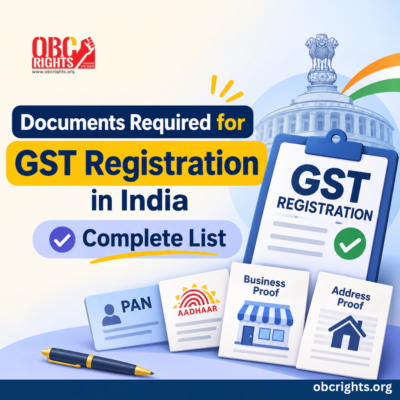
The GST registration documents required in India generally include PAN details, proof of business constitution, photographs, authorised signatory details and business address proof. The exact documents depend on your business structure and whether your premises are owned, rented or used with permission.
CBIC’s October 2026 guidelines also clarify which documents officers can request during registration.
What Documents Are Required for GST Registration?
Before applying on the official GST Portal, prepare these details and documents:
- PAN: Valid PAN of the applicant or business entity.
- Identity details: Aadhaar and other relevant identification details for authentication, where applicable.
- Photographs: Proprietor, partners or authorised signatory, as applicable.
- Business constitution proof: Registration certificate, partnership deed or other applicable document.
- Business address proof: Electricity bill, property tax receipt or other accepted supporting document.
- Authorisation: Letter or resolution appointing the authorised signatory, where required.
For complete Fresh GST application instructions, read our GST Registration 2026 Guide.
GST Registration Documents Required by Business Type
| Business Type | Main Supporting Document |
| Sole proprietorship | Proprietor’s PAN and applicable details |
| Partnership firm | Partnership deed |
| LLP | Incorporation or registration certificate |
| Private limited company | Certificate of Incorporation |
| Trust or society | Trust deed or registration certificate, as applicable |
Additional identity, address and authorisation documents may be required.
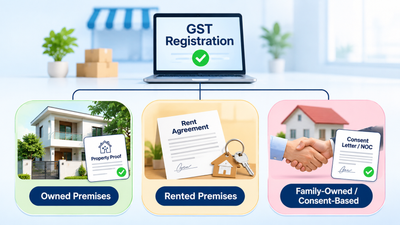
What Address Proof Is Accepted for GST Registration?
The documents depend on how you use the premises.
| Premises Type | Required Proof |
| Owned | Electricity bill, property tax receipt or another accepted ownership document |
| Rented | Rent/lease agreement and supporting premises ownership proof |
| Family-owned or consent-based | Owner’s consent letter, identity proof and ownership document |
| Shared | Applicable rent agreement or consent letter with supporting documents |
For a rented property, additional proof may apply when the agreement is unregistered.
Is a Rent Agreement or NOC Required for GST Registration?
A rent agreement is generally required for rented premises. If you operate from a family member’s property without paying rent, a consent letter or NOC, along with the required supporting proof, may be accepted.
You do not necessarily need to own a commercial building to apply for GST registration.
What If a GST Officer Requests Additional Documents?
CBIC’s registration guidelines discourage unnecessary document demands, including routine requests for Udyam/MSME certificates when these are not prescribed.
If you receive a GST REG-03 clarification notice:
- Review the exact document or information requested.
- Check whether the existing upload is legible and matches your application.
- Submit the clarification through GST REG-04, generally within seven working days.
If an inappropriate request remains unresolved, use the GST grievance mechanism or seek professional assistance.
Frequently Asked Questions
1. Is an Electricity Bill Mandatory for GST Registration?
No. An electricity bill is one accepted proof. Other prescribed property or ownership documents may also be used.
2. Can I Apply for GST Registration Using My Home Address?
Yes, where the premises are genuinely used for business and the required address or consent documents are available.
3. Is an Udyam Certificate Mandatory for GST Registration?
No. CBIC guidelines clarify that officers should not routinely demand an Udyam/MSME certificate as additional business-constitution proof.
For official instructions, refer to the GST Registration user manual and CBIC Registration Guidelines.