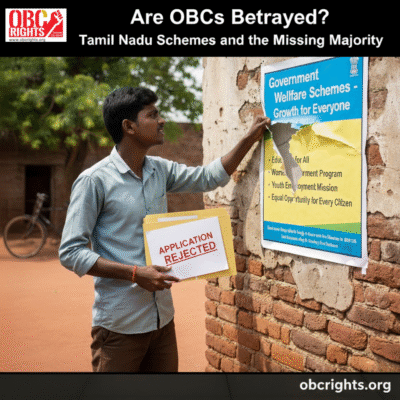
For years, Tamil Nadu Government Schemes have been celebrated as the backbone of the state’s welfare model. From education support to housing aid, marriage assistance, and entrepreneurship promotion, these initiatives have shaped the image of a socially conscious government. But beneath this image lies a quiet imbalance – many backward and marginalized sections within the OBC category remain outside the circle of meaningful benefits. Most of the schemes become advertisement/publicity oriented.
The Unequal Reach of Welfare
A closer look at Tamil Nadu Government Schemes shows that welfare distribution is uneven. While some groups receive strong institutional support through dedicated departments and well-funded programmes, OBC communities are often placed under general categories with limited focus – or at times it goes as an eye–wash.
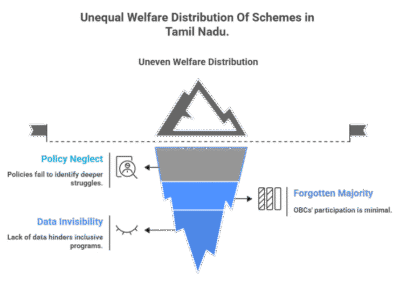
This lack of targeted attention creates silent exclusion. Policies appear inclusive on paper, yet fail to identify the deeper social and economic struggles of the backward groups within the OBC population. For many, the benefits that exist are either too small, too scattered, or too difficult to access.
Policy Neglect and Unequal Focus
Many Tamil Nadu Government Schemes address broad areas such as education, employment, and entrepreneurship, but they rarely identify how much support actually reaches OBC communities. Because of this, the most backward groups within the OBC category remain unnoticed and under-supported. In Scholarships for BC and MC – Students doing higher education, the aforesaid neglect is visible.
There is also a long-standing belief that OBC welfare needs no special attention since reservation already provides enough opportunity. This assumption has slowed the creation of new welfare initiatives and limited funding for their development.
In reality, welfare inclusion has become uneven — some groups move ahead while many OBC communities continue to face the same economic and social barriers as before. It shows that equality in policy design does not always mean equality in results.
The Forgotten Majority
OBCs make up the largest share (i.e., 76%) of Tamil Nadu’s population, yet their direct participation in Tamil Nadu Government Schemes is minimal when measured against their numbers. Many smaller and backward communities still struggle with poor access to higher education, limited employment opportunities, and barriers in starting small enterprises.
While awareness campaigns and welfare announcements reach urban areas effectively, rural OBC households often remain unaware of their entitlements. For many, government benefits remain distant dreams rather than visible realities.
Are Welfare Policies Deepening Inequality?
The goal of Tamil Nadu Government Schemes is to create equality through opportunity. But when some groups within the backward category advance faster while others remain stagnant, the imbalance becomes deeper and structural.
Without accurate data on OBC livelihoods, income levels, and education gaps, the government cannot design truly inclusive welfare programmes. This data invisibility has allowed inequality to grow quietly inside the very system meant to correct it. This is the prime reason for demanding – insisting on the Socio-Economic census, which is often called the Caste Census.
What Needs to Change
For genuine inclusion, the state must go beyond symbolic equality and ensure that every backward group receives focused policy attention. Key steps could include:
- Conducting a genuine/transparent Caste – Census with a minimum of eleven parameters.
- Establishing dedicated OBC Development Boards with community-wise socio-economic surveys.
- Publishing transparent welfare expenditure reports under the Tamil Nadu Government Schemes.
- Launching exclusive OBC-oriented initiatives for higher education, digital literacy, and entrepreneurship.
- Conducting regular welfare audits to evaluate whether the intended groups actually benefit.
True equality demands visibility, and visibility begins with accurate recognition of who is being left behind.
The Final Question
Tamil Nadu is known for building one of India’s most extensive welfare networks. But equality cannot be measured by the number of schemes alone – it must be seen in the faces of those who actually benefit.
So the question remains: If Tamil Nadu Government Schemes do not reach the most backwards, can we still call the model inclusive?
For all such Critical – Factual analysis – read our Blogs in www.obcrights.org.