Other Backward Classes (OBC)
Other Backward Classes (OBC) are socially and educationally backward classes in India. OBCs are distinct from the Scheduled Classes (SC) or the Scheduled Tribes (ST). The Central Government of India maintains a list of castes/communities to be considered as OBC. To uplift Other Backward Classes (OBC), both the Central Government and State Governments are running a lot of programs and schemes.
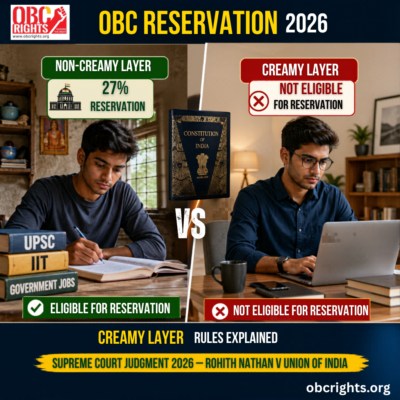
Some benefits include: 27% Reservation Quota with respect to the seats in Government Jobs (like IAS, IPS, etc.) and Government institutes (like the IIMs and IITs). There is relaxation with respect to the number of attempts for exams and with respect to the cut-off marks.
Creamy Layer
The Creamy Layer refers to the wealthier and better-educated segment within the OBC category. These individuals are considered socially advanced and thus not eligible for reservation benefits in jobs, education, or government schemes meant for socially and educationally backward classes.
Due to the recommendations of the Mandal Commission, the Central Government issued an Office Memorandum to reserve 27% posts in central government services. The order was challenged by Indra Sawhney (Indra Sawhney and Others Vs Government of India) in Supreme Court (1992).
The 9 judges constitutional bench of the apex court upheld the decision to reserve 27% reservation for OBC’s in Central Government service. But in the verdict, the Honourable Supreme Court cleared that the creamy layer among OBCs should be excluded from the reservation. The central Government constituted a commission chaired by Justice Ram Nandan Prasad to identify the creamy layer among OBC’s.
The commission recommendations were as such approved by the Central Government. Based on this, the Central Government issued an order regarding the guidelines and criteria for excluding Creamy Layer among OBC. The same criteria and guidelines are still in force for identifying Creamy Layer among OBCs.
The creamy layer is based on the status of a candidate’s parents. For the jobs under the Central Government, if the parents of an applicant entered the service as Class I officer before the age of 40 (direct recruitment), the applicant is considered as a creamy layer. Also, if both the parents of the candidates entered into service as class II officers, before the age of 40 (direct recruitment), and entered into the service before the age of 40, the applicant is considered as a creamy layer.
For the Armed Forces, officers up to the rank of Lieutenant Colonel remain eligible for OBC reservation benefits, while those holding higher ranks are classified under the creamy layer.
Non-Creamy layer:
The Non-Creamy Layer refers to the economically and socially backward segment of OBCs. This group qualifies for reservation benefits in education, employment, and other government welfare schemes.
- Except for the children of the above-mentioned employees in the creamy layer, almost all get the benefit of “Non-Creamy Layer” Status.
- If your parents are not directly recruited Class1 (Group A) or Class2 (Group B) officers OR they do not occupy any constitutional posts (like that of President, Vice President, Governor etc) you are most likely to fall under Non-Creamy Layer OBC.
- If your parents are not employed by the government, their income should be within the limits by the government to be treated as Non-Creamy Layer OBC.
- Regarding parents under Government employment, the status of the job (Group A/B/C/D) is more important than the salary. If your parents are earning more than 8 lakhs but their rank is below that of group B officers, you will still come under the Non-Creamy Layer.
- In order to qualify as an OBC non-creamy layer candidate, the applicant’s parents’ annual income should be less than Rs. 8 lakhs.
- As far as the Government employees are considered, the entry cadre/post is to be taken into consideration. Salary and agricultural income are not to be considered as income for calculating annual income for creamy layer status.
While applying the “Income/Wealth Test” to determine the creamy layer status of any candidate, income from the salaries and income from the agricultural land shall not be taken into account. It means that if income from other sources, other than the salary and agriculture, exceeds the income limit, then only the candidates shall be treated as Creamy Layer.
The 2026 Development:
The 2026 Supreme Court judgment on OBC creamy layer – Rohith Nathan v Union of India clarified that determining creamy layer status cannot be based solely on parental income, rejecting the common practice of using the ₹8 lakh threshold as the only criterion.
The Court emphasized that social status, nature of employment (such as Group A or B posts), and overall advancement of the family must also be considered, reaffirming the original principles laid down after the Indra Sawhney v. Union of India case.
It also held that treating government employees differently from PSU or private sector employees in applying income criteria is unconstitutional and discriminatory, thereby ensuring uniform standards across sectors.
Further, the Court invalidated the 2004 government clarification that allowed income to dominate the test, stating it cannot override the 1993 policy.
Overall, the judgment strengthens the idea that OBC reservation is meant for the socially and educationally backward, not merely the economically weaker sections, and restores a more balanced, status-based approach to identifying the creamy layer.
Children of parents working in Public Sector Undertakings (PSUs) are not automatically classified as belonging to the creamy layer under OBC reservation rules. Their status depends primarily on the equivalence of the parent’s post with government service categories.
If the PSU position is clearly equivalent to a Group A (Class I) or certain Group B (Class II) government posts, then the child may be treated as creamy layer based on status.
However, in many cases where such equivalence is not clearly established, the determination shifts to the income/wealth test. Under this test, importantly, salary income and agricultural income are excluded, and only income from other sources, such as business, profession, or investments, is considered over a specified period.
Therefore, even a high salary in a PSU job alone does not make the child a creamy layer.
This differential treatment of PSU employees compared to government servants has also been questioned in light of equality principles under Article 14 of the Constitution of India, as it may lead to inconsistent classification despite similar socio-economic status.
In PSUs, all executive-level posts, board-level executives and managerial-level posts are treated as equivalent to Group ‘A’ posts in the government and will be considered ‘creamy layer’.
Junior management grade scale 1 and above of public sector banks, financial institutions and public sector insurance corporations will be treated as equivalent to group ‘A’ in the government and considered as OBC ‘creamy layer’.
For your further reference, we have annexed the relevant documents below.
1. 1993 Office Memorandum – No. 36012/22/93 Estt. (SCT)
2. Rohith Nathan v. Union of India [CIVIL APPEAL NO(S). 2827 – 2829 of 2018]