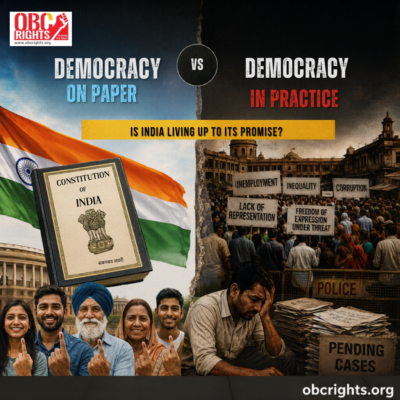
Democracy is beautiful in imagination. On paper, it looks clean, logical, and empowering. Every citizen has a voice. Every institution works for the people. Every right protects dignity and freedom.
But once this ideal enters the everyday life of a billion people, the cracks begin to show.
This is where the real debate starts:
Is Indian democracy something we celebrate only in textbooks, or something we truly experience?
To answer this, we must explore the idea of Democracy in Theory and Practice – how it is designed, and how it is actually lived.
1. The Right to Participation: High Turnout, Low Accountability
Indians show tremendous faith in elections. Crores stand in long queues, proving that participation is still strong.
But what happens after the ink fades from their fingers?
- Many elected leaders rarely return to their constituencies.
- Public decisions are made without meaningful consultation.
- Alliances shift overnight, but people have no say.
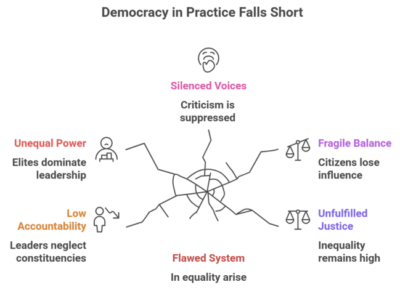
Voting feels powerful in theory. But the real strength of democracy comes from continuous accountability, not a single day every five years. This gap between the ideal and reality is one of the clearest examples of how Democracy in Theory and Practice can differ sharply.
2. Representation vs. Power: Who Truly Leads India?
In a perfect democratic structure, anyone should be able to lead. But in reality:
- A small political class dominates leadership across generations.
- Wealthy candidates shape narratives with huge campaign budgets.
- OBCs, Dalits, Adivasis, and other marginalized groups remain underrepresented in key positions.
Related reading: The Barriers of OBC Are Not Invisible – Intentionally Ignored by Political Powers
When diversity is missing in leadership, the system becomes democratic on paper but socially unequal in practice. This isn’t the failure of citizens – it’s the failure of institutions that have not evolved with society’s needs.
3. Freedom of Expression: A Right with Hidden Costs
For democracy to breathe, criticism must be free. Debate must be open. Journalism must be fearless.
But today:
- People think twice before speaking openly.
- Online spaces feel more monitored than before.
- Journalists face lawsuits, pressure, or targeted attacks.
A right that cannot be freely exercised is not truly a right. It becomes a line written in the Constitution but erased in public life.
4. Citizens vs. the State: Who Holds Power?
According to the Constitution, state institutions must be accountable to the people.
In everyday life, however, the reverse often happens.
- Citizens spend years fighting slow legal systems.
- Powerful individuals escape scrutiny.
- Grievances get lost in bureaucratic layers.
- When institutions gain power, but citizens lose influence, democracy becomes unbalanced and fragile.
5. Social Justice: A Promise Yet to Be Fulfilled
One of the core promises of Indian democracy is social equality. But inequality remains stubbornly high:
- Wealth concentration has widened
- Access to education, healthcare, and opportunities still depends heavily on affluence.
- Many communities participate in democracy only as voters, not as decision-makers.
(Read: Why every child needs access to Education)
Democracy is not just about political rights. It is also about equal access to a dignified life. When large sections still struggle for basic fairness, the system needs introspection.
6. The Everyday Question: Are Citizens Losing Space?
Look closely at daily experiences:
- Are protests welcomed or controlled?
- Are dissenters heard or dismissed?
- Do youth feel safe questioning authority, or do they stay silent?
- Are marginalized groups invited into discussions, or told to “wait”?
- Do you feel the government belongs to you – or do you feel like an outsider?
If people stop speaking not because they agree, but because they are afraid, then democracy weakens at its roots.
7. What India Must Rethink
If India wants to close the gap between Democracy in Theory and Practice, three major shifts must happen:
a) Transparent Institutions
Public decisions must become easier to access, question, and examine.
b) Representation That Reflects Reality
Communities that form India’s majority – especially OBCs and marginalized groups – must have real seats at the table.
c) Everyday Public Participation
Democracy must become a daily habit, not a festival celebrated once in five years.
A Democracy That Listens or a Democracy That Performs?
The core question is simple but powerful: Does the system serve the people, or does it exist only for those in power?
Rights matter only when citizens insist on them.
Equality becomes real only when society rejects discrimination.
Accountability grows only when people raise their voice.
So let this be the moment you choose not to stay silent.
A democracy grows with every voice that speaks – and weakens with every voice that gives up.
Raise your voice. Protect your rights. Democracy survives only when its people do.
Join the movement at obcrights.org.