The story of the Kaka Kalelkar Commission is not just about a government report. It is about an early warning that India chose to ignore. Set up soon after Independence, the Kaka Kalelkar Commission was the first serious attempt by the Indian state to understand the deep social and educational backwardness of large sections of society beyond Scheduled Castes and Scheduled Tribes. What it discovered was uncomfortable – and what followed was silence.
Even today, debates on reservation, OBC rights, and social justice cannot be fully understood without revisiting the Kaka Kalelkar Commission.
Why the Kaka Kalelkar Commission Was Necessary
After Independence, India adopted a Constitution that promised equality, dignity, and opportunity. But equality on paper did not erase centuries of caste-based exclusion. While Scheduled Castes and Scheduled Tribes were given constitutional recognition, a vast population remained invisible—communities that were socially oppressed, educationally deprived, and economically weak but not classified as SC or ST.
To address this gap, the government appointed the Kaka Kalelkar Commission under Article 340 of the Constitution. This was the first time the Indian state officially admitted that backwardness was not limited to only two categories.
This recognition alone makes the Kaka Kalelkar Commission historically important.
When Was Kaka Kalelkar Commission Set Up and What Was Its Task?
Many people ask when was Kaka Kalelkar Commission set up. It was constituted in 1953, barely six years after Independence. The commission was asked to identify socially and educationally backward classes across India and suggest steps for their progress.
The Kaka Kalelkar Commission travelled across the country, interacted with communities, studied living conditions, education levels, employment patterns, and social status. Its work was slow, detailed, and grounded in reality.
This was not a theoretical exercise. It was a mirror held up to Indian society.
Key Findings of the Kaka Kalelkar Commission
The Kaka Kalelkar Commission concluded that backwardness in India was deeply rooted in social structure, especially caste. Its major findings included:
- Social backwardness was closely linked to a low position in the traditional caste hierarchy
- Educational levels among the backward classes were extremely poor
- These communities were grossly underrepresented in government services
- Many backward classes were confined to traditional, low-income occupations
- Economic poverty was a result of social exclusion, not lack of effort
- Backwardness was inherited and structural, not temporary
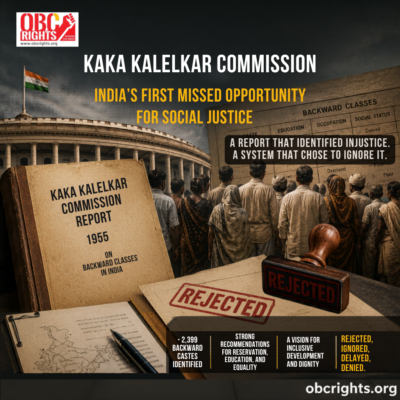
The Kaka Kalelkar Commission report identified 2,399 backward castes and communities, of which 837 were considered extremely backward. This made it clear that backwardness was not a small or marginal issue – it affected a massive section of Indian society.
Major Recommendations of the Kaka Kalelkar Commission (In Short)
The Kaka Kalelkar Commission made strong and practical recommendations to reduce social and educational inequality:
- Reservation in education and government jobs at central and state levels, including technical and professional institutions, stating that equality is impossible without reservation.
- Recognition of caste as a real cause of backwardness, not just economic poverty.
- Caste-wise data collection through the census to create policies based on facts.
- Special support for women, acknowledging their systemic disadvantage across communities.
- Educational support measures such as scholarships, hostels, adult education, and help for first-generation learners.
- Economic and rural development, including land reforms, promotion of small occupations, rural industries, and access to credit.
- Creation of a permanent Backward Classes Commission to continuously review and update policies.
These recommendations aimed at long-term social transformation, not temporary relief.
Why the Kaka Kalelkar Commission Report Was Rejected
Despite its depth, the Kaka Kalelkar Commission report was rejected by the central government. The main argument was that it relied too much on caste and lacked objective standards.
This rejection exposed a contradiction:
India accepted caste as a social reality but refused to use it as a policy tool.
The result was inaction. The burden of reform was pushed to states, leading to uneven progress and decades of delay.
The Long Shadow of Ignoring the Kaka Kalelkar Commission
The failure to implement the Kaka Kalelkar Commission had lasting consequences. By postponing corrective action, inequality deepened. Education gaps widened. Government institutions remained unrepresentative.
When similar issues resurfaced decades later, the country had already lost valuable time.
The Kaka Kalelkar Commission did not fail because it was wrong. It failed because it was inconvenient.
A Report That Still Asks Questions
The Kaka Kalelkar Commission was India’s first honest attempt to confront inequality beyond slogans. Its findings were clear and Its recommendations were strong. Its intent was constitutional.
What was missing was political courage.
Even today, the Kaka Kalelkar Commission stands as a reminder that social justice delayed is social justice denied, and that ignoring truth does not erase it, it only postpones accountability.
If commissions can identify injustice but governments ignore it, who speaks for the people?
Explore untold reports, forgotten data, and ground realities at obcrights.org.