Tamil Nadu is often projected as a pioneer in social justice and reservation policy. Yet, a closer look at every commission for backward class appointed by the state reveals a troubling pattern: commissions formed without data, reports ignored, and recommendations selectively implemented.
From the colonial era to recent decades, Tamil Nadu has constituted multiple commissions for backward classes, each promising reform, equity, and correction. But did these Commissions truly serve the most backward communities? This blog examines key commissions, their data practices, recommendations, and how the state acted on the reports of these commissions.
Why Commissions for Backward Class Matter
A commission for backward classes is not merely an advisory body. It is meant to:
- Assess social and educational backwardness
- Collect population and representation data
- Recommend fair reservation structures – Measures to improve the education and job opportunities
When these commissions fail or are ignored, reservation becomes political arithmetic instead of social justice.
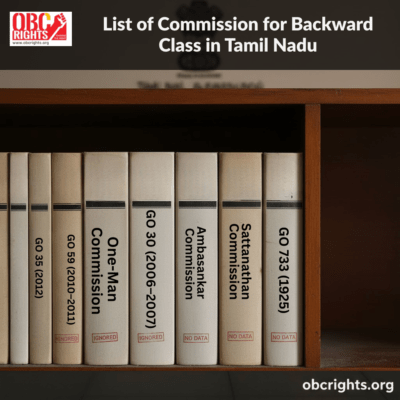
List of Commissions In Tamil Nadu
1. GO 733 (1925): The First Attempt Without Accountability
- Year: 3 August 1925
- Chairman: Diwan Bahadur M. Krishnan Nayar & 9 members
- Purpose: Study the working of communal reservation
- Report Submitted: ❌ No
Key Insight:
The very first commission for backward class in Tamil Nadu failed at the most basic leve. This set an early precedent of symbolic commissions without accountability.
2. GO 842 (1969): The Sattanathan Commission – A Turning Point Ignored
- Chairman: A.N. Sattanathan
- Purpose: Study conditions of Backward Classes
- Population Data:
- Based on 1931 Census extrapolation
- Vanniyars estimated at 8% (32 lakhs)
- DNT population at 7% (30 lakhs)
- Key Recommendations:
- Subdivision of BC into BC & MBC
- Introduction of creamy layer
- Proposed Reservation: Total 33%, BC: 17%, MBC: 16%
- Action Taken: Reservation reduced to 31%, Creamy layer introduced and later withdrawn
Key Insight:
This commission for backward class was visionary and data-conscious, but its most crucial recommendation, subclassification, was politically buried.
3. GO 3078 (1982–1985): Ambasankar Commission and Data Manipulation
- Chairman: Ambasankar
- Purpose: To justify 50% reservation given to BCs (During AIADMK (MGR) Rule)
- Data Issues:
- The door-to-door survey excluded many castesThe sample survey again left out 52 castesVanniyar population inflated from 8% to 13%
- DNT population reduced from 7% to 3%
- Recommendations:
- The majority members rejected survey as unreliable
- Chairman suggested backwardness scoring (1–15)
- Reservation Proposed: Majority: 67%, Chairman: 50%
- Action Taken: Government retained 50%, No subdivision implemented (GOS 1564 & 1565/1985)
Key Insight:
This commission for backward class exposed how faulty data can distort social justice—yet the state used the flawed process to justify inaction. Out of 20 Members, 5 Members refused to sign 14 Members made allegations against the Chairman Amba Sankar and submitted a separate report. Chairman Amba Sankar gave a separate report
4. GO 9 (1993):
First Permanent Backward Classes Commission called Tamil Nadu Backward Class Commission (TNBC) inpursuance of the Judgement in Indra Sawhney Case.
- Chairman: Shanmugam
- Purpose: Inclusion and exclusion of BC/MBC lists
- Recommendations: Nil
Key Insight:
Making a commission permanent without data transparency renders it powerless.
5. GO 30 (2006–2007): Minority Reservation Within BCs
- Chairman: M.S. Janarthanan
- Purpose: Improve reservation for Muslims and Christians
- Data Used: Caste and official records
- Recommendation: Subclassification within BCs
- 3.5% reservation each for Muslims and Christians
- Action Taken: Act 33/2007 passed, Christians removed later via Act 51/2008
Key Insight:
This commission for backward class shows how legal recognition without political consensus collapses midway.
6. One-Man Commission (2008): Arunthathiyar Subclassification
- Chairman: M.S. Janarthanan
- Purpose: Study Arunthathiyar communities
- Data Used: Census and official data
- Recommendation: Subclassification within SCs
- Reservation Outcome:
- 3% earmarked for 7 Arunthathiyar castes
- 16% preferential reservation out of 18% SC quota
- Action Taken: Act 4/2009 implemented
Key Insight:
This is one of the rare cases where a commission for backward class (and SCs) led to meaningful structural reform because data was accepted and acted upon.
7. GO 59 (2010–2011): Justifying 69% Without New Data
- GO Number: 59
- Appointment & Report: 14.7.2010 & 8.7.2011
- Chairman: M.S. Janarthanan (extended tenure)
- Nature: Permanent Backward Classes Commission
l Purpose / Terms
- Examine quantifiable data to justify 69% reservation
- Comply with Supreme Court direction dated 13.7.2010
l Population / Data Used
- 1985 Ambasankar Commission data only
- No fresh caste-wise or contemporary data collected
Recommendation: Certified that 69% reservation is correct
Reservation Outcome: 69% reservation continued
Action Taken: GO 50 dated 11.7.2011 issued, Government accepted TNBCC recommendation
Key Insight:
This commission for backward class legitimised 69% reservation without producing new evidence, raising serious concerns about judicial compliance and data credibility.
8. GO 35 (2012)
- Year: 2012
- Chairman: M.S. Janarthanan (extended)
- Purpose: Recommend subdivision of MBCs
- Data Used: 1985 Ambasankar data (no fresh caste-wise data)
- Majority Recommendation:
- Rejected MBC subdivision
- Insisted on fresh caste-wise data before any split
- Chairman’s Recommendation:
- Supported subdivision
- Proposed 10.5% for Vanniyars out of 20% MBC quota
- Action Taken:
- Government did not accept the report
- No data collected, no reform implemented
Key Insight:
This commission for backward class admitted the lack of reliable data, but the State chose to postpone data collection and delay internal equity reform.
9. GO 52 (2020–2021)
- Year: 2020–2021
- Chairman: Thanukachalam
- Purpose: Subdivision of MBCs
- Data Used: 1985 Ambasankar data
- Recommendation Status:
- No collective recommendation by the Commission
- Chairman gave expert remarks on 22.2.2021, based on Government letter dated 18.2.2021
- Subdivision Implemented:
- MBC (Vanniyar): 10.5%
- MBC & DNC (93 castes): 7%
- MBC Others (22 castes): 2.5%
- Action Taken: Act 8/2021 enacted, Subdivision enforced as proposed
Key Insight:
For the first time, reservation was altered hours before the announcement of Assembly Elections – 2021 for Political Considerations.
10. GO 99 (2020)
- GO Number: 99
- Year: 21.12.2020
- Chairman: Justice Kulasekaran
- Nature: Special Commission
- Purpose:
- Collect caste-wise data
- Justify 69% reservation amid criticism of data absence
- Data Status: No data collected, No survey conducted
- Outcome: No report submitted, Commission tenure ended without results
Key Insight:
This commission for backward class exposes the gravest institutional failure:
even after admitting the lack of data, the State still chose not to collect it. But this GO – categorically exposed – justified the power of the State to conduct Caste Census.
Conclusion
Tamil Nadu does not lack commissions. It lacks political honesty to implement them.
Every commission for backward class documented here proves one truth:
Reservation without data is injustice by design.
If social justice is to remain meaningful, commissions must stop being rituals and start becoming instruments of correction. It is highly impossible to amend / increase/decrease reservation without a Caste Census and Contemporary data. As per 105 amendment of the Constitution, the Tamil Nadu State Government must conduct a (State) Caste Census to finalize the BC/MBC/SC/ST list.