The Commission for Backward Classes either the NCBC or the State Backward Classes Commission play be a crucial role in India’s reservation system, welfare policies, and social justice framework. Yet, even today, there is widespread confusion about who actually holds power—the Centre, the States, or the commissions themselves.
With multiple constitutional amendments and Supreme Court judgments in recent years, the authority of the commission for backward classes has become a serious constitutional question, not just an administrative one.
This blog examines the legal position, constitutional intent, and practical reality of the National and State Commissions for Backward Classes.
Why the Commission for Backward Classes Matters?
Reservation is not only about numbers. It is about recognition, representation, and redistribution of opportunity. The commission for backward class exists to:
- It is in pursuance of the Judgment in Indra Sawhney case (a Constitutional Bench Judgement)
- Identify socially and educationally backward communities
- Protect constitutional safeguards
- Examine failures in implementation of welfare schemes
- Advise governments on policy matters
But advisory power is not the same as decision-making power. This is where the real debate begins.
The Constitutional Starting Point: Article 340
Originally, the Constitution did not create a permanent commission for the backward class.
- Article 340 only allowed the President to appoint a temporary commission
- It was reiterated by the Supreme Court in the Indra Sawhney Case
- It focused on studying the conditions of the backward classes
- No detailed powers or permanent structure were defined
In contrast, Scheduled Castes and Scheduled Tribes had stronger constitutional protection under Articles 338 and 338A.
This imbalance later became a major concern.
Indra Sawhney Case: The Turning Point (1992)
The Indra Sawhney judgment changed everything.
The Supreme Court:
- Accepted OBC reservation
- Recommended permanent commissions
- Said these bodies should regularly review inclusion and exclusion
This led to:
- The National Commission for Backward Classes Act, 1993
- Creation of State-level bodies like the Tamil Nadu Backward Classes Commission
From this point onward, the commission for backward classes became a permanent institutional feature.
Clear Division of Powers (Before 2018)
For many years, the system was simple:
National Commission for Backward Classes
- Handled the Central OBC list
State Commission for Backward Classes
- Managed state-level lists
- Advised state governments on welfare and reservations
States had autonomy. The federal balance existed. Conflicts were limited.
102nd Constitutional Amendment: Centralization Begins
In 2018, the 102nd Constitutional Amendment changed the structure. It:
- Gave constitutional status to the National Commission for Backward Classes
- Added Article 338B and Article 342A
- Made the President the authority to notify the backward classes
This raised a serious question: Did states lose their power to identify backward classes?
Maratha Reservation Case: A Shock to States
In the Jaishri Laxmanrao Patil (Maratha) case, the Supreme Court interpreted the amendment strictly.
The Court said:
- States no longer had the power to identify backward classes
- Only the Centre could do so
- This interpretation shook the foundation of federalism.
- Many states feared that their commission for backward classes had been reduced to a symbolic body.
105th Constitutional Amendment: Power Restored
The 105th Constitutional Amendment (2021):
- Restored states’ power to identify backward classes
- Allowed states to maintain their own lists
- Clarified that consultation with the National Commission is not mandatory for state lists
This amendment revived the relevance of the state commission for backward classes.
Internal Reservation and Policy Decisions: What the Court Said
In the PMK vs Mayilerumperumal case, the Supreme Court examined internal reservation within backward classes.
Key observations:
- Any policy decision on quota or internal reservation among backward classes should involve consultation with the National Commission for Backward Class.
- Governments can take policy decisions without prior consultation.
- Such laws are not automatically invalid

Current Legal Position: A Reality Check
1. National Commission for Backward Classes
- Constitutional body under Article 338B
- Investigative and advisory powers
- Can summon witnesses and examine records
- Cannot enforce its recommendations
2. State Commission for Backward Classes
- Statutory or executive body
- Can recommend inclusion or exclusion in State lists
- Advises the State governments on welfare and reservation
- Power depends entirely on political acceptance
In simple terms:
The commission for backward classes can speak, but it cannot decide.
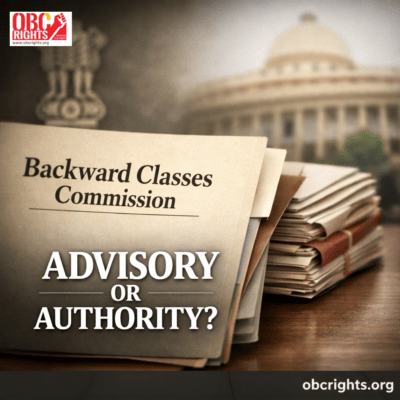
The Bigger Question: Advisory or Authority?
Legally, recommendations of the commission for backward classes are not binding.
This leads to uncomfortable questions:
- What happens if governments ignore expert findings?
- Should commissions have stronger enforcement power?
- Is advisory status enough in a deeply unequal society?
A commission without authority risks becoming a formality.
Final Thoughts
The story of the commission for backward class is not just legal history. It reflects India’s struggle to balance:
- Social justice
- Federal autonomy
- Constitutional clarity
While recent amendments have restored state powers, the real test lies ahead:
”Will commissions be heard, or merely consulted?”
That question will define the future of backward class policy in India.
Want deeper legal explanations on OBC rights and reservation policy?
Visit obcrights.org for fact-based articles, court analysis, and clear updates on backward class justice.