
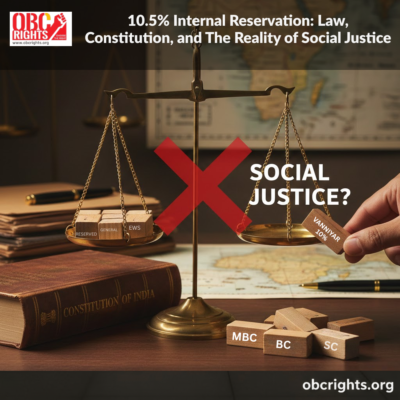
Reservation is a constitutional tool meant to correct historical injustice. It is not a political reward and not a benefit that belongs to any one caste. Yet, the 10.5% internal reservation for Vanniyars has been projected as a measure of social justice without explaining its legal, constitutional, and social consequences.
This article examines the issue based on law, court rulings, rationality, and constitutional principles.
Reservation Is for Classes, Not for Single Caste
The Indian Constitution allows reservation for socially and educationally backward classes, not for any individual caste. Any internal reservation must be group-based, supported by evidence, and applied equally.
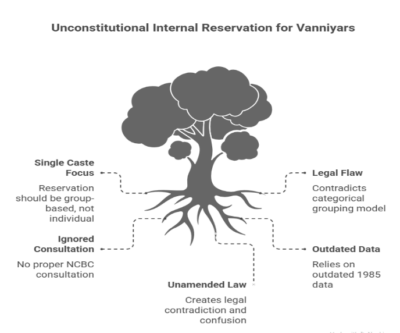
In practice, the 10.5% quota was carved out only for one dominant group within the Most Backward Classes (MBC). Other communities in the same category were left out. If this method were applied to every caste, the reservation system would become unworkable. This alone shows that the policy is unequal and discriminatory and illegal.
Internal Reservation Has a Clear Legal Purpose
Internal reservation exists to ensure that the most backward communities within a category receive fair access to opportunities. It is not meant to advantage politically powerful groups.
States like Karnataka, Telangana, and Andhra Pradesh follow a categorical grouping model, where multiple castes are grouped based on relative backwardness. Dividing reservation for a single caste is legally flawed and contradicts this principle. A group pf Communities which are equally ignored/deprived (on the basis of datas) are grouped in same category.
False Comparisons with Arunthathiyars and Kerala
Claims that Arunthathiyars received similar internal reservations are incorrect. Arunthathiyar is not a single caste, but a group of several castes identified as extremely backward. Their internal reservation was granted to correct severe exclusion, not political imbalance.
Similarly, Kerala’s caste-based reservation system existed before independence and continues under historical protection. It is not a new reservation created under the present Constitution and cannot be used as a justification today.
Mandatory Consultation Was Ignored
Previously or prior to the 105 Amendment, Article 338B (9) of the Constitution requires consultation with the National Commission for Backward Classes (NCBC) on all policy decisions affecting backward classes.
The 10.5% reservation was introduced without proper NCBC consultation. No collective report was approved, and no Commission members signed it. A recommendation from the Chairman – Tamil Nadu Backward Class Commission (TNBC) alone was true. More than all there was no contemporary datas.
No Recent Data, No Legal Foundation
The Supreme Court has repeatedly ruled that quantifiable and current data is essential for granting reservation. This was clearly stated in cases such as M. Nagaraj and the Maratha Reservation case (2021).
In Tamil Nadu, no recent data exists to justify this quota. The only cited source is the Ambasankar Commission Report of 1985, which is outdated. Using decades-old data violates Supreme Court guidelines.
The “No Stay” Argument Is Misleading
There was no court order forcing the government to implement this law. Petitions challenging it were pending, and no interim stay was granted. However, the government failed to file its stand and repeatedly sought more time in court.
Claiming “no stay” while avoiding legal responsibility is misleading.
Existing MBC Law Was Never Amended (1994 Act)
Tamil Nadu already has a law providing 20% reservation for all MBCs under the 69% framework. This law remains unchanged. Implementing a new internal quota without amending the existing law creates legal contradiction and confusion.
Conclusion: Social Justice Must Be Constitutional
Dividing a fixed MBC quota and allocating 10.5% to one caste reduces opportunities for other equally backward communities. This weakens unity among Backward Classes and violates constitutional principles.
- True social justice requires:
- Proper caste census
- Current data
- Equal treatment
- Constitutional procedure
Anything else is not justice—it is political convenience.
Read more evidence-based analysis on reservation and backward class rights at obcrights.org.