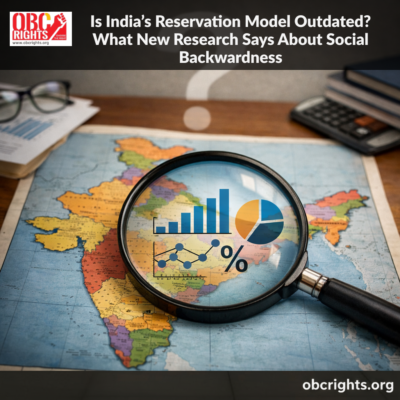
India’s reservation system was created with a clear purpose: to correct centuries of discrimination and give disadvantaged communities a fair chance in education and jobs. But as India changes—economically, socially, and demographically—a big question keeps resurfacing:
Is our reservation model still suited for the realities of today, or are we using decades-old formulas to solve today’s problems?
To answer that, we must look at what recent studies reveal about Social Backwardness, how inequality is shifting, and whether our current system is catching up—or falling behind.
1. The Original Idea: A Remedy for Historical Injustice
When the Constitution introduced reservations for SCs and STs and later for OBCs, the idea was simple:
- Identify communities trapped in discrimination
- Make education and government jobs more accessible
- Reduce structural inequality
But the challenge is that backwardness is not a fixed condition. Social and economic realities evolve. Some groups improve, while others fall behind. Yet our reservation structure has barely changed in decades.
This is where the debate begins.
2. New Research Shows a Different India
Several independent studies by universities, policy bodies, and economic researchers show a clear pattern:
- Inequality is no longer only caste-based; it is also deeply shaped by geography, schooling quality, digital access, and family income.
- Many communities that were once economically strong are now slipping behind.
- Rural–urban gaps have widened more than ever.
- There are also poor students from non-reserved categories struggle just as much as disadvantaged OBC students.
This is where the question of Social Backwardness becomes complex. It is no longer tied to just caste identity—it is now tied to opportunity access to a class.
3. But Our Reservation System Still Uses Old Metrics
This is the heart of the problem.
India has never conducted a full, up-to-date caste census after 1931. Without proper data, how do we measure:
- Who is still backward?
- Who has improved?
- Who needs support today?
The Mandal Commission used data from the 1970s. Most state lists haven’t been updated for decades. The Center does not have a clear picture of Social Backwardness today—yet reservation decisions continue.
This leaves the system open to political influence, not evidence-based reform.
4. Does the Current Model Reward the Truly Disadvantaged?
This is the most uncomfortable question.
Many families within OBC, SC, and ST categories have progressed significantly—good education, stable jobs, urban living. Meanwhile, millions of rural and poor children across India—regardless of caste—lack basic resources to compete.
Should the reservation model consider:?
- School quality
- Household income
- Rural disadvantage
- Disability
- Regional inequality
…alongside caste?
If the goal is justice, why are we not updating the framework to match today’s realities of Social Backwardness?
5. A System That Must Evolve – Not End
Reservation is still necessary. The data is clear: discrimination has not disappeared; it has only changed shape.
But the model needs serious rethinking.
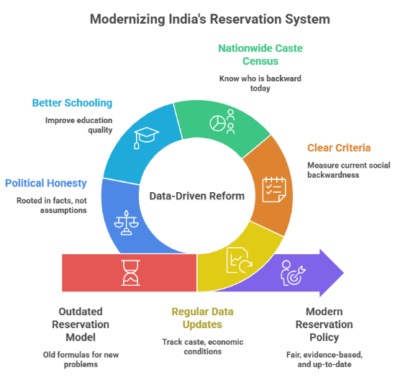
We need:
- Regular data updates on caste and economic conditions
- Clear criteria to measure current Social Backwardness
- Nationwide caste census
- Better schooling, not just quotas
- Political honesty, not vote-bank mathematics
A modern India needs a modern reservation policy—one rooted in facts, not assumptions.
A meticulous – scientific analysis of such data.
Final Thought: Are We Afraid of Data?
If India truly wants fairness, the first step is simple:
Know who is really backward today.
Without real data, our current model risks helping those who no longer need it and ignoring those who genuinely do.
The question remains:
“Are we avoiding changes because it’s too hard to update the system, or because many politicians benefit from keeping it the way it is?”
To read more research-based, people-centered analysis on inequality, caste, and education justice, visit obcrights.org — your source for informed social empowerment.