
Every year, thousands of students and job applicants face the same confusion while filling out application forms:
“My family income is below ₹8 lakh. Should I apply under EWS or OBC non-creamy layer?”
At first glance, both categories appear similar because they mention income limits. But in reality, EWS and OBC non-creamy layer are based on completely different ideas, objectives, and eligibility rules. Treating them as interchangeable can lead to wrong applications, rejected certificates, or even loss of opportunities.
This article clearly explains the difference between EWS and OBC non-creamy layer, helping applicants make informed and confident decisions.
What Is OBC Non-Creamy Layer?
The OBC non-creamy layer is not a separate reservation category. It is a filter within the Other Backward Classes (OBC) to ensure that reservation benefits reach those who are still socially and educationally disadvantaged.
OBC reservation exists because certain communities have faced historical exclusion from education, administration, and opportunities, regardless of their current income. The non-creamy layer concept was introduced to exclude the advanced sections within OBCs who no longer require reservation support. Through this exclusion filter within OBC – is not correct – not fully justified, it is in implemented in pursuance of the Judgement in Indra Sawhney Case.
Key features of the OBC non-creamy layer:
- Applicable only to communities listed in the Central or State OBC list
- Based on social and educational backwardness
- Income limit is one of several exclusion criteria – Those OBCs who have income above Rs.8,00,000 – come under “Creamy Layer”.
Families with high-ranking government posts, large landholdings, or certain professional/business income are excluded even if income is low
The OBC Certificate is not permanent. It is now valid for one year. In short, income alone does not define OBC non-creamy layer eligibility. The focus remains on correcting long-standing social disadvantage.
What Is EWS Reservation?
EWS (Economically Weaker Sections) reservation was introduced for people who are economically poor but do not belong to SC, ST, or OBC categories.
The Principle conditions are to be an EWS:
(i) You should not be a member of any reserved category.
(ii). Your annual income must be below 8 lakhs.
Unlike the OBC non-creamy layer, EWS is purely based on economic condition, not social backwardness. It applies mainly to individuals from the general category who have not historically received reservation benefits.
Key features of EWS:
- Available only to those not covered under SC, ST, or OBC reservations
- Based entirely on income and asset criteria
- Includes limits on land ownership, house size, and residential property
- No link to caste-based social exclusion
EWS is designed as economic support, not as a tool to correct historical discrimination.
Reservation Percentage at a Glance
OBC Non-Creamy Layer
- Eligible for 27% reservation at the Central Government level
- Applies to central government jobs and educational institutions
- State-wise percentage may vary based on state reservation policies
EWS
- Eligible for 10% reservation
- Applicable only to candidates not covered under SC, ST, or OBC (i.e. General / Advanced Communities)
Difference Between EWS and OBC Non-Creamy Layer
Understanding the difference between EWS and OBC non-creamy layer requires looking beyond income limits.
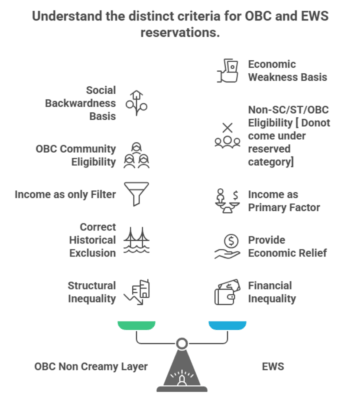
1. Basis of Reservation
- OBC non-creamy layer: Social and educational backwardness
- EWS: Economic weakness only or Economically Backward.
2. Who Can Apply
- OBC non-creamy layer: Only those whose community is listed as OBC
- EWS: Only those not belonging to SC, ST, or OBC (Nor Coming under any reserved category)
3. Role of Income
- OBC non-creamy layer: Income is a filtering tool, not the foundation
- EWS: Income is the primary eligibility factor
4. Purpose
- OBC non-creamy layer: Correct historical exclusion and underrepresentation
- EWS: Provide economic relief to financially weak individuals in the general category / not in the reserved category
5. Nature of Inequality Addressed
- OBC non creamy layer: Structural and social inequality
- EWS: Financial inequality
Even if two families earn the same income, their reservation eligibility may be completely different due to their social background.
Why Income Alone Cannot Decide Reservation Category
One of the biggest misunderstandings is assuming that similar income means similar disadvantage.
Social disadvantage operates across generations. It affects:
- Access to quality schooling
- Professional networks
- Representation in decision-making positions
- Confidence in navigating institutions
That is why OBC non creamy layer reservation is not reduced to a simple income test. Economic hardship can change within a generation, but social exclusion often persists much longer.
Which Category Should You Apply Under?
Applicants should choose carefully:
- If your community is listed under OBC → check OBC non creamy layer eligibility
- If you are not SC, ST, or OBC → check EWS eligibility
Applying under the wrong category can result in:
- Certificate rejection
- Cancellation during verification
- Loss of admission or job opportunity
Understanding the rules beforehand prevents unnecessary stress later.
Conclusion
The OBC non creamy layer and EWS categories exist to address different forms of inequality. While income limits may appear similar, their logic, purpose, and eligibility rules are fundamentally different.
Applicants must remember:
- OBC non creamy layer focuses on historical social disadvantage
- EWS focuses on the present economic hardship
- One cannot replace or merge into the other
Reservation categories are not interchangeable forms.
They are carefully designed responses to different realities of inequality.
For more clear explanations, legal insights, and applicant-focused guides, explore obcrights.org — a platform dedicated to informed access.