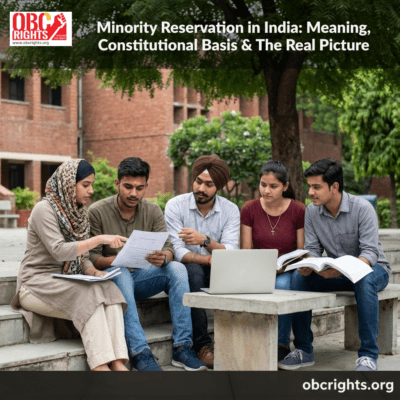
The idea of Minority Reservation in India is often debated in our country, but very few people understand what it actually means. Many assume that all minorities automatically receive special quotas, while others believe minority rights are the same as reservation.
Both ideas are incorrect.
This blog explains the concept in simple terms—what minority reservation is, who qualifies, how the Constitution views minorities, and whether religious minorities truly get reservation in education or jobs.
1. What Minority Reservation Really Means
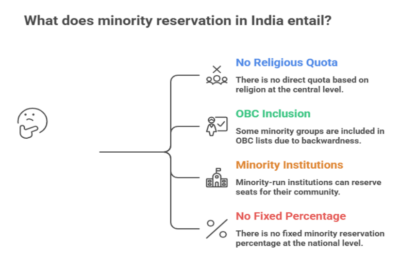
In India, the phrase minority reservation does not refer to a direct quota based on religion.
It mainly refers to three things:
- Reservation for backward-class groups within minority communities
- Seats in minority-run colleges and schools under Article 30
- Government schemes aimed through minority development
This is very different from giving reservation only because someone belongs to a minority religion.
2. How Minorities Are Defined in India
The Constitution protects the rights of cultural and religious minorities, but it does not list them by name.
The official list comes from the National Commission for Minorities Act, 1992, which recognizes:
- Muslims
- Christians
- Sikhs
- Buddhists
- Parsis
- Jains
These groups are considered religious minorities, but that alone does not qualify them for reservation.
3. Do Minorities Get Reservation? The Clear Answer
This is one of the most common doubts people have. The answer is straightforward:
“Minorities do not get reservation simply because they are minorities”
Reservation in India is based on social and educational backwardness, not on religion.
Here’s how it works in practice:
A. No Religious Quota at the Central Level
- No separate minority quota in UPSC, SSC, Railways, or central universities
- Only SC, ST, OBC, and EWS reservations apply
B. Indirect Access Through OBC Lists
Some groups within minority communities are included in the OBC category because they are socially and educationally backward.
For example:
- Many Muslim sub-communities are listed as OBC in Tamil Nadu, Kerala, Karnataka, and other states
- Some Christian and Buddhist groups are included under OBC or SC depending on their historical background
C. Minority Educational Institutions
Under Article 30, minority-run institutions can reserve up to 50% of seats for students from their community/religion.
This is sometimes mistaken as minority reservation, but it applies only to minority-run institutions, not to all colleges or jobs.
4. Is There a Minority Reservation Percentage in India?
A lot of people search for India’s “minority reservation percentage,” but there is no fixed percentage at the national level.
l Central level: 0% minority quota
l State level: varies (only for backward groups within minorities through OBC reservation)
l Minority institutions: up to 50% seats
l In Tamil Nadu, Muslims are given 3.5% sub-quota from BC Reservation.
This means there is no single nationwide percentage for minority reservation.
5. Why Some Minority Groups Receive Reservation Under OBC
Backwardness—not religion—is the deciding factor.
Key historical developments:
- The Mandal Commission (1979) identified several Muslim castes as backward
- The Sachar Committee (2006) reported low literacy, high dropout rates, and poor representation among Muslims
- Various state commissions have identified backward-caste Christians, Sikhs, and Buddhists
These findings led to the inclusion of many minority groups in OBC lists—not because they are minorities, but because they face disadvantages similar to other backward classes.
6. What the Courts Have Said About Minority-Based Reservation
Several major judgments shape the current rules:
Indra Sawhney (1992)
- Reservation cannot be based purely on religion
- Backwardness must be social and educational
St. Stephen’s (1992)
- Minority institutions can reserve 50% seats for their community
TMA Pai (2002) & PA Inamdar (2005)
- Reinforced autonomy of minority institutions
AP Muslim quota cases
- Repeatedly struck down because the quota was based mainly on religion
- These rulings ensure reservation remains caste- and class-based, not religion-based.
7. The Real Takeaway: What People Should Understand
To put everything simply and clearly:
- India does not have a religion-based minority reservation
- The Constitution protects minority rights but forbids religion-only quotas
- Some minority groups get reservation only because they are classified as OBCs
- Minority institutions have special seat rights
- Welfare schemes exist but are not reservation
- There is no single minority reservation percentage
Understanding these facts makes public debate more rational and less political.
Conclusion
Minority reservation in India is one of the most misunderstood public issues. There is no special religious quota at the national level, but there are constitutional protections and welfare programs. Most importantly, backward groups within minority communities are included in reservation systems only through the OBC category, not because of their religion.
A clear view of the law, history, and data helps us separate facts from assumptions—and leads to more informed discussions on equality and social justice.
Want to Learn More About Reservation, Social Justice & OBC Rights?
Visit obcrights.org for detailed blogs, guides, legal explanations, and resources that empower students, parents, and communities.