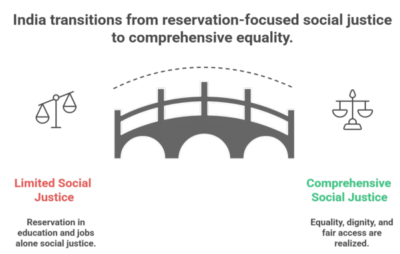
In India, social justice is often reduced to a single argument: reservation in education and government jobs. Reservation is important. It is constitutional. It is necessary. But is it the whole idea of social justice?
The Constitution never treated social justice as a quota-only policy. It spoke of equality, inclusiveness, dignity, access to power, and fair distribution of resources. When social justice is narrowed to reservation debates alone, larger and deeper inequalities quietly escape attention.
This blog asks uncomfortable but essential questions:
- Are our policies actually delivering social justice?
- Or has social justice become a political slogan used when convenient?
Social Justice Is More Than Reservation
Reservation is one tool, not the entire framework.
If social justice truly exists, it must reflect in everyday life, not just in admission lists or recruitment notifications.
True social justice includes:
- Equal political representation
- Fair access to economic opportunities
- Access to public land, water, forests, and natural resources
- Freedom from social and cultural discrimination
- Equal access to education, healthcare, housing, and justice
- Equal representation in Government administration.
A key question arises: If social justice is real, why do power, wealth, and decision-making still remain concentrated within a few communities?
Budgeting Without Social Justice: A Silent Failure
Every year, governments present large budgets filled with figures, schemes, and growth projections. But budgets are not neutral documents. They reflect priorities.
The real question is simple: Do our budgets promote social justice, or do they merely manage accounts?
Patterns seen repeatedly:
- Welfare allocations grow slower than inflation
- Social sector spending fails to match population needs
- Capital-intensive growth is prioritized over redistribution
Data from past budgets show that health and education spending as a percentage of GDP remains low compared to global standards, even as inequality rises.
When budgets ignore social justice, growth benefits those already ahead. Social justice without financial commitment becomes empty rhetoric.
Economic Growth vs Social Justice: A Widening Gap
India celebrates growth numbers—GDP, investments, and stock market highs. But growth without inclusiveness creates a dangerous illusion of progress.
Warning signs are visible:
- Wealth concentration has increased sharply over the last decade
- A large majority of workers remain informal and unprotected or under protected.
- Real income growth for the poor has stagnated
Data consistently shows that the top few percent control a disproportionate share of national wealth, while public services remain overstretched.
A nation cannot call itself developed if economic progress excludes the majority.
GST and Federalism: Is Social Justice Being Centralized?
The introduction of GST transformed India’s fiscal structure. While it simplified taxation, it also centralized revenue control.
Impact on states:
- States lost independent taxation powers
- Welfare-focused states struggle to raise resources
- Dependence on the Centre has increased
For states like Tamil Nadu, which historically invested heavily in social justice-driven welfare, reduced fiscal autonomy weakens their ability to protect marginalized communities. But when we throw a question whether OBCs are given due importance, definitely it is not.
Can social justice survive without financial freedom for states?
Debt, Reforms, and the Cost of Ignoring Social Justice
Public debt continues to rise, yet the conversion of announced investments into actual projects remains weak.
This gap raises serious questions:
- Why is there a heavy reliance on short-term, high-interest loans?
- Why do many approved projects face long delays or partial execution?
- Why is the gap between promised and realised investment so large?
When debt increases and investment slows, governments often cut welfare spending first. Social justice then becomes the immediate casualty.
If financial reforms weaken welfare capacity, who really pays the price?
Infrastructure and Social Justice: Who Really Benefits?
Infrastructure is often presented as neutral development. In reality, it reflects social choices.
Ground realities show:
- Urban projects displace low-income communities
- Affordable housing supply remains inadequate
- Quality healthcare access remains unequal
True social justice demands:
- Affordable housing for urban and rural poor
- Strong public healthcare systems
- Equal access to infrastructure—not elite access
Development without inclusion deepens inequality instead of reducing it.
Education and Social Justice: The Missing Link
Higher education is expanding, but quality and access remain unequal.
Key concerns:
- Limited awareness of scholarships among eligible students
- Rapid privatization excluding the poor
- Elite institutions remain socially inaccessible
Data shows that dropout rates rise sharply after the school level among marginalized communities. These gaps highlight the educational exclusion of OBCs, showing that systemic barriers still block true empowerment.
Without education reform rooted in social justice, reservation alone cannot create real empowerment.
Tamil Nadu: Progressive Image, Structural Questions
Tamil Nadu is often praised for its social justice legacy. Yet beneath the success narrative, warning signs are visible:
- Most of the schemes and policies are made/focused on votes.
- Rising public debt
- Weak conversion of investment promises into reality
- Growing inequality beneath welfare schemes
This raises a critical question: Are we protecting social justice structurally, or only symbolically?
Conclusion: Social Justice Needs Tough Questions
Social justice is not charity. It is not a scheme. It is not just a reservation. It is a Constitutional Mandate.
It is a continuous constitutional responsibility to correct an imbalance.
To protect social justice, we must ask:
- Who controls resources?
- Who benefits from growth?
- Who bears the cost of reforms?
Without honest answers, social justice risks becoming a celebrated word but an abandoned value.
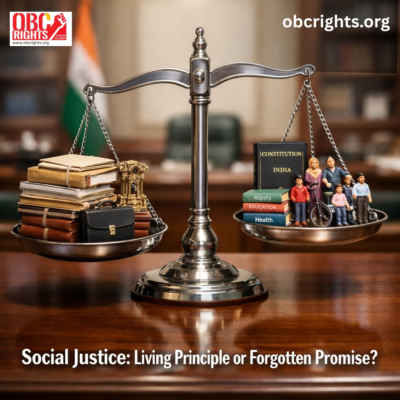
The question remains: Is social justice still a living principle, or a forgotten promise?
Want to understand the full picture of social justice in India? Explore more blogs on obcrights.org covering reservation, education, welfare, and empowerment of marginalized communities.