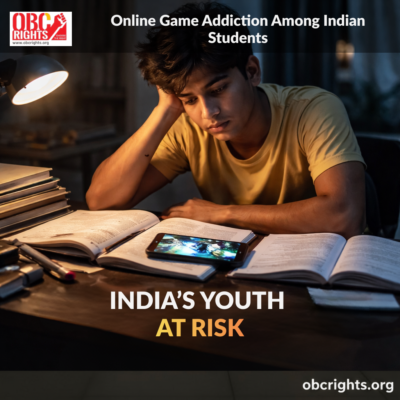
Online gaming in India has grown from a harmless leisure activity into a silent epidemic of online game addiction, particularly among school and college students. What was once marketed as “entertainment” has now become a powerful digital trap, stealing time, wealth, focus, health, and careers from an entire generation of youth.
Despite alarming data, growing emotional distress among students, and repeated warnings from educators and mental health experts. But the pity is that the government action remains largely reactive, fragmented, and insufficient. The cost of this inaction is being paid by India’s students who are the pillars of our nation.
Online Gaming Addiction Is Visible Everywhere: Even on Village Buses
This crisis is no longer confined to urban homes or private bedrooms. Even during bus travel in villages, small towns, and district routes, students can be seen roaming with mobile phones in their hands, deeply absorbed in online games. Instead of observing their surroundings, interacting with friends, or engaging with real life, many remain completely glued to screens.
When online gaming addiction follows students into public buses, rural roads, streets, and common spaces, it stops being a private issue and becomes a visible social disorder. The presence of mobile gaming addiction even in rural and semi-urban areas proves that this is not an urban or elite problem, it is a nationwide crisis cutting across geography, class, and age.
The Scale of Online Game Addiction Among Students
Multiple surveys now confirm that online game addiction among Indian students is real, widespread, and accelerating and disastrous.
According to the Tamil Nadu Online Gaming Authority (TNOGA), 85% of students play online games, and nearly 20% show signs of addiction. Around 23% experience emotional distress, including anger, anxiety, and behavioral changes.
A 2024 study found that 7.2% of Indian youth already suffer from gaming disorder, while 31.8% are at risk—a figure alarmingly higher than the global average of 1–3%.
Among urban adolescents, addiction rates rise close to 20%, and even district-level rural studies report growing prevalence—suggesting that the problem is not limited to cities or elite schools.
Not Just School Children: College Students Are Vulnerable Too
Public debate often frames online gaming as a “school student issue.” This is misleading. College students, facing academic pressure, job insecurity, and career anxiety, are equally, if not more, vulnerable.
Online games offer instant rewards, false achievement, and artificial social validation. Slowly, students begin replacing skill development, competitive exam preparation, internships, and real learning with hours of gaming. What starts as stress relief turns into dependency, eroding discipline, ambition, and long-term thinking.
What Teachers and Parents Are Observing?
Teachers and parents are witnessing the consequences firsthand:
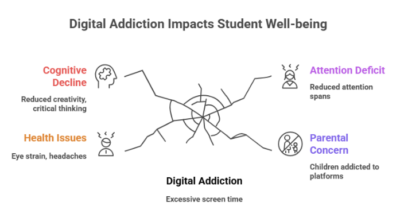
- 67% report eye strain, headaches, and vision issues
- 74% observe a decline in creativity, intelligence, and critical thinking
- Over 60% note reduced attention spans and classroom disengagement
- 50% of parents say their children are addicted to a mix of games, social media, and OTT platforms
This is not moral panic or generational blame. It is a measurable collapse of attention, health, and learning capacity happening inside classrooms and homes.
Why Government Response Remains Inadequate
Despite overwhelming data, India lacks a strong, student-centric national policy on digital addiction, especially on the evil/adverse effects of Social Media Platforms.
There is:
- No awareness programs or education on the adverse/evil effects of Social Media Platforms.
- No nationwide screen-time regulation for minors
- Weak enforcement of age restrictions
- No digital addiction education in schools
- Minimal mental health support in colleges
State-level bans and restrictions remain temporary, inconsistent, and poorly enforced, treating symptoms, not causes. Neither the Government nor the top brasses in the administration take a serious note or view of it.
Long-Term Damage to Careers and Society
Online game addiction doesn’t just waste time, it reshapes futures.
Students face declining academic performance, reduced exam preparation, poor communication skills, delayed employment, and loss of self-discipline. For a country that calls its youth a “demographic dividend,” this addiction risks turning opportunity into liability.
Who Will Take Responsibility?
Online game addiction in India is not a personal failure of students, it is a collective, formidable policy failure.
When data screams warning, silence becomes complicity.
Final Question:
If nearly one-third of youth are already at risk today, what future is India preparing for tomorrow?
To know similar real/genuine concern on the future of Youth / Students, visit: obcrights.org.