
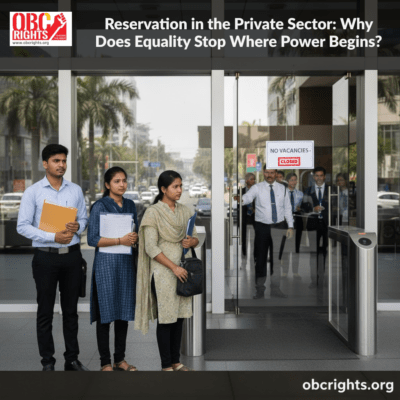
Reservation was never meant to be limited only to Parliament, legislatures, or government jobs. The Indian Constitution visualized equality as a living reality across all structures of society. Restricting reservations only to the public sector is like addressing inequality in one room while ignoring the entire house. In today’s economy, where the private sector dominates employment, the debate on Reservation in the Private Sector is no longer optional, it is unavoidable. More than all, we must know that the Government is prioritizing considerable part of the Government services.
The Reality Behind the “Merit” Argument
One of the most repeated arguments against reservations is that they harm merit and deprives forward-class candidates of opportunities. However, available data clearly contradict this narrative. Forward classes constitute around 15% of India’s population, yet they enjoy nearly 70% of government jobs and about 90% of private-sector employment. If reservations were truly blocking opportunities, these numbers would not exist. Till now, there is no scientific data to prove that the reservation erodes/reduces.
On the other hand, Backward Classes make up 62.5% of the population but hold only 10% of government jobs. Scheduled Tribes, constituting 22.5% of the population, get around 20% of government employment. These figures show a structural imbalance, not a merit-based system. When access to education, networks, capital, and social mobility is unequal, merit itself becomes unequal. Data proves that the advanced/forward communities are well placed in education as well as in government services, especially in Union Government services.
Constitutional Intent and Legal Evolution
The Constitution never treated social justice as limited to government employment alone. Article 16(4) empowered the state to provide reservations in public services for backward classes. Articles 330, 332, and 335 ensured representation of SC/ST communities in legislatures and services.
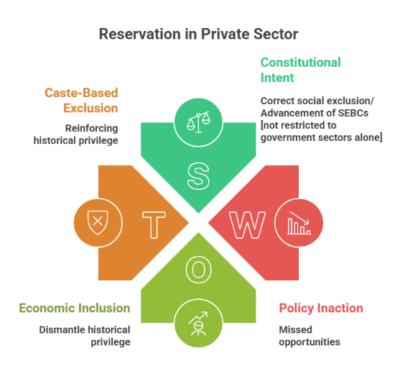
After the Supreme Court’s Champakam Dorairajan judgment, Article 15(4) was added in 1951, making it clear that the state can take special measures for the advancement of SEBC, SC, and ST communities. When the Inamdar judgment (2006) restricted reservation in private educational institutions, Parliament responded with Article 15(5). This legislative correction clearly shows that constitutional morality evolves to correct social exclusion. The same logic supports reservation in the private sector employment as well. The Constitutional provision narrates or aims at the advancement or upliftment of SEBCs in both the Government / Private sectors.
Private Sector: The New Centre of Power
Today, the private sector controls most employment, wealth creation, and decision-making power. Excluding it from social justice policies means excluding marginalized communities from the future of the economy. Under the excuse of “neutral hiring” and “market efficiency,” caste-based exclusion continues silently.
Studies and committee observations reveal that SC, ST, and OBC representation sharply declines as one moves from public sector jobs to private corporate positions, especially in leadership roles. Without intervention, the private sector becomes a caste-filtered space, reinforcing historical privilege rather than dismantling it. This is precisely why reservation in the private sector is a democratic correction, not an economic threat.
Policy Discussions and Missed Opportunities
The Kaka Kalelkar Commission in 1953 acknowledged backward class underrepresentation in private employment, but its findings were ignored. In 2016, the National Commission for Backward Classes recommended 27% reservation in private employment, yet no concrete action followed.
Some states like Andhra Pradesh and Haryana attempted local reservations, but these are residence-based, not social justice-driven. Internationally, countries like the United States implement Affirmative Action in private institutions, recognizing that markets alone cannot correct historical injustice.
Conclusion: Equality Cannot Stop at the Factory Gate
If social justice applies only to government offices, it becomes symbolic rather than real. True equality demands representation wherever power and opportunity exist.
Reservation in the private sector is not about charity or revenge; it is about correcting a system that has silently excluded the majority for decades. Without inclusive access to private employment, constitutional equality remains incomplete. A society cannot be built by leaving the largest employment sector untouched.
So, we must ask this question: Can a democracy remain equal when its largest employment sector remains socially exclusive?
Read real stories, data reports, and constitutional perspectives on exclusion in employment only on obcrights.org.