The debate on reservation in India often begins with the Mandal Commission. But long before Mandal reshaped national politics, Tamil Nadu had already confronted a deeper and more uncomfortable truth: inequality existed even within the Backward Classes. This truth was first formally acknowledged by the Sattanathan Commission.
The Sattanathan Commission remains one of the most important yet under-discussed milestones in India’s social justice history. Its findings continue to challenge how reservation is understood, implemented, and defended even today.
What Was the Sattanathan Commission?
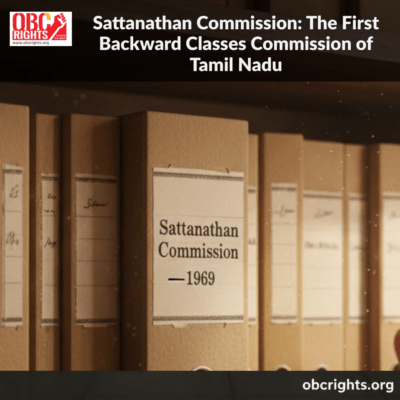
The Sattanathan Commission was constituted in 1969 by the Government of Tamil Nadu. Officially known as the First Backward Classes Commission of Tamil Nadu, it was chaired by Justice A. N. Sattanathan, a retired judge of the Madras High Court.
The commission was appointed at a time when reservation had existed for decades in the state, yet large sections of backward communities remained invisible in education and government employments.
This raised a disturbing question: If reservation existed, why were many backward communities still left behind?
Why the Sattanathan Commission Was Necessary
The Sattanathan Commission was formed to investigate:
- Whether reservation benefits were equitably distributed
- Whether certain OBC communities had become dominant beneficiaries
- Why do several weaker communities remain persistently excluded?
- Whether the idea of “Backward Classes” needed internal differentiation
Methodology: How the Sattanathan Commission Studied Backwardness
The Sattanathan Commission Report adopted a data-based and comparative approach—rare for its time.
The commission relied on:
- Caste-wise government employment records
- Educational enrollment and admission data
- Scholarship and hostel beneficiary lists
- Community certificates issued by state authorities
- Field visits to rural, nomadic, and denotified settlements
- Memoranda submitted by caste associations
- Historical census data (1931) and district gazetteers
Instead of asking who is backward, the Sattanathan Commission asked: Who is actually getting representation, and who is not?
What the Sattanathan Commission Discovered
The Sattanathan Commission revealed deep inequalities within the Backward Classes:
- Reservation benefits were unevenly captured, with a few OBC communities dominating government jobs and higher education, while many others had little or no representation.
- This unequal access created new hierarchies within backward groups instead of removing inequality.
- The Sattanathan Commission Report showed that some backward communities had become relatively advanced due to better literacy, land ownership, political influence, and early entry into public employment.
- In contrast, Most Backward Classes (MBCs) and Denotified Communities (DNCs) remained severely marginalised, facing illiteracy, nomadic living conditions, and near-total exclusion from government employment.
The Commission concluded that treating all backward communities as a single category was structurally unfair and reinforced existing disadvantages.
Key Recommendations of the Sattanathan Commission
The Sattanathan Commission, the First Backward Classes Commission of Tamil Nadu, proposed a holistic framework combining education, employment, and economic empowerment. At the heart of its recommendations was a bold and historic idea: sub-classification within Backward Classes.
1. Core Recommendation: Sub-classification of Backward Classes
- The most significant contribution of the Sattanathan Commission was its call to divide Backward Classes into distinct categories to ensure fair distribution of reservation benefits.
- Identified dominance of certain OBC communities in education and employment
- Highlighted the continued exclusion of Most Backward Classes (MBCs) and Denotified Communities (DNCs)
- Proposed internal division to prevent monopolisation of reservation benefits
This principle directly shaped Tamil Nadu’s later policy of separate reservation for MBCs and DNCs and remains central to today’s OBC sub-categorisation debates.
2. Education
- Issued 39 recommendations spanning primary to higher education
- Focus on hostels, scholarships, coaching, and women’s education
- Special support for first-generation learners
3. Employment and Reservation
- Recommended increasing reservation to 33%
- Proposed split reflecting sub-classification:
- 17% for Backward Classes (BC)
- 16% for Most Backward Classes (MBC)
- Suggested extending reservation to local bodies, PSUs, and aided institutions
- Introduced early Creamy Layer exclusion
- Supported reservation in promotions and permanent posts
- Called for coaching centres for competitive exams
- Urged pursuit of BC reservation in Central and defence services
4. Economic Development
- Recommended land redistribution and livelihood loans
- Proposed housing assistance for vulnerable occupational groups
- Suggested industrial estates and forest-based industries
- Emphasised banking access and modernisation of traditional occupations
Implementation: Delay, Resistance, and Partial Justice
Despite its clarity, the recommendations of the Sattanathan Commission faced:
- Political resistance from dominant OBC groups
- Fear of backlash
- Administrative hesitation
As a result, the report was not immediately implemented.
However, its core idea survived.
In 1989, Tamil Nadu introduced:
- Separate reservation for MBCs and DNCs
- A policy directly rooted in the logic of the Sattanathan Commission
- Tamil Nadu thus became the first state in India to operationalise OBC sub-categorisation.
Why the Sattanathan Commission Still Matters Today
The Sattanathan Commission is not a historical footnote. It is central to current debates on:
- OBC sub-categorisation at the national level
- Fair distribution of reservation benefits
- Data-driven social justice
- Representation gaps in higher education and bureaucracy
When policymakers ask whether sub-categorisation is constitutional or necessary, the Sattanathan Commission already provides the answer, grounded in evidence, not ideology.
A Commission in India that Cannot Ignore
The Sattanathan Commission was one of India’s earliest attempts to make reservation fair, accountable, and evidence-based. It understood that social justice is not just about percentages, but about who actually benefits. Its vision remains unfinished, but its relevance has only grown.
If equitable reservation matters, informed voices must lead the debate.
Explore more evidence-based articles on reservation, OBC rights, and social justice history at obcrights.org. Learn, question, and be part of a platform that puts fairness at the centre of policy discussions.
To know the updates follow our blogs in the said website.