For decades, a dangerous myth has shaped India’s recruitment and admission systems: “Open (General) Category seats belong to upper castes.”
This belief was never written in the Constitution. Yet, in practice, it quietly became a rule with the sole aim of excluding meritorious OBC, SC, and ST candidates from seats they rightfully earned.
A recent Supreme Court clarification has finally exposed this distortion.
Why Was This Clarification Necessary at All?
Article 14 promises equality before law.
Article 16 guarantees equal opportunity in public employment.
Nowhere do these Articles say:
- Meritorious candidates should not be placed in the Open–Merit list on par with other (advanced) communities
- Open category = upper caste
- Merit seats = caste-restricted
- Reserved candidates must stay “within limits” even when they outperform others
Yet across exams, recruitments, and merit lists, reserved category candidates scoring higher than general cut-offs were routinely pushed aside confined in quota / reserved categories
How?
By quietly treating the open category as a closed social space, not an open merit pool.
The Supreme Court had to step in because administrative practices had normalized constitutional violations.
Who Benefited from This Confusion?
Let’s be honest.
This confusion did not hurt everyone equally.
Beneficiaries were:
- Historically advantaged communities
- Candidates with access to coaching, networks, English education
- Those already overrepresented in government services
By treating open category as an upper-caste entitlement, the system:
- Preserved dominance without calling it reservation
- Converted privilege into “neutral merit”
- Shifted blame onto reservation policies instead of structural bias
This was invisible reservation for the already powerful affluent – advanced communities!
How Long Has This Been Happening?
Not for a year. Not for a decade. This exclusion has been happening since competitive exams began expanding in post-Mandal India (1992).
Every year:
- Thousands of first-generation learners crossed merit thresholds
- Thousands lost opportunities without protest
- Thousands never knew they were excluded unfairly
There were no protests because:
- The loss was individual, not collective
- The discrimination was procedural, not explicit
- The narrative blamed “quota”, not manipulation
- Sometimes it was done in the name of getting/giving seniority benefits to the reserved categories.
This is what makes it a systemic injustice.
Silent Loss of First-Generation Achievers
Imagine a student:
- First in the family to reach college
- Studying without guidance or legacy
- Competing against generations of accumulated advantage
Now imagine that student:
- Scoring above the open cut-off
- Being denied an open seat
- Being told, “You belong elsewhere”
- Go to / get accommodated in your compartment.
This is not reservation misuse. This is merit punishment.
The emotional cost is invisible:
- Confidence breaks
- Aspirations shrink
- Silence replaces resistance
- No headlines. No outrage. Just loss.
- No backing/support of bearcats or high-level politicians
What the Supreme Court Finally Clarified
The Court reaffirmed a simple constitutional truth:
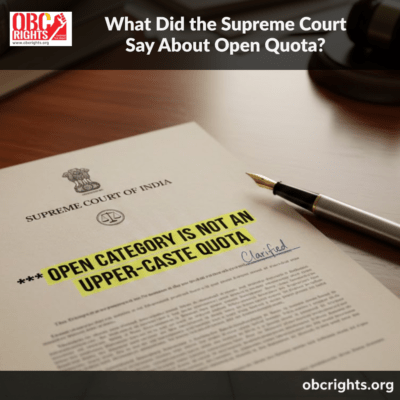
Open category seats are not reserved for any caste. They are open to all who qualify on merit.
Key clarification:
- Reserved category candidates must be counted in the open merit lists if they score higher
- Doing so is not a “double benefit”
- Merit cannot be filtered by caste identity
This ruling does not expand reservation. It restores equality.
Conclusion
Merit does not fail when marginalized students succeed.
Merit fails when systems decide who is allowed to benefit from it?
Systems definitely don’t have that right.
The Supreme Court’s clarification reminds us that equality is not about managing numbers, but about respecting outcomes. When higher scores are ignored and opportunity is filtered through social identity, injustice becomes procedural and therefore invisible.
Unless institutions correct how merit lists are prepared and implemented, constitutional promises will remain court judgments, not lived reality.
Stay informed, explore evidence, and demand accountability at obcrights.org, because social justice needs more than judgments; it needs action.