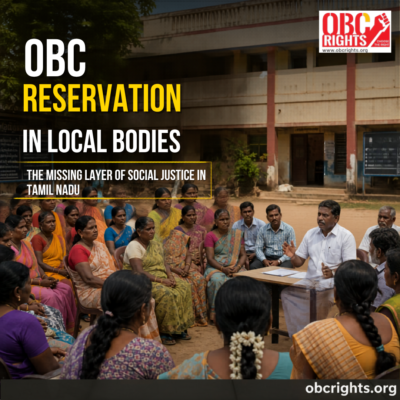
When we talk about OBC Reservation in India, our minds immediately go to education and government jobs. But an equally powerful – and often ignored – arena is Reservation in Local Bodies, where everyday governance decisions are made.
A recent report has quietly shaken this illusion of progress. The Indian Institute of Public Administration (IIPA), in its 2024 study “Status of Devolution to Panchayats in States”, has revealed that Tamil Nadu – a state hailed as the cradle of social justice – shows alarmingly low numbers of OBC representation in its rural local bodies (RLBs).
The Data That Demands Answers
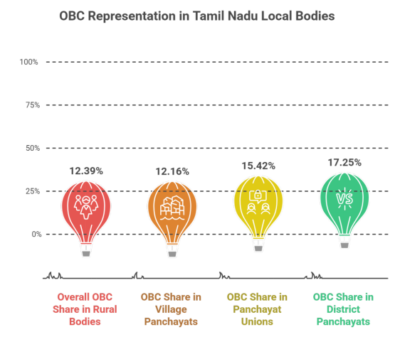
According to the IIPA report, commissioned by the Union Ministry of Panchayati Raj:
- The overall share of OBCs in Tamil Nadu’s rural local bodies is only 12.39%.
- In village panchayats, it’s a mere 12.16%.
- In panchayat unions, 15.42%.
- And in district panchayats, 17.25%.
For a state with a long legacy of social reform and a proud history of OBC Reservation, these figures are not just low – they are unsettling.
How can the state that once fought for 69% total reservation and led the national debate on equality now show such a weak reflection in grassroots power?
Read our guide on how Tamil Nadu protected the 69% reservation policy to understand how the state secured constitutional backing for one of India’s most extensive reservation systems.
A Legal and Political Reminder
Tamil Nadu’s journey with Reservation in Local Bodies is not new. Nearly three decades ago, then Chief Minister J. Jayalalithaa issued an ordinance providing a 50% quota for Backward Classes in rural local bodies.
However, the Madras High Court struck it down in 1996, citing a lack of constitutional backing and data justification. Since then, no major attempt has been made to legally secure robust OBC Reservation in these institutions.
Ironically, what Tamil Nadu tried more than 25 years ago – giving reservations to OBCs in local-body elections — is now being done by states like Maharashtra and Telangana, but this time with a stronger legal foundation.
After the Supreme Court’s Vikas Kishanrao Gawali judgment (2021), states can’t just declare OBC quotas in panchayat or municipal elections without proper evidence. The Court said they must follow a “Triple Test”, meaning three conditions must be met before giving reservation:
- Set up a special commission to study how backward OBCs are in local bodies and whether they are underrepresented.
- Collect real data (empirical evidence) to decide how much reservation is actually needed.
- Keep the total quota – for SCs, STs, and OBCs together – below 50%.
In short, the Supreme Court made it clear: reservation in local bodies must be based on data, not politics.
But here’s the uncomfortable question – if OBCs make up nearly half of Tamil Nadu’s population, can a 50% ceiling on total reservations ever ensure true representation?
Why Representation in Local Bodies Matters
Panchayats and municipalities are not symbolic posts – they are the foundation of real democracy.
- They decide on village schools, road works, housing allocations, welfare implementation, and development priorities.
- Without strong OBC Reservation at this level, the voices of backward communities rarely reach decision tables.
- Representation here means control over policy, not just access to schemes.
If the state that pioneered backward class politics cannot ensure Reservation in Local Bodies, what message does it send to the rest of India?
Understanding the Gap
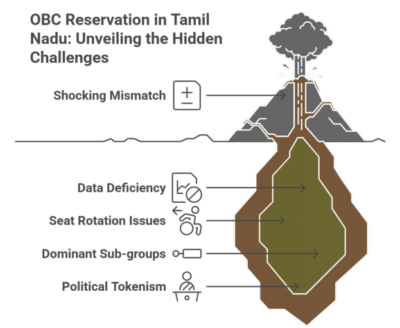
Several factors could explain this shocking mismatch between Tamil Nadu’s progressive image and the data reality:
- Data deficiency: Without caste-wise documentation of elected members, tracking OBC participation becomes impossible.
- Seat rotation issues: The random rotation of reserved wards often breaks community continuity.
- Dominant sub-groups: Even within OBCs, dominant castes may corner the few available seats.
- Political tokenism: Reservation laws exist, but political power remains with entrenched elites.
All these factors combine to weaken the very goal of OBC Reservation – to democratize power.
Why OBC Youth Must Take Notice
This is not just a statistical issue – it’s a generational challenge.
Reservation in Local Bodies is where OBC youth can begin their political journey, learning governance, accountability, and public service. Without these opportunities, leadership pipelines dry up, and the next generation remains dependent on traditional hierarchies.
Social justice movements that once filled the streets must now fill the ballot.
If OBC students, workers, and professionals do not claim their political space at the grassroots, OBC Reservation will remain a number on paper – not a force of empowerment.
The Way Forward
Tamil Nadu can reclaim its social justice leadership only through decisive reforms:
- Publish annual OBC representation data in all tiers of local governance.
- Create a State Commission for empirical assessment of Reservation in Local Bodies.
- Ensure transparent seat rotation to avoid long gaps for OBC wards.
- Integrate capacity-building for OBC representatives – training, awareness, and legal support.
- Conduct a caste census to align representation with real demographics.
A Fight Renewed
OBC Reservation is not a relic of the past – it is a living constitutional promise.
If equality is to move beyond slogans, it must start where power begins: the local level.
The 2024 IIPA data is a wake-up call. Tamil Nadu’s underrepresentation of OBCs in panchayats is not just a bureaucratic flaw – it’s a democratic failure.
So the question is not whether we have Reservation in Local Bodies, but whether we have the political will to make it meaningful.
Until the voices of OBCs echo from every ward, union, and district, social justice in Tamil Nadu will remain incomplete.
Join the Fight for Real Representation
The struggle for OBC Reservation in Local Bodies is far from over.
At the Society for the Rights of Backward Communities (SFRBC), we believe justice begins when citizens participate – not just when policies are written.
Be part of the movement.
Raise your voice, spread awareness, and stand with those demanding equality at the grassroots.
Join OBCRights / SFRBC today – because representation is not charity, it’s a right.