Reservation for Other Backward Classes (OBC) is one of the most important social justice measures in India. It was introduced to correct the historical inequality faced by socially and educationally backward communities. Even today, many people search for clear answers about OBC reservation in India, its percentage, history, and how effective it has been.
What Is OBC Reservation in India?
OBC reservation in India is a policy that provides a fixed share of seats and jobs to communities classified as “Other Backward Classes.” These communities were historically denied access to education, government jobs, and economic opportunities.
The goal of the OBC reservation is:
- To ensure equal opportunity
- To improve representation in education and government services
- And to reduce long-standing social and economic gaps
If you are unsure whether your community falls under OBC, you can check the OBC caste list in India.
OBC Reservation Percentage in India
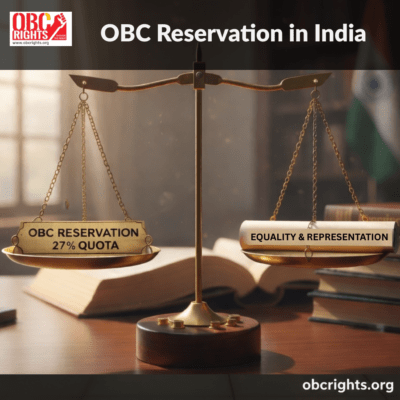
OBC reservation in India differs between the central and state levels. At the central level, it’s 27%, while states like Tamil Nadu and Karnataka set their own quotas.
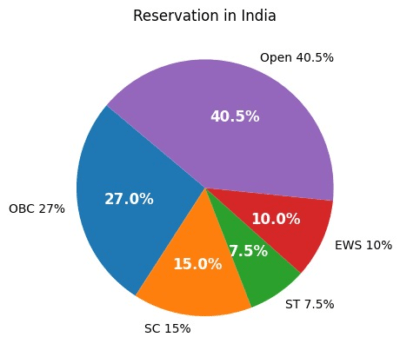
Current OBC Reservation percentage (Central Level)
- SC: 15%
- ST: 7.5%
- OBC: 27%
- Total reservation: 49.5%
This 27% quota applies to:
- Central universities and colleges
- IITs, IIMs, AIIMS, and other central institutions
- Central government jobs
State-Level Variations
At the state level, OBC reservation percentage differs:
- Tamil Nadu: 50% total BC + MBC (within 69% reservation)
- Karnataka: Around 32%
- Bihar: Recently increased OBC share after caste survey
- Telangana: Proposed to raise OBC quota to 42%
States can set their own percentages, but the Supreme Court’s 50% ceiling rule often limits them.
OBC Reservation History in India
Many people ask: when was OBC reservation started in India?
The direct answer is 1990, but the journey of OBC reservation began much earlier and evolved over several decades through social movements, government commissions, and legal decisions.
1. Early Foundations Before Independence
Even before India became independent, several regions, especially the Madras Presidency, had reservation systems for backward communities. Social reformers and non-Brahmin movements demanded fair representation in education and government services. These early efforts laid the moral and social foundation for future reservation policies.
2. Kalelkar Commission(1953): The First Official Recognition
After independence, the Indian government formally acknowledged the need to support backward classes. In 1953, the Kalelkar Commission, also known as the First Backward Classes Commission, was appointed.
- It studied social and educational backwardness
- It highlighted deep inequalities faced by many communities
- Although its recommendations were not fully implemented, it started a national debate on OBC reservation
This was the first time the Indian state officially recognised the need for special measures for backward classes.
3. Mandal Commission Report: The Turning Point
To address unresolved inequalities, the government formed the Mandal Commission in 1979.
In 1980, the commission submitted its report after detailed research using indicators such as:
- Caste status
- Education levels
- Access to land, employment, and basic resources
The commission found that Other Backward Classes formed nearly 52% of India’s population and recommended 27% reservation in central government jobs and educational institutions.
4. 1990 – Actual Implementation of OBC Reservation
For nearly a decade, the Mandal Commission report remained unimplemented.
In 1990, the central government finally decided to enforce its recommendations.
- 27% OBC reservation was introduced in central government jobs and institutions.
- This decision marked the official start of OBC reservation in India
- It transformed access to education, employment, and political participation for backward communities
This moment became a landmark in India’s social justice history.
5. Supreme Court Judgment (Indra Sawhney Case)
The implementation of OBC reservation led to nationwide protests and legal challenges.
In 1992, the Supreme Court delivered the historic Indra Sawhney judgment, which:
- Upheld the 27% OBC reservation
- Introduced the Creamy Layer concept to ensure fairness
- Fixed the 50% reservation ceiling, except in extraordinary circumstances
- But, said No OBC Reservation for Promotion, It must be based on merit and seniority for OBC candidates
This judgment provided constitutional clarity and continues to shape reservation policies today.
What Is the Creamy Layer in OBC Reservation?
The creamy layer refers to economically advanced OBC families who are excluded from reservation benefits. Key points:
- Determined mainly by parental income and position
- Income limits are revised periodically by the government
(At present, Families with an annual income of ₹8 lakh or more are considered part of the creamy layer and do not get OBC reservation benefits) - Members of the creamy layer cannot claim OBC reservation
- Ensures that benefits reach the most disadvantaged sections of OBCs
How Effective Was the Reservation for the OBC in India?
Positive Outcomes
- Increased Representation
- More OBC students entered higher education
- OBC presence in government jobs improved
- Social Confidence
- Political participation of OBC communities increased
- Leadership roles expanded at local and national levels
Limitations and Gaps
- Unequal Benefits
- Dominant OBC groups benefited more
- Extremely backward communities lagged behind
- Poor Implementation
- Vacant reserved seats in many institutions
- Vacant seats in many government jobs.
- Private Sector Exclusion
- Most private colleges and jobs do not follow the OBC reservation
- Access to quality education remains unequal
Overall Assessment
OBC reservation has helped significantly, but it has not fully achieved its goal. Structural inequality, weak enforcement, political hesitation and lack of data-driven updates (like caste census)continue to limit its effectiveness.
Why OBC Reservation Still Matters Today
Even after decades:
- OBCs remain underrepresented in elite institutions
- Dropout rates are higher among backward communities
- Access to financial resources, professional networks, and quality education remains unequal.
Reservation is not a privilege, it is a corrective tool to ensure fairness.
Way Forward: Strengthening OBC Reservation
To make OBC reservation more effective:
- Regular caste-based data collection
- Sub-categorisation within OBCs
- Strict enforcement in all public institutions
- Extension of social justice principles to private education and job
Conclusion
OBC reservation in India is a result of decades of struggle for equality. The 27% OBC reservation percentage, introduced after long debates and legal scrutiny, has changed many lives. However, the journey is incomplete.
The fight for social justice doesn’t end with awareness, it continues through collective action. Join OBC Rights today. Together, we strive to restore the rights of oppressed communities by ensuring access to education, employment, and legal protection, guided by awareness, unity, and dedicated leadership.
Real change begins when people act together with purpose.