
Introduction
Higher education in India is increasingly dominated by private institutions. From engineering and medicine to law and management, private colleges now control a major share of quality seats. However, unlike government institutions, most private colleges do not follow reservation policies for SC, ST, and OBC students. It is a serious violation of T.N Act – 45 of 1994.
This has raised a crucial question: Can social justice be achieved if access to quality education depends on the ability to pay?
The debate on reservation in private institutions has gained fresh momentum after a Parliamentary Standing Committee (2025) strongly recommended mandatory quotas. This article explains the issue in simple terms, covering the law, court rulings, current reality, challenges, and a practical way forward.
What Does “Reservation in Private Institutions” Mean?
Reservation in private institutions refers to providing fixed admission quotas for SC, ST, and OBC students in private colleges and universities, similar to what already exists in government institutions.
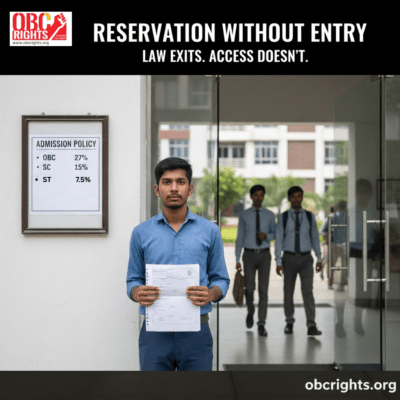
The proposed quotas are:
- 27% for OBCs
- 15% for SCs
- 7.5% for STs
These would apply only to non-minority private institutions, as minority institutions are protected under Article 30 of the Constitution.
Constitutional and Legal Foundation
Article 15(5): The Key Provision
The 93rd Constitutional Amendment Act of 2005 added Article 15(5) to the Indian Constitution. This provision empowers the State to make special provisions for the advancement of SCs, STs, and OBCs even in private, unaided educational institutions (excluding minority institutions).
Supreme Court Judgments
The legal position is clear:
- P.A. Inamdar (2005): Private unaided institutions were initially exempt from reservations.
- 93rd Amendment (2005): Overruled this judgment by constitutional change.
- Ashok Kumar Thakur (2008) & Indian Medical Association (2011): Upheld OBC reservation when backed by law.
- Pramati Trust (2014): Confirmed Article 15(5) as constitutional and valid.
- EWS Quota Judgment (2022): Even economic reservation applies to private institutions.
Important point:
Reservation in private institutions is constitutionally allowed, but not automatic. A law is required to enforce it.
Why Reservation in Private Institutions Is Necessary Today
1. Private Sector Dominates Higher Education
- Over 78% of colleges and 500+ universities in India are private.
- Between 2014 and 2022, 84% of higher education expansion happened outside public institutions.
- Private colleges dominate professional courses like MBBS, engineering, law, and management.
- Without reservation in this sector, social justice remains limited to shrinking public spaces.
2. Severe Underrepresentation of Marginalised Groups
Data presented to Parliament shows:
In the top private “Institutions of Eminence”:
- SC students: ~0.9%
- ST students: ~0.5%
- OBC students: ~11%
This is far below their population share and even below public university levels.
3. High Fees Create an Invisible Barrier
- Private medical and engineering fees often range from ₹10–25 lakh per year.
- Most SC/ST/OBC families cannot afford these costs, even if their children qualify academically.
- As a result, many talented students are forced into overcrowded or low-quality public colleges.
- Reservations without addressing fees are meaningless, but no reservation at all is still worse.
Parliamentary Standing Committee Report (2025):
The Parliamentary Committee on Education made three crucial recommendations:
- Mandate reservations in private higher education:
- 27% OBC, 15% SC, 7.5% ST
- The government should financially support reserved seats in private institutions, on the lines of how it reimburses schools for the 25% seats mandated under the Right to Education Act.
- Increase total seats and infrastructure, so general category seats are not reduced.
This is the first time a parliamentary body clearly linked reservation with public funding, making the proposal more practical.
The Real Reasons Behind Resistance to Reservation in Private Institutions
1. Profit Protection, Not Financial Burden
The core issue is not sustainability but profit margins. Many private institutions operate as commercial enterprises under a “non-profit” label. Reservation threatens high-fee seats, management quotas, and capitation income. Though Non- profit organizations/trusts run private institution, they function as Commercial establishments only.
2. Control Over Admissions = Power
Admissions are the main source of institutional power. Reservation reduces management discretion, limits elite capture, and disrupts caste- and class-based gatekeeping networks.
3. Fear of Social Mixing
Elite resistance is driven by discomfort with inclusive campuses. The unspoken fear is not academic decline, but loss of social exclusivity in professional spaces.
4. Political Ownership: The Unspoken Barrier
A major but rarely discussed reason for resistance is that a significant number of private educational institutions are owned or controlled by political leaders, their families, or close associates. This creates a direct conflict of interest:
- Lawmakers who should pass reservation laws are often stakeholders in private colleges.
- Policies that enforce reservation would reduce their financial control over admissions and fees.
- As a result, reforms are delayed, diluted, or indefinitely “under review.” Mostly OBC Reservation remains only on paper.
Student-Level Impact: What Leaders Ignore
For a first-generation SC/ST/OBC student, reservation in private institutions means:
- Access to better infrastructure and faculty
- Entry into elite professional networks
- Higher chances of upward social mobility
Without it, private education becomes a closed space for the privileged.
A Practical Way Forward:
1. National Law under Article 15(5):
Without a binding central law, reservations in private institutions will remain optional and politically convenient. Parliament must stop delaying and clearly mandate quotas, instead of hiding behind “autonomy” arguments.
2. Government-Funded Seat Expansion:
Claims of financial burden are used to block reform. If the state can fund private schools under RTE, it can reimburse private colleges too, lack of funding is a policy choice, not a constraint.
3. Regulation & Transparency:
Mandatory caste-wise admission data and annual audits by UGC/NMC are essential to expose exclusion.
For more such analysis, visit our website: https://obcrights.org/.