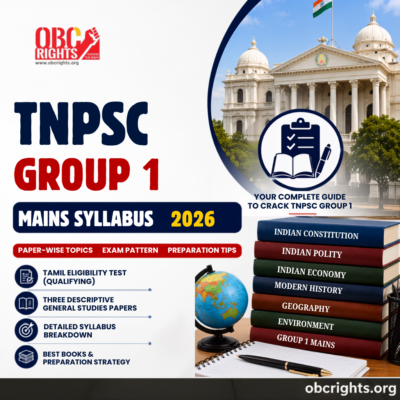
The TNPSC Group 1 Mains Syllabus outlines the subjects and topics candidates must prepare for the descriptive stage of the Group 1 recruitment process. Covering the Tamil Eligibility Test and three General Studies papers, the syllabus helps candidates plan their preparation, choose the right study resources, and focus on the topics prescribed by TNPSC. This guide provides the latest paper-wise syllabus, exam pattern, preparation tips, and official syllabus information in one place.
TNPSC Group 1 Mains Syllabus 2026: Highlights
| Particular | Details |
| Conducting Body | Tamil Nadu Public Service Commission (TNPSC) |
| Examination Stage | Main Examination |
| Examination Mode | Offline |
| Question Type | Descriptive |
| Papers | Tamil Eligibility Test + Three General Studies Papers |
| Written Examination Marks | 750 |
| Interview Marks | 100 |
| Standard | Degree Standard |
| Official Website | www.tnpsc.gov.in |
This article covers only the TNPSC Group 1 Preliminary Examination syllabus. For a complete overview of the recruitment process – including the Main Examination syllabus, exam pattern, recommended books, view our detailed guide.
👉 View Complete TNPSC Group 1 Syllabus 2026
TNPSC Group 1 Mains Exam Pattern 2026
The Main Examination consists of one qualifying Tamil Eligibility Test followed by three descriptive General Studies papers. Candidates who satisfy the qualifying requirements in the Tamil paper have their General Studies papers evaluated as per the TNPSC rules.
| Paper | Subject | Marks |
| Paper I | Tamil Eligibility Test (Qualifying) | 100 |
| Paper II | General Studies Paper I | 250 |
| Paper III | General Studies Paper II | 250 |
| Paper IV | General Studies Paper III | 250 |
Preparation Tip
Unlike the Preliminary Examination, the Main Examination focuses on descriptive answers rather than objective questions. Building conceptual clarity, organising ideas logically, and presenting well-structured answers are essential for performing well in the written examination.
TNPSC Group 1 Mains Syllabus 2026
The TNPSC Group 1 Mains Syllabus 2026 is divided into four papers. The first paper is a Tamil Eligibility Test, while the remaining three papers cover various General Studies subjects through descriptive questions. Each paper assesses a candidate’s ability to analyse issues, organise thoughts, and communicate ideas clearly.
Paper I: Tamil Eligibility Test Syllabus
The Tamil Eligibility Test is a qualifying paper conducted to assess a candidate’s proficiency in the Tamil language. Although its marks are not added to the final written score, candidates must secure the prescribed qualifying marks for the evaluation of the remaining papers as per the TNPSC notification.
| Subject | Key Topics | Study Approach |
| Grammar | Sentence structure, language usage and grammatical rules | Revise grammar fundamentals and practise sentence correction exercises. |
| Vocabulary | Word meanings, usage and language development | Improve vocabulary through regular reading and revision. |
| Reading Comprehension | Passage-based questions and comprehension skills | Practise identifying key ideas and answering comprehension-based questions accurately. |
| Writing Skills | Letter writing, précis writing and structured responses | Focus on clarity, organisation and correct language usage while writing. |
| Literature | Prescribed Tamil literary topics and language appreciation | Revise important literary themes and understand the context of prescribed works. |
Preparation Tip: Consistent practice is more effective than last-minute revision. Reading Tamil newspapers, editorials, and standard reference materials can strengthen vocabulary, comprehension, and writing skills required for the qualifying paper.
Paper II: General Studies Paper I
General Studies Paper I examines a candidate’s understanding of Modern Indian History, Indian Culture, Social Issues, and Ethics. Rather than testing factual recall alone, the paper evaluates the ability to analyse historical developments, social challenges, and ethical issues from an administrative perspective.
| Subject | Key Topics | Study Approach |
| Modern Indian History | Freedom Movement, Nationalism, Social Reform Movements and Independence | Study events chronologically and understand their impact on India’s political and social development. |
| Indian Culture | Heritage, Literature, Architecture, Art and Cultural Traditions | Integrate culture with historical events for better conceptual understanding. |
| Social Issues | Education, Women, Social Justice, Poverty, Inclusion and Welfare | Relate topics to contemporary government initiatives and recent developments. |
| Ethics | Integrity, Accountability, Public Service Values and Ethical Governance | Practise analytical and case-based answers instead of memorising definitions. |
Preparation Tip: General Studies Paper I rewards analytical thinking. While preparing, focus on explaining the significance of events and issues instead of simply listing facts.
Paper III: General Studies Paper II
General Studies Paper II includes topics related to the Indian Constitution, Governance, Science & Technology, and Tamil Society, helping candidates understand their significance in governance and administrative decision-making. The paper evaluates a candidate’s understanding of constitutional principles, public administration, technological developments, and social issues that influence governance. Questions generally require well-structured answers supported by relevant examples and logical reasoning.
| Subject | Key Topics | Study Approach |
| Indian Constitution | Evolution of the Constitution, Preamble, Fundamental Rights, Directive Principles of State Policy, Union and State Governments, Judicial System | Develop a clear understanding of constitutional concepts and governance principles instead of relying solely on memorising Articles and provisions. |
| Governance | Public Administration, Government Policies, Local Governance, Citizen-Centric Administration | Connect governance concepts with recent government initiatives and administrative reforms. |
| Science & Technology | Emerging Scientific Developments, Digital Governance, Biotechnology, Space Research, Innovation and Modern Technologies | Focus on recent scientific advancements and learn how technological innovations influence governance, public services, and national development. |
| Tamil Society | Social Structure, Social Justice, Culture, Development and Contemporary Issues | Relate social topics to Tamil Nadu’s development, welfare programmes and current issues. |
Preparation Tip: Many topics in this paper are linked with current affairs. While studying the static syllabus, note recent government initiatives, constitutional developments, and technological advancements that can strengthen your descriptive answers.
Paper IV: General Studies Paper III
General Studies Paper III covers Geography, Environment, Disaster Management, and the Indian Economy. Candidates are expected to demonstrate a clear understanding of economic and environmental issues, geographical concepts, and their relevance to public administration and policy-making.
| Subject | Key Topics | Study Approach |
| Geography | Physical Geography, Indian Geography, Tamil Nadu Geography, Natural Resources and Agriculture | Use maps, diagrams and real-world examples to improve conceptual understanding and answer presentation. |
| Environment | Ecology, Biodiversity, Climate Change, Environmental Conservation and Sustainable Development | Link environmental concepts with current environmental challenges, government initiatives and international commitments. |
| Disaster Management | Disaster Preparedness, Mitigation, Response and Recovery | Study disaster management through recent case studies and understand the role of government agencies during emergencies. |
| Indian Economy | Economic Development, Budget, Banking, Public Finance, Agriculture, Infrastructure and Welfare Schemes | Connect economic concepts with the latest Budget, economic policies and development programmes to write balanced answers. |
Preparation Tip: Instead of preparing Geography, Environment and Economy separately, connect them wherever possible. For example, understanding agriculture becomes easier when studied alongside climate, water resources, and rural development.
How to Make the Most of the TNPSC Group 1 Mains Syllabus?
Downloading the syllabus is only the first step. Using it as a structured preparation plan helps you complete every paper systematically and ensures that no prescribed topic is overlooked.
| Steps | Learning Plan |
| Step 1 | Read the latest official syllabus carefully and understand the scope of each paper. |
| Step 2 | Prepare concise topic-wise notes instead of relying only on textbooks. |
| Step 3 | Begin descriptive answer-writing practice soon after completing each subject. |
| Step 4 | Analyse previous year question papers to understand recurring themes and question patterns. |
| Step 5 | Revise regularly and improve answer presentation using headings, subheadings and relevant examples. |
Preparation Tip: Keep a printed copy of the official syllabus and tick off each topic after completing it. This simple habit helps you track your progress and ensures your preparation stays aligned with the prescribed syllabus.
Common Mistakes to Avoid During TNPSC Group 1 Mains Preparation
Many candidates complete the syllabus but struggle in the Main Examination because of poor preparation strategies. Avoiding these common mistakes can improve both answer quality and overall performance.
| Common Mistake | Better Approach |
| Memorising facts without understanding concepts | Focus on analysing topics and explaining them in your own words. |
| Delaying answer-writing practice | Start writing descriptive answers soon after completing each subject. |
| Referring to too many books | Complete one reliable source before using additional references. |
| Ignoring current affairs | Connect static topics with recent government policies and important developments. |
| Skipping regular revision | Revise completed topics consistently to improve retention and answer quality. |
Preparation Tip: The Main Examination rewards well-structured, analytical answers. Present your responses using clear introductions, relevant examples, and logical conclusions wherever appropriate.
Recommended Books for TNPSC Group 1 Mains
Selecting the right study material is as important as following the official syllabus. Begin with Tamil Nadu State Board textbooks and supplement them with standard reference books for subjects that require deeper conceptual understanding.
| Subject | Recommended Books |
| History | Samacheer Kalvi History Textbooks and standard reference books |
| Indian Polity | Indian Polity by M. Laxmikanth |
| Indian Economy | Indian Economy by Ramesh Singh |
| Geography | Samacheer Kalvi and NCERT Geography Books |
| Environment | Standard Environment reference books and government publications |
| Ethics | Ethics reference books and descriptive practice materials |
| Current Affairs | Monthly Current Affairs compilations and official government publications |
Book Selection Tip: Avoid collecting multiple books for the same subject. Completing one trusted resource thoroughly is usually more effective than reading several books superficially.
Official TNPSC Group 1 Mains Syllabus
The syllabus discussed in this guide is based on the latest syllabus published by the Tamil Nadu Public Service Commission. Candidates should always verify updates through the official notification. For the complete official syllabus, visit the TNPSC Group 1 Syllabus page on our website, where you’ll also find links to the latest notification and other preparation resources.
👉 View Official TNPSC Group 1 Syllabus
Frequently Asked Questions
1. What papers are included in the TNPSC Group 1 Main Examination?
The Main Examination includes a qualifying Tamil Eligibility Test followed by three descriptive General Studies papers that assess candidates across subjects such as History, Constitution, Governance, Science & Technology, Geography, Environment, and the Indian Economy.
2. Is the Tamil Eligibility Test compulsory?
Yes. The Tamil Eligibility Test is a qualifying paper. Candidates must secure the minimum qualifying marks prescribed by TNPSC for the evaluation of the remaining General Studies papers.
3. Are all TNPSC Group 1 Mains papers descriptive?
Yes. Except for the qualifying Tamil Eligibility Test, the Main Examination is conducted using descriptive answer writing to assess a candidate’s analytical ability, conceptual understanding, and communication skills.
4. Do the marks obtained in the Main Examination count towards the final selection?
Yes. The marks secured in the descriptive General Studies papers form an important part of the final selection process, along with the interview, as per the applicable TNPSC recruitment rules.
5. Which books should I refer to for TNPSC Group 1 Mains preparation?
Tamil Nadu State Board (Samacheer Kalvi) textbooks provide the foundation for many subjects. Candidates should also refer to standard books for Polity, Economy, Geography, Ethics, and Current Affairs based on the official syllabus.
6. When should I start answer-writing practice for the Main Examination?
Begin practising descriptive answers as soon as you complete the basic concepts of each subject. Regular answer-writing helps improve structure, clarity, time management, and presentation.
Conclusion
The TNPSC Group 1 Mains Syllabus 2026 serves as the foundation for preparing the descriptive stage of the examination. Understanding the syllabus helps you organise your study plan, choose appropriate study materials, and focus on topics prescribed by the Tamil Nadu Public Service Commission.
Use the official syllabus as your preparation checklist, strengthen your conceptual understanding, and practise descriptive answer writing consistently. Combining disciplined revision with regular practice and reliable study resources will help you approach the Main Examination with greater confidence and improve your chances of success.
Need Help with TNPSC Group 1 Preparation?
Understanding the syllabus is only the first step. Consistent practice is equally important for success in the Main Examination.
At OBCRIGHTS, you can access TNPSC preparation materials, beginner-friendly mock tests, and study resources designed to help you strengthen your concepts, improve answer writing, and prepare with confidence.