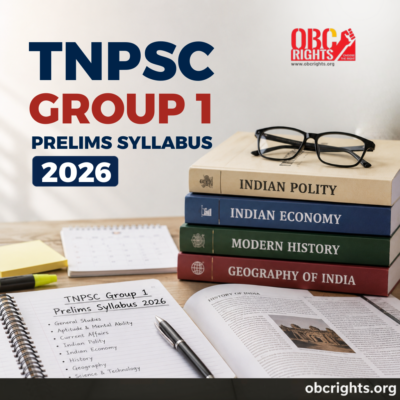
The TNPSC Group 1 Preliminary Examination is the first stage of the Group 1 recruitment process conducted by the Tamil Nadu Public Service Commission (TNPSC). The Preliminary Examination serves as the qualifying stage that evaluates candidates’ understanding of General Studies and Aptitude & Mental Ability before determining eligibility for the Main Examination.
Understanding the latest TNPSC Group 1 Prelims Syllabus 2026 is the first step towards effective preparation. It helps you identify the prescribed subjects, select appropriate study materials, and create a focused study plan without spending time on topics outside the syllabus.
This guide provides a subject-wise overview of the latest Preliminary syllabus, exam pattern, important topics, official PDF, and practical preparation insights to help you prepare with confidence.
TNPSC Group 1 Prelims Exam Syllabus 2026: Highlights
| Particular | Details |
| Conducting Body | Tamil Nadu Public Service Commission (TNPSC) |
| Examination Stage | Preliminary Examination |
| Examination Mode | Offline (OMR Based) |
| Question Type | Multiple Choice Questions (MCQs) |
| Total Questions | 200 |
| Maximum Marks | 300 |
| Duration | 3 Hours |
| Negative Marking | No |
| General Studies Standard | Degree Standard |
| Aptitude & Mental Ability Standard | SSLC Standard |
TNPSC Group 1 Prelims Exam Pattern 2026
The Preliminary Examination consists of a single objective-type paper comprising General Studies and Aptitude & Mental Ability. Although the marks obtained in this stage are not considered for the final merit list, qualifying the Preliminary Examination is mandatory to appear for the Main Examination.
| Particular | Details |
| Mode of Examination | Offline (OMR) |
| Question Type | Objective (MCQ) |
| Total Questions | 200 |
| Maximum Marks | 300 |
| Duration | 3 Hours |
| Negative Marking | No |
Preparation Insight: Since there is no negative marking, candidates can attempt every question. However, maintaining good accuracy is equally important because the Preliminary Examination is highly competitive and the cut-off varies each year.
Want to understand the entire recruitment process? Read our TNPSC Group 1 Syllabus 2026 guide for a complete overview of the Preliminary Examination, Main Examination, interview, and preparation resources.
TNPSC Group 1 Prelims Syllabus 2026
The TNPSC Group 1 Preliminary Examination syllabus consists of two sections:
- General Studies (Degree Standard)
- Aptitude & Mental Ability (SSLC Standard)
The General Studies section covers subjects ranging from science and history to polity, economy, geography, and current affairs, while the Aptitude section evaluates numerical ability and logical reasoning.
General Science Syllabus
The General Science section evaluates your understanding of basic scientific principles and their practical applications in everyday life.
| Area | Topics Covered |
| Physics | Motion, Energy, Electricity, Magnetism, Heat, Light and Sound |
| Chemistry | Matter, Elements, Compounds, Acids, Bases, Salts and Chemical Reactions |
| Biology | Human Body, Plant Biology, Zoology, Genetics, Nutrition |
| Environment | Ecosystem, Biodiversity, Pollution, Climate Change and Conservation |
| Biotechnology | Basic Concepts and Applications of Biotechnology |
| Space Science | Indian Space Programme, Satellites and Space Technology |
| Scientific Developments | Recent Scientific Innovations and Emerging Technologies |
Preparation Insight: Most questions focus on applying scientific concepts and understanding recent advancements rather than recalling isolated facts.
Geography Syllabus
The Geography section tests your knowledge of physical geography, natural resources, environmental issues, and the geographical features of India and Tamil Nadu.
| Area | Topics Covered |
| Physical Geography | Earth Structure, Landforms and Geographical Features |
| Climate | Weather, Monsoon, Rainfall and Climatic Conditions |
| Agriculture | Crops, Irrigation, Soil Types and Agricultural Practices |
| Natural Resources | Forests, Minerals, Water Resources and Energy Sources |
| Disaster Management | Floods, Cyclones, Earthquakes and Disaster Preparedness |
| Environment | Environmental Conservation and Sustainable Development |
| India & Tamil Nadu Geography | Rivers, Industries, Population, Transport and Resources |
Preparation Insight: Pay special attention to the geography of Tamil Nadu, including river systems, agriculture, industries, and natural resources, as these topics are often linked with current affairs.
Indian History Syllabus
This section covers India’s historical journey from early civilizations to Independence, while highlighting significant social reforms and cultural contributions.
| Area | Topics Covered |
| Ancient India | Early Indian Civilizations, Vedic Society, Mauryan Rule and the Gupta Period |
| Medieval India | Major Medieval Dynasties, Mughal Rule, and Important Regional Powers |
| Modern India | British Administration and Colonial Rule |
| Freedom Movement | Revolt of 1857, Indian National Movement and Independence |
| Social Reform | Reform Movements and Contributions of National Leaders |
| Art & Culture | India’s Architectural Heritage, Literary Traditions, Classical Dance Forms and Music |
Preparation Insight: Build a clear understanding of how historical events are connected instead of relying solely on memorising years and dates. This approach makes it easier to analyse questions and retain concepts.
Indian Polity Syllabus
Indian Polity evaluates your understanding of the Constitution, democratic institutions, governance, and the functioning of the Indian political system.
| Area | Topics Covered |
| Constitution | Historical Background, Features and Preamble |
| Fundamental Rights | Rights, Duties and Directive Principles |
| Union Government | President, Prime Minister, Parliament and Union Administration |
| State Government | Governor, Chief Minister and State Legislature |
| Judiciary | Supreme Court, High Courts and Judicial System |
| Local Government | Panchayats, Municipalities and Urban Local Bodies |
| Constitutional Bodies | Election Commission, Finance Commission and Other Institutions |
Preparation Insight: Develop conceptual clarity on constitutional provisions and governance rather than memorising articles alone. Understanding how institutions function is equally important.
Indian Economy Syllabus
The Economy section assesses your understanding of India’s economic system, development policies, banking, public finance, and government welfare initiatives.
| Area | Topics Covered |
| Economic Development | Growth, Planning and Sustainable Development |
| Agriculture | Agricultural Economy, Rural Development and Allied Activities |
| Banking | Reserve Bank of India, Commercial Banks and Financial Institutions |
| Inflation | Inflation, Monetary Policy and Price Stability |
| Budget & Taxation | Public Finance, GST Framework, Direct and Indirect Tax Systems |
| Employment | Poverty, Unemployment and Skill Development |
| Government Schemes | Major Central and Tamil Nadu Welfare Programmes |
Preparation Insight: Connect economic concepts with recent government policies, Budget announcements, and welfare programmes. Understanding the application of these concepts makes revision easier and improves retention.
Tamil Nadu History & Culture Syllabus
The Tamil Nadu History & Culture section evaluates your understanding of the state’s historical evolution, cultural traditions, literary heritage, social reform movements, and administrative developments. Since TNPSC places considerable emphasis on Tamil Nadu-specific topics, candidates should prepare this section alongside Indian History.
| Area | Topics Covered |
| Sangam Age | Society, Administration, Economy and Literature |
| Tamil Kingdoms | Cheras, Cholas, Pandyas and Pallavas |
| Bhakti Movement | Saivism, Vaishnavism and Religious Developments |
| Literature | Sangam Literature, Tamil Epics and Classical Works |
| Temple Architecture | Dravidian Architecture and Heritage Monuments |
| Social Reform | Periyar, Bharathiyar, Bharathidasan and Other Reformers |
| Art & Culture | Dance, Music, Festivals, Folk Arts and Cultural Heritage |
Preparation Insight: Do not prepare Tamil Nadu History separately from Indian History. Many historical developments are interconnected, making integrated preparation more effective.
Current Affairs Syllabus
Current Affairs assesses your awareness of recent developments at the state, national, and international levels. Questions are generally based on significant events that have social, economic, political, scientific, and environmental relevance.
| Area | Topics Covered |
| National Affairs | Government Policies, Economy, Parliament and Important Events |
| Tamil Nadu Affairs | State Government Schemes, Welfare Initiatives and Major Developments |
| International Affairs | Global Organisations, International Relations and Summits |
| Science & Technology | Scientific Innovations, ISRO Missions and Emerging Technologies |
| Economy | Banking, Budget, Financial Institutions and Economic Policies |
| Environment | Climate Change, Biodiversity and Environmental Conservation |
| Sports & Awards | National and International Sports Events, Awards and Honours |
Preparation Insight: Monthly revision is more effective than reading daily news repeatedly. Prioritise official government initiatives, major policy decisions, and important developments related to Tamil Nadu.
Aptitude & Mental Ability Syllabus
The Aptitude & Mental Ability section measures your ability to solve numerical problems, think logically, analyse information, and make accurate decisions within a limited time.
| Area | Topics Covered |
| Arithmetic | Percentage, Ratio, Profit & Loss, Simple & Compound Interest |
| Time-Based Problems | Time & Work, Pipes & Cisterns, Time, Speed & Distance |
| Data Interpretation | Tables, Graphs, Charts and Basic Data Analysis |
| Logical Reasoning | Coding-Decoding, Blood Relations, Direction Sense and Series |
| Analytical Ability | Number Series, Puzzles and Logical Thinking |
| Numerical Ability | Average, Simplification and Basic Mathematics |
Preparation Insight: Accuracy and regular practice are the keys to scoring well in Aptitude. Solve timed practice questions regularly to improve speed and confidence.
Key Focus Areas for TNPSC Group 1 Prelims Preparation
Although every topic prescribed by TNPSC is important, some areas consistently require greater attention because of their broad coverage and conceptual importance.
| Subject | Priority Areas |
| Indian Polity | Constitution, Fundamental Rights, Parliament, Judiciary and Local Government |
| Indian Economy | Budget, Inflation, Banking, Agriculture and Government Schemes |
| Indian History | Modern India, Freedom Movement and Social Reformers |
| Geography | Climate, Agriculture, Water Resources and Disaster Management |
| General Science | Biology, Environment, Space Science and Scientific Developments |
| Tamil Nadu History | Sangam Age, Cholas, Temple Architecture and Reform Movements |
| Current Affairs | Tamil Nadu, Economy, Science & Technology and Government Policies |
| Aptitude | Arithmetic, Logical Reasoning and Data Interpretation |
Important Note: These are preparation priorities based on the breadth of the syllabus. Candidates should complete the entire official syllabus rather than focusing only on selected topics.
Steps to Plan Your Preparation Using the TNPSC Group 1 Prelims Syllabus?
Downloading the syllabus is only the starting point. Using it as a study checklist helps you complete every subject systematically and keeps your preparation aligned with the official syllabus.
| Step | What You Should Do |
| Step 1 | Download the latest TNPSC Group 1 Prelims syllabus and understand every prescribed subject. |
| Step 2 | Review the exam pattern and identify the subjects that require more preparation time. |
| Step 3 | Complete the relevant Samacheer Kalvi textbooks before referring to additional books. |
| Step 4 | Use one standard reference book for each subject to strengthen conceptual understanding. |
| Step 5 | Solve previous year question papers after completing each subject. |
| Step 6 | Attempt mock tests regularly to improve speed, accuracy and time management. |
| Step 7 | Revise completed topics consistently and focus on improving weaker subjects. |
Preparation Tip: Keep the official syllabus beside your study materials and mark each topic after completing it. This simple approach helps you monitor your progress and ensures that no prescribed topic is overlooked.
Recommended Books for TNPSC Group 1 Prelims
Choosing reliable study material is essential for effective preparation. Begin with Tamil Nadu State Board textbooks and supplement them with standard reference books wherever required.
| Subject | Recommended Books |
| General Science | Samacheer Kalvi Science Textbooks |
| Indian History | Samacheer Kalvi History Textbooks |
| Indian Polity | Indian Polity – M. Laxmikanth |
| Indian Economy | Indian Economy – Ramesh Singh |
| Geography | Samacheer Kalvi & NCERT Geography Books |
| Current Affairs | Monthly Current Affairs Compilations |
| Aptitude & Mental Ability | R.S. Aggarwal (Quantitative Aptitude) or equivalent practice books |
Download TNPSC Group 1 Prelims Syllabus 2026 PDF
The official TNPSC Group 1 Prelims Syllabus 2026 is published by the Tamil Nadu Public Service Commission (TNPSC) along with the recruitment notification. Candidates should always refer to the latest official syllabus before beginning their preparation to ensure they cover all the prescribed topics.
View the Official TNPSC Group 1 Prelims Syllabus
Frequently Asked Questions on TNPSC Group 1
1. What subjects are included in the TNPSC Group 1 Preliminary Examination?
The Preliminary Examination includes General Science, Geography, Indian History, Indian Polity, Indian Economy, Tamil Nadu History & Culture, Current Affairs, and Aptitude & Mental Ability.
2. What is the standard of questions in the TNPSC Group 1 Preliminary Examination?
General Studies questions are based on the Degree standard, while Aptitude & Mental Ability questions follow the SSLC standard.
3. Does the TNPSC Group 1 Preliminary Examination have negative marking?
No. TNPSC does not deduct marks for incorrect answers in the Preliminary Examination.
4. Are Tamil Nadu State Board (Samacheer Kalvi) textbooks enough for preparation?
Samacheer Kalvi textbooks provide the foundation for many syllabus topics. Candidates should also use standard reference books and reliable current affairs resources for comprehensive preparation.
5. Where can I download the TNPSC Group 1 Prelims Syllabus PDF?
The latest syllabus PDF is available on the official website of the Tamil Nadu Public Service Commission after the release of the recruitment notification.
6. How should I begin preparing for the TNPSC Group 1 Preliminary Examination?
Start by understanding the official syllabus and exam pattern, complete the prescribed textbooks, practise previous year question papers, attempt mock tests regularly, and revise the syllabus consistently.
Conclusion
The TNPSC Group 1 Prelims Syllabus 2026 serves as the foundation for your preparation and helps you identify the subjects and topics prescribed for the Preliminary Examination. Preparing according to the official syllabus enables you to organise your studies efficiently, avoid unnecessary topics, and build a strong conceptual understanding of every subject.
Use the syllabus as a preparation checklist, complete each subject in a planned manner, practise previous year question papers, and revise regularly. A disciplined approach based on the latest official syllabus will help you prepare confidently for the TNPSC Group 1 Preliminary Examination.