A Pollution Under Control (PUC) Certificate is an important document for vehicle owners in India. It confirms that a vehicle’s exhaust emissions are within the pollution limits prescribed under applicable regulations. Vehicle owners must obtain a valid certificate after the applicable initial exemption period and renew it as required.
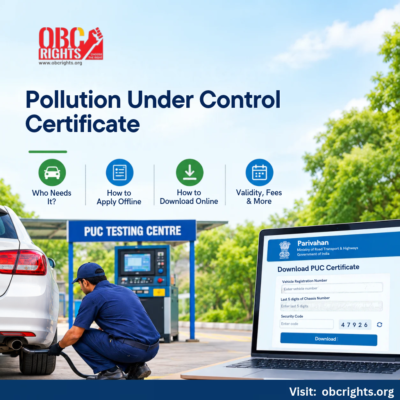
The PUC Certificate is obtained through an authorised pollution testing centre, where the vehicle undergoes a physical emission test. Once issued, the certificate can also be accessed and downloaded online through the Parivahan portal.
What Is a Pollution Under Control Certificate?
A Pollution Under Control Certificate (PUCC) is an official document issued after testing a vehicle’s exhaust emissions. It records whether the vehicle meets the prescribed emission standards.
The certificate helps monitor vehicle pollution and encourages owners to maintain their vehicles in proper working condition. It includes details such as the vehicle registration number, emission test results, issue date and validity period.
Who Needs a PUC Certificate?
Most petrol, diesel, CNG and LPG vehicles operating on public roads in India require a valid PUC Certificate after the applicable initial exemption period.
This includes:
- Two-wheelers: Motorcycles and scooters
- Four-wheelers: Private cars and other applicable vehicles
- Commercial vehicles: Taxis, buses, trucks and other applicable transport vehicles
Battery-operated electric vehicles that do not produce exhaust emissions are generally exempt from PUC testing.
Meet legal requirements for operating a vehicle on public roads. Vehicle owners should also ensure their driving licence is valid by following the driving licence renewal process when required.
How to Apply for a PUC Certificate Offline?
A new PUC Certificate requires the vehicle to undergo an emission test at an authorised PUC testing centre. Follow these steps:
- Find a testing centre: Visit an authorised PUC centre, which may be available at a fuel station or another approved location.
- Take your vehicle: Bring your vehicle to the testing centre for an emission test.
- Provide vehicle details: Share your vehicle registration details and any other information requested by the operator.
- Complete the emission test: The operator uses authorised testing equipment to measure the vehicle’s exhaust emissions.
- Receive the certificate: If the vehicle meets the prescribed emission limits, the testing centre records the result and issues the PUC Certificate.
If the vehicle fails the test, get it inspected and repaired as necessary before undergoing another emission test.
Note: To find an authorised PUC testing centre near you, visit the List of PUC Testing Centres on the Parivahan Portal. Select your state and the relevant RTO office to view the available centres and their addresses. Confirm availability before visiting.
How to Download a PUC Certificate Online?
If your vehicle already has an issued PUC Certificate, you can retrieve it through the official Parivahan portal without visiting the testing centre again.
- Visit the Parivahan PUC portal.
- Enter your vehicle registration number.
- Enter the last five characters of your chassis number.
- Enter the security code displayed on the screen.
- Submit the details to view your PUC information.
- Download the available certificate for your records.
The online download facility is for accessing an existing certificate. It does not replace the physical emission test required to obtain a new certificate.
What Is the Validity of a PUC Certificate?
Under the Central Motor Vehicles Rules, a PUC Certificate is generally required after one year from the vehicle’s first registration. The prescribed validity is generally:
- BS-III and earlier applicable vehicles: Six months
- BS-IV and BS-VI vehicles: Twelve months
The actual validity depends on the applicable rules and vehicle category. Always check the expiry date mentioned on your certificate.
What Is the PUC Certificate Fee?
The PUC testing fee depends on the vehicle category, applicable state regulations and testing centre. Vehicle owners in Tamil Nadu should confirm the current fee at an authorised PUC centre before taking the test.
What Happens If a Vehicle Fails the PUC Test?
If a vehicle does not meet the prescribed emission limits, the testing centre will record the test result. The owner may need to service the engine, inspect the exhaust system or address other emission-related issues. The vehicle must undergo a subsequent test to obtain a valid certificate.
What Is the Penalty for Not Having a Valid PUC Certificate?
Driving a vehicle without a valid PUC Certificate, when required, can result in penalties under the Motor Vehicles Act, 1988. Under Section 190(2), violations relating to air pollution standards may attract a fine of up to ₹10,000 or imprisonment of up to three months, or both, along with possible licence disqualification, subject to the applicable legal provisions.
Frequently Asked Questions
1. Can I apply for a PUC Certificate online?
The vehicle must undergo a physical emission test at an authorised PUC centre to obtain a certificate. Online facilities may be available for related services, but they do not eliminate the required test.
2. Can I download my PUC Certificate without visiting a testing centre?
Yes. If a valid certificate has already been issued and its details are available in the system, you can download it through the Parivahan PUC portal.
3. Is a PUC Certificate mandatory for new vehicles?
A PUC Certificate is generally required after the first year from the vehicle’s initial registration, subject to applicable rules.
4. Is a PUC Certificate required for electric vehicles?
Battery-operated electric vehicles that produce no exhaust emissions are generally exempt from PUC testing.
Conclusion
A valid Pollution Under Control Certificate helps vehicle owners comply with emission regulations and monitor their vehicle’s pollution levels. Visit an authorised PUC testing centre to get your vehicle tested and obtain the certificate. You can then use the Parivahan portal to access and download your issued certificate online.