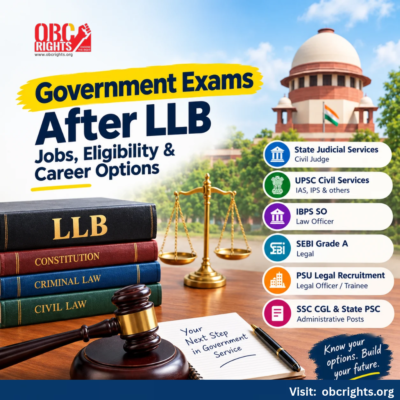
Government exams after LLB include State Judicial Services, UPSC Civil Services, SSC CGL, IBPS SO Law Officer and SEBI Grade A Legal recruitment. Law graduates can also explore Assistant Prosecution Officer and public sector undertaking (PSU) legal vacancies.
Some opportunities accept fresh graduates, while others require Bar Council enrolment or professional experience. The right examination depends on your qualifications and the type of government career you want.
Which Government Exams Can You Take After LLB?
Law graduates can apply for both law-specific government jobs and general graduate-level government examinations.
Here are the main options:
| Exam or recruitment | Job opportunity | Eligibility or selection route |
| State Judicial Services | Civil Judge | LLB; practice rules and selection depend on the applicable judicial directions and state recruitment |
| Assistant Prosecution Officer (APO) | Government prosecution | Law degree; state-specific examination and eligibility |
| IBPS SO Law Officer | Law Officer in a public sector bank | LLB and Bar Council enrolment; competitive examination |
| SEBI Grade A Legal | Assistant Manager (Legal) | Law degree; recruitment examination and interview |
| PSU Legal Recruitment | Legal Officer / Officer Trainee | Organisation-specific process; some use CLAT PG scores |
| UPSC Civil Services | IAS, IPS and other services | Recognised degree; Civil Services Examination |
| SSC CGL | Various central government posts | Recognised degree; post-specific eligibility and examination |
| State PSC Examinations | State government administrative posts | State-specific recruitment conditions |
Not every vacancy is announced annually. Candidates should check official recruitment websites rather than assume that all these examinations are currently accepting applications.
Which Government Exams After LLB Are Open to Freshers?
Government jobs after LLB for freshers are available through recruitment processes that do not require previous legal work experience.
Fresh law graduates can consider:
- UPSC Civil Services and SSC CGL: General graduate-level examinations where an eligible LLB holder can apply.
- SEBI Grade A Legal: A law-specific opportunity where the law degree is central to eligibility.
- State Judicial Services: Subject to the applicable recruitment notification and the Supreme Court’s current practice directions.
- Eligible PSU legal trainee vacancies: Where the organisation accepts fresh law graduates and any required entrance scores.
Candidates who have enrolled with a State Bar Council can also consider IBPS SO Law Officer, subject to the recruitment conditions.
The key is to distinguish having an LLB degree from satisfying every condition for a particular post.
Judiciary Exam After LLB: Can You Become a Civil Judge?
State Judicial Services examinations recruit eligible candidates for entry-level judicial posts, including Civil Judge (Junior Division).
Recruitment generally involves preliminary and main written examinations followed by an interview, although the exact process depends on the state.
What Are the Latest Judiciary Eligibility Rules?
The Supreme Court modified the legal-practice requirement through its judgment dated 21 August 2026.
The applicable rules depend on when the recruitment is notified:
- Notifications issued up to 31 March 2027: Law graduates can apply without satisfying the earlier three-year practice requirement, subject to other eligibility conditions.
- Notifications issued on or after 1 April 2027: Candidates must have at least one year of actual District Court practice, supported by the required certification.
Selected candidates must complete the prescribed judicial academy training and supervised clerkship before regular judicial service.
Therefore, fresh graduates should not rely on older advice stating that three years of practice is always compulsory.
Check the recruitment notice issued by the relevant High Court or State Public Service Commission and read the Supreme Court’s August 2026 judgment.
Law Officer and Legal Government Recruitment After LLB
For graduates who want to use their legal education directly, the following recruitment routes are particularly relevant.
1. IBPS SO Law Officer
- The Institute of Banking Personnel Selection recruits Law Officers (Scale I) for participating public sector banks.
- Candidates need an LLB degree and enrolment as an advocate with a Bar Council. Selection involves a preliminary examination, main examination and interview under the applicable recruitment process.
- Check the IBPS official website for notifications and eligibility conditions.
2. SEBI Grade A Legal
- The Securities and Exchange Board of India recruits Assistant Managers through its Legal Stream.
- The essential educational qualification is a bachelor’s degree in law from a recognised institution. Candidates are selected through the recruitment stages specified by SEBI, including examinations and interviews.
- This is an option for law graduates interested in securities regulation, legal research and regulatory work.
- Visit SEBI recruitment for the latest vacancies.
3. PSU Legal Officer Recruitment
- Public sector undertakings recruit law graduates for legal and trainee positions.
- Some organisations use CLAT PG scores as part of their recruitment process. For example, POWERGRID used CLAT 2026 PG scores for its Officer Trainee (Law) recruitment.
- However, CLAT PG is not itself a government job examination. It is an entrance examination whose scores may be accepted by certain recruiting organisations.
- Candidates should check the POWERGRID careers page and other PSU recruitment notices for qualification, score and selection requirements.
4. Assistant Prosecution Officer Recruitment
- State governments recruit Assistant Prosecution Officers or Assistant Public Prosecutors to perform legal work in criminal prosecution.
- Recruitment may be conducted through a State Public Service Commission or another designated authority.
- An LLB degree is generally central to eligibility, but age limits, language requirements, experience and selection stages differ between states.
- Candidates should follow their state’s official recruitment notifications.
Can LLB Graduates Apply for UPSC, SSC and State PSC Exams?
Yes. Government exams for law graduates are not limited to legal departments.
An eligible LLB graduate can appear for the UPSC Civil Services Examination because it accepts recognised degrees from different disciplines.
Similarly, SSC CGL offers access to various central government posts, while State Public Service Commissions recruit candidates for administrative and other state government positions.
These are general recruitment routes. A law degree may be useful preparation for certain subjects, but it does not automatically provide special preference.
Other Government Career Routes for Law Graduates
Two additional opportunities are worth knowing about, although neither should be confused with a standard permanent government job examination.
Supreme Court Law Clerk: The Supreme Court recruits Law Clerk-cum-Research Associates for short-term contractual assignments involving legal research and assistance. Selection follows its own examination and interview procedures.
Army JAG Entry: The Indian Army offers a legal officer entry route through the Judge Advocate General branch. The selection process, qualifications and additional entry requirements must be checked against the relevant Army notification.
Both routes have distinct eligibility and service conditions.
How to Choose the Right Government Exam After LLB?
Before starting preparation, ask yourself three questions:
- What career interests me? Judiciary, legal departments, banking, administration or defence?
- Am I eligible now? Check the required law degree, advocate enrolment, professional experience and age limits.
- How does selection work? Understand whether recruitment involves a written examination, interview, entrance score or another process.
Read the latest official notification before committing to an examination. Recruitment conditions and category-based relaxations may vary.
Frequently Asked Questions
Yes. Fresh law graduates can apply for vacancies that accept their qualifications without prior experience. UPSC, SSC CGL and certain specialist legal recruitments are possible options, subject to eligibility.
Yes. Both recognised three-year LLB degrees and five-year integrated law degrees can satisfy the law-degree requirement where the recruiting authority accepts them. Other eligibility conditions still apply.
No. CLAT PG scores are used by certain PSUs for legal recruitment, but many other government examinations have independent selection processes.
Conclusion
Government exams after LLB provide routes into judicial services, legal departments, banking, public sector organisations and administration.
Start by identifying the posts that interest you, checking whether you meet the eligibility requirements and understanding the recruitment process. A suitable choice begins with knowing which opportunities you can realistically apply for.
Official Sources
Information reviewed on 27 October 2026. Eligibility, vacancies, selection processes and relaxations must be confirmed through the relevant recruitment notification.