
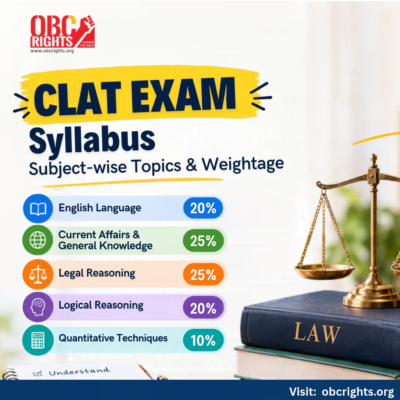
The CLAT Exam syllabus consists of five subjects: English Language, Current Affairs and General Knowledge, Legal Reasoning, Logical Reasoning, and Quantitative Techniques.
The undergraduate examination contains 120 multiple-choice questions carrying 120 marks, with two hours to complete the paper. The syllabus tests reading, comprehension, reasoning and numerical skills rather than memorisation alone.
Here is the official CLAT UG syllabus, subject-wise weightage and the topics students should focus on.
CLAT Exam Syllabus and Subject-Wise Weightage
The Consortium of National Law Universities has prescribed the following question distribution for CLAT UG.
| Subject | Approximate Questions | Weightage |
| English Language | 22–26 | 20% |
| Current Affairs & General Knowledge | 28–32 | 25% |
| Legal Reasoning | 28–32 | 25% |
| Logical Reasoning | 22–26 | 20% |
| Quantitative Techniques | 10–14 | 10% |
| Total | 120 | 100% |
Source: Consortium of NLUs – CLAT Question Format. The section-wise figures are approximate.
Legal Reasoning and Current Affairs together account for roughly half the examination. However, students should prepare for all five subjects rather than focusing only on the highest-weightage sections.
CLAT Exam Subject-Wise Syllabus
The CLAT UG syllabus focuses mainly on the ability to understand passages, interpret information and apply reasoning. The following sections explain what students are expected to know and practise.
1. English Language – 20%
The English section contains passages of approximately 450 words, taken from fiction and non-fiction writing.
Questions assess how well students understand the passage, rather than how many grammar rules they can memorise.
What to study:
- Reading comprehension and identifying the main idea
- Understanding the author’s arguments and viewpoints
- Drawing inferences and conclusions
- Summarising passages
- Comparing different opinions
- Understanding vocabulary in context
Preparation focus: Practise reading passages and answering questions using information from the text. Pay attention to the difference between what the author states directly and what can reasonably be inferred.
2. Current Affairs and General Knowledge – 25%
This section uses passages based on news reports, journalistic writing and other non-fiction sources.
It examines awareness of important developments in India and around the world.
What to study:
- Major national and international events
- International relations and developments
- Arts and culture
- Historical events with continuing importance
- Significant public and legal developments
Preparation focus: Read reliable newspapers and follow important events along with their background. Understanding why an event matters is more useful than remembering headlines alone.
The official syllabus does not prescribe a fixed list of current-affairs topics or months to study.
3. Legal Reasoning – 25%
Legal Reasoning is an important part of CLAT, but students do not need prior knowledge of law to attempt this section.
Questions are based on passages discussing legal situations, public policy or moral issues.
What to study:
- Identifying legal rules or principles from passages
- Understanding the facts of a given situation
- Applying a principle to different situations
- Analysing how changes in facts affect an outcome
- Understanding arguments involving law, rights and public policy
Preparation focus: Read the principle carefully before applying it to a situation.
For example, if a passage states that a person is responsible for damage only when a particular condition is satisfied, check whether that condition exists in the question’s facts before choosing an answer.
This is an illustrative reasoning example, not a question from an official CLAT paper.
4. Logical Reasoning – 20%
The Logical Reasoning section tests how well students analyse arguments and reach conclusions from information given in a passage.
Questions are generally based on short passages of approximately 450 words.
What to study:
- Identifying arguments, premises and conclusions
- Understanding assumptions
- Drawing logical inferences
- Strengthening and weakening arguments
- Recognising contradictions
- Comparing arguments and identifying relationships
Preparation focus: Learn to distinguish evidence from conclusions. When answering a question, check whether the selected option is supported by the passage rather than by personal assumptions.
Practising argument-based questions can help students become more accurate in this section.
5. Quantitative Techniques – 10%
Quantitative Techniques tests the ability to interpret numerical information and apply basic mathematics.
Questions may contain short passages, numerical facts or data that students must analyse before calculating an answer.
What to study:
- Ratios and proportions
- Basic algebra
- Mensuration
- Statistical estimation
- Numerical interpretation
- Mathematical calculations based on given data
The required mathematical operations are generally based on Class 10-level concepts.
Preparation focus: Practise identifying relevant numerical information before calculating. Students should be comfortable with percentages, ratios and interpreting data presented in different forms.
These additional practice suggestions support the official syllabus but are not a separate prescribed chapter list.
CLAT Exam Pattern and Marking Scheme
The CLAT UG 2027 examination follows this format:
| Exam Detail | CLAT |
| Examination mode | Offline (pen and paper) |
| Question type | Multiple-choice questions |
| Total questions | 120 |
| Maximum marks | 120 |
| Duration | 2 hours |
| Correct answer | +1 mark |
| Incorrect answer | −0.25 mark |
| Unattempted question | 0 marks |
The negative marking system makes accuracy important. Students should avoid answering solely through random guesses when they cannot evaluate the options.
What Should Students Focus on While Preparing for CLAT?
The official syllabus gives importance to comprehension and reasoning across multiple sections.
Students can prepare more effectively by following these approaches:
- Practise passage-based questions: English, Legal Reasoning and Logical Reasoning require careful reading and interpretation.
- Revise current affairs regularly: Understand important events and their background rather than memorising isolated facts.
- Strengthen basic mathematics: Focus on applying Class 10-level concepts to numerical information.
- Use timed practice papers: Check reading speed, question accuracy and areas where mistakes occur.
The subject weightage can guide preparation, but the time spent on each section should also depend on individual strengths and weaknesses.
Where Can You Find the Official CLAT Exam Syllabus?
Students can refer directly to the Consortium of National Law Universities for the prescribed syllabus and question format.
The CLAT postgraduate examination has a different syllabus covering Constitutional Law and other areas of law. The five subjects explained above apply to CLAT UG, for admission to five-year integrated law programmes.
Planning to Apply for CLAT 2027?
Now that you know the CLAT syllabus and exam pattern, check the eligibility requirements and registration process before applying.
Read our CLAT Eligibility and Application Process Guide to understand who can apply and how to complete the registration.
Frequently Asked Questions
1. Has the CLAT Exam syllabus changed?
The officially published CLAT UG syllabus retains the five-section structure and 120-question format. Students should follow the current Consortium syllabus instead of relying on reports of proposed changes.
2. Is mathematics compulsory in CLAT Exam?
Yes. Quantitative Techniques is one of the five sections in CLAT UG 2027. It accounts for approximately 10% of the question paper and tests the application of basic mathematics.
3. Do students need to study law before attempting CLAT?
No. Prior legal knowledge is not required for the Legal Reasoning section. Students must understand the principles given in the passage and apply them to the questions.
A clear understanding of the CLAT syllabus can help students identify what the examination actually tests and organise their preparation around the five official sections.
For CLAT eligibility and application guidance, refer to the relevant OBC Rights entrance-exam article once its published link has been verified.
