
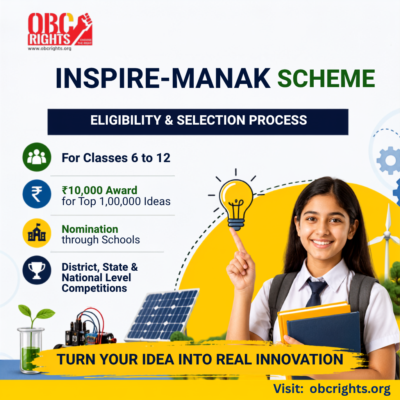
Every student has ideas that can make life easier, whether it’s saving water, reducing plastic waste, improving farming, or solving problems in their school or community. The INSPIRE-MANAK Scheme allows young innovators to turn those ideas into reality.
Launched by the Department of Science & Technology (DST), Government of India, the scheme encourages students from Classes 6 to 12 to think beyond textbooks and develop innovative solutions to real-life challenges. Instead of selecting students based only on academic performance, INSPIRE-MANAK recognizes creativity, scientific thinking, and practical problem-solving.
If you’re wondering who can participate, how schools nominate students, what the ₹10,000 award is for, and what happens after selection, this guide covers everything you need to know.
INSPIRE-MANAK Scheme 2026-27: Overview
| Detail | Information |
| Full form | Million Minds Augmenting National Aspirations and Knowledge |
| Run by | Department of Science & Technology (DST) |
| Implemented by | National Innovation Foundation – India (NIF) |
| Eligible classes | 6 to 12 |
| Award amount | ₹10,000 (Direct Benefit Transfer) |
| Nominations per school | Up to 5 |
| Class 11–12 limit | Max. 2 nominations, Science stream only |
| Application mode | School nomination via E-MIAS portal (no direct student applications) |
| Registered schools so far | 6 lakh+ |
| Students who’ve participated | 69 lakh+ |
| National winners so far | 600+ |
| Patents filed / granted | 255+ / 51 |
What Is the INSPIRE MANAK Scheme?
INSPIRE MANAK stands for Million Minds Augmenting National Aspirations and Knowledge. It’s run by the Department of Science & Technology (DST) along with the National Innovation Foundation – India (NIF), and it targets one specific thing: original, science-based ideas from school students that solve a real problem.
No entrance exam. No marks cutoff. A student doesn’t need to top their class – they need an idea that’s genuinely theirs and genuinely useful.
The scheme runs through schools, not through students directly, and it has grown into one of the largest innovation outreach programmes in the country.
Who Can Participate in the INSPIRE-MANAK Scheme?
The INSPIRE-MANAK Scheme is open to both students and schools. However, students cannot submit their ideas directly. Participation begins at the school level.
Schools That Can Participate:
The following schools can register under the INSPIRE-MANAK Scheme:
- Government Schools
- Government-Aided Schools
- Private Schools
- Private-Aided Schools
- Kendriya Vidyalayas
- Navodaya Vidyalayas
- Municipal and Panchayat Schools
- Recognized schools managed by trusts or NGOs
To participate, the school must first register on the E-MIAS portal. Once the registration is approved, the Principal or Headmaster can nominate students every year.
Students Who Can Participate:
Students are eligible if they:
- Students in Classes 6 to 12, studying in a recognised school.
- Have an original science-based idea or innovation.
- Are nominated by their school through the E-MIAS portal.
Important: For Classes 11 and 12, only Science stream students are eligible under the scheme.
Can a Student Apply Without Going Through School?
No. There’s no form or portal where a student submits an idea on their own behalf.
The process starts with the student showing their idea to a teacher or the Principal. The school then decides whose ideas actually get uploaded to E-MIAS. So a student’s first real test isn’t at the national level, it’s convincing their own school the idea is worth putting forward.
How Does a School Nominate a Student for INSPIRE-MANAK Scheme?
| Step | Process |
| 1 | Register the school on the E-MIAS portal (one-time) |
| 2 | Run an internal idea/innovation competition among students |
| 3 | Shortlist the strongest entries |
| 4 | Pick up to 5 ideas (max. 2 from Class 11–12 Science stream) |
| 5 | Upload nominations on E-MIAS before the deadline |
| 6 | Wait for NIF’s evaluation and shortlist announcement |
Schools that miss the nomination window can’t submit late entries for that cycle – the internal competition needs to happen early enough to leave time for the online upload.
What Are the Stages After Nomination?
Once a school submits its nominations, the idea moves through a fixed sequence:
- School level – Internal competition, top ideas nominated via E-MIAS
- National shortlisting – NIF reviews all nominations; top 1,00,000 ideas shortlisted; each of these students gets ₹10,000 via DBT
- District Level Exhibition and Project Competition (DLEPC) – Award winners present locally
- State Level Exhibition and Project Competition (SLEPC) – Best district entries move up
- National Level Exhibition and Project Competition (NLEPC) – Top state entries present before scientists and mentors
- National recognition – Top 60 ideas get further support: mentoring, prototype funding, and links to product development programmes
Very few ideas make it all the way to NLEPC – but every one of the 1,00,000 shortlisted students already gets the ₹10,000 award regardless of how far they go afterward.
What NIF Actually Looks for When Selecting Ideas?
NIF doesn’t judge ideas on how polished the presentation is. It scores them against five specific parameters:
| Criterion | What It Checks |
| Novelty | How original the idea is |
| Social applicability | Whether it solves a real, everyday problem |
| Environment friendliness | Sustainability of the solution |
| User friendliness | How easy it is to actually use |
| Comparative advantage | Whether it’s better than existing alternatives |
An idea that scores well across these – even if it’s built with basic materials – has a real shot. This is worth knowing before a school runs its internal competition, since it changes what students should actually pitch.
What Kind of Ideas Does INSPIRE-MANAK Encourage?
The INSPIRE-MANAK Scheme encourages students to identify real-life problems and develop original ideas using science and technology. Some examples include:
- Water conservation solutions, such as smart water-saving systems.
- Agriculture innovations that help improve farming practices.
- Waste management ideas for recycling or reducing pollution.
- Renewable energy projects using solar or other clean energy sources.
- Health and hygiene innovations that improve everyday well-being.
- Road safety solutions that make travel safer.
- Education tools that support better learning in schools.
- Environmental innovations that help protect natural resources.
- Assistive technologies for persons with disabilities.
- Practical household innovations that make daily life easier.
Note: These are only examples to help students understand the type of innovations encouraged under the scheme. Students should submit their own original ideas, as creativity, originality, and practical usefulness are important factors in the selection process.
What Do Selected Students Receive?
Being selected under the INSPIRE-MANAK Scheme offers much more than a cash award. It gives students an opportunity to improve their ideas, interact with experts, and gain recognition at different levels.
1. Financial Support
Students shortlisted among the top 1,00,000 ideas receive an INSPIRE Award of ₹10,000, which is credited directly to their bank account through the Direct Benefit Transfer (DBT) system.
2. Opportunity to Showcase Innovations
Students whose ideas progress further can present their projects at:
- District Level Exhibition and Project Competition (DLEPC)
- State Level Exhibition and Project Competition (SLEPC)
- National Level Exhibition and Project Competition (NLEPC)
These platforms help students share their innovations with educators, scientists, and experts.
3. Prototype Development Support
Students reaching the advanced stages receive guidance from the National Innovation Foundation (NIF) and other academic or technology institutions to improve their ideas and develop working prototypes.
4. National Recognition
The top 60 innovations receive national-level recognition and may be considered for further innovation and product development support under suitable programmes of the National Innovation Foundation and the Department of Science & Technology.
Why This Scheme Is Worth Paying Attention To?
Most students with a decent idea never get a real outlet for it. No funding, no one to show it to, nothing. INSPIRE MANAK gives that outlet at the school level, before college, before any formal research setup.
It also rewards something school report cards usually miss: noticing a problem and being able to explain a fix for it. That’s a different skill than scoring well on a test, and this is one of the few programmes built specifically around it.
Frequently Asked Questions
1. Who can participate INSPIRE-MANAK Scheme?
Students studying in Classes 6 to 12. For Classes 11 and 12, only Science stream students are eligible.
2. Can private schools register in INSPIRE-MANAK Scheme?
Yes. Government, aided, private, Kendriya Vidyalayas, Navodaya Vidyalayas, and other recognized schools can participate.
3. How much is the INSPIRE Award?
The top 1,00,000 shortlisted students receive ₹10,000 through Direct Benefit Transfer (DBT).
4. How many students can a school nominate in INSPIRE-MANAK Scheme?
A registered school can nominate up to five original ideas, including a maximum of two ideas from Class 11 or 12 Science stream students.
5. What happens after selection INSPIRE-MANAK Scheme?
Selected students can participate in District, State, and National Level Exhibition & Project Competitions, where they receive mentoring and opportunities to develop their innovations.
Conclusion
The INSPIRE-MANAK Scheme encourages school students to turn creative ideas into real-world innovations. By recognizing original thinking instead of just academic performance, the scheme helps young innovators receive financial support, expert guidance, and national-level exposure.
If your school is registered under the scheme, discuss your idea with your teachers or Principal and participate in the school’s innovation selection process.
Want to explore more opportunities? Browse our Scholarship and Education sections on obcrights.org for the latest student schemes and financial aid programmes.
Related Reading:
Central Government Schemes in India
Scholarship for school students in India