Despite decades of reservation policies, elite exams like JEE, NEET, UPSC, and CLAT continue to reflect deep inequalities. Cut offs are often cited as the benchmark of merit,
but they hide a crucial truth:
OBC students struggle to compete not because of lack of ability, but because they start at a disadvantage.
The current 27% quota for OBCs is insufficient relative to their population share, and without expanding both reservation seats and support systems, the promise of social justice remains unfulfilled.
Why OBC Students Still Miss Out Despite Reservation?
Many OBC students face hurdles long before they reach the exam hall. High coaching fees in cities like Kota, Delhi, and Hyderabad make preparation inaccessible. Government schemes exist, but limited seats, low awareness, and uneven implementation reduce their impact. Rural students, first-generation learners, and those from vernacular-medium schools often fall behind, while urban students with access to private coaching dominate reserved seats.
Cut offs reflect the competition, but not the disparity in preparation. A student from a well-funded urban school competing for the same seat as a rural OBC candidate may clear the exam with less effort, highlighting systemic inequities.
Many students also miss valuable financial assistance simply because they are unaware of the scholarships available to them. If you’re looking for financial support, Explore our complete guide on OBC Scholarships in India.
The 27% Problem – Why the Current Quota Is Not Enough?
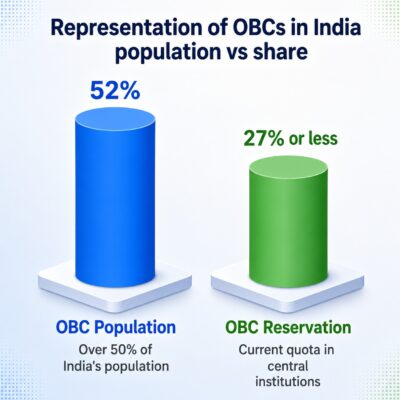
OBCs constitute roughly 52% of India’s population, yet they receive only or below 27% reservation in central institutions. Within this quota, the benefits are often cornered by a few relatively advanced OBC communities, leaving the most disadvantaged behind.
As a result, many capable OBC students remain unrepresented in elite colleges and competitive exams. Vacant seats due to lack of preparation support further illustrate that the existing quota alone cannot bridge the gap.
Increasing Reservation Share – Correcting an Imbalance
Expanding the OBC quota is essential for equitable representation. The goal is not merely to redistribute seats but to align reservation with demographic reality. Sub-categorization and internal quotas can ensure that the most backward OBC communities get their fair share. States like Tamil Nadu and Bihar have experimented with larger shares and sub-quotas, highlighting the potential for national-level reform.
However, increasing seats without addressing preparation gaps will have limited impact.
The solution must be dual: more reservation and better access.
Systemic Barriers Beyond Seats
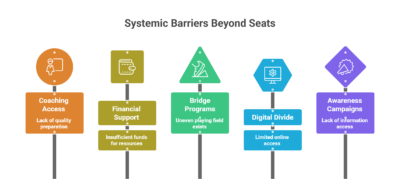
Even with expanded reservation, OBC students face challenges that limit their competitiveness:
- Coaching Access: Localized government-funded centers can help bridge the gap.
- Financial Support: Hostels, stipends, and scholarships are critical for students from low-income backgrounds.
- Bridge Programs: Foundation courses before entrance exams can level the playing field.
- Digital and Language Divide: Many students cannot access online content or coaching in English, requiring vernacular solutions.
- Awareness Campaigns: Students must be informed about scholarships, exam patterns, and eligibility to maximize the benefit of reserved seats.
Also Read: The Barriers of OBC Are Not Invisible – They’re Intentionally Ignored by Political Powers
What Needs to Change – Policy and Support?
To truly empower OBC students, reforms must include:
- Expanding Reservation Seats: Increase OBC quota in line with population and ensure sub-quotas for the most backward groups.
- Accessible Coaching Programs: District-level centers and partnerships with universities for affordable, quality coaching.
- Financial and Residential Support: Stipends and hostels to reduce economic barriers.
- Pre-Exam Preparation Programs: Foundation and bridge courses targeting weaker academic backgrounds.
- Monitoring and Accountability: Track unfilled OBC seats, ensure government schemes reach the intended beneficiaries, and maintain transparency in implementation.
Beyond Cut Offs, Towards Real Equity
It is clear that cut offs alone cannot create fairness. True social justice requires a larger share of reservation for OBCs and a robust system of preparatory support. Until these two pillars are addressed, many capable OBC students will continue to be left behind, and the promise of reservation will remain only partially fulfilled. Expanding seats and empowering students simultaneously is not optional – it is essential for a meritocracy that claims to be fair and inclusive.
For more guidance and support, you can contact People Centre at obcrights, where we will guide you through available schemes and opportunities.
Please share your views/grievances through our interactive website www.obcrights.org
Source: