The history of OBC reservation in medical seats is not a tale of equality achieved, but one of injustice buried under bureaucracy. For years, thousands of deserving students were silently pushed aside — victims of a flawed system that ignored the very principles of social justice enshrined in India’s Constitution. What unfolded under the All India Quota (AIQ) system remains one of the darkest chapters in the story of reservation in higher education.
The Root of a Systemic Injustice
When the All India Quota was introduced, it was meant to ensure that students from every state had equal access to medical education across India. Under this arrangement, 15% of undergraduate (MBBS/BDS) and 50% of postgraduate (MD/MS/MDS) seats from each medical college are pooled nationally.
However, the idea of equality was betrayed in execution. The OBC reservation in medical seats was applied only to those offered by central government institutions, while seats contributed by state government colleges — where OBC students traditionally had better access — were treated as unreserved once pooled into AIQ.
In contrast, the SC and ST quotas (15% and 7.5%) were implemented fully and consistently across all seats. This selective application meant that thousands of OBC students were quietly pushed aside in favour of General and EWS candidates.
The Numbers That Exposed the Truth
The All India Federation of OBC Employees’ Welfare Associations brought the extent of this injustice to light. Between 2017 and 2019, over 5,500 medical seats that should have gone to OBC students were instead filled by others.
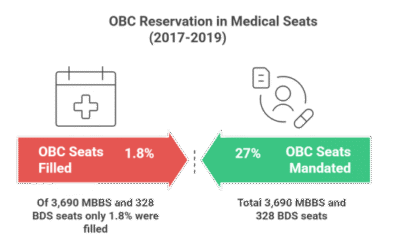
In 2017–18, out of 3,690 MBBS and 328 BDS seats in the AIQ, only 68 MBBS and 10 BDS seats went to OBCs — a shocking 1.8% share where 27% was mandated. Similarly, of the 5,709 PG medical seats, only 183 were allotted to OBCs, when more than 1,600 should have been reserved for them.
In Tamil Nadu, where the state’s policy reserves 50% of seats for BC/MBC students, hundreds of OBC medical aspirants lost out because the AIQ stripped away the state’s reservation framework. If those seats had stayed under Tamil Nadu’s control, nearly half would have gone to OBC students.
These aren’t just data points — they represent the shattered dreams of students who worked hard, qualified, but were denied their constitutional due.
A Constitutional Right Betrayed
Articles 15(4) and 16(4) of the Indian Constitution empower the State to make special provisions for socially and educationally backward classes. The OBC reservation in medical seats flows directly from this principle. Yet, for years, authorities treated it as optional, not mandatory.
The Health Ministry’s defence — that the 27% quota applied only to seats in Central Educational Institutions under the 2006 Reservation Act — was both legally narrow and morally indefensible. Once seats are pooled under a central process like AIQ, they must follow central reservation norms. Anything less is a denial of equality enshrined in the Constitution.
The Long-Awaited Correction
Pressure from activists, students, Members of Parliament, and the National Commission for Backward Classes (NCBC) finally forced action. In 2021, the Supreme Court directed that 27% OBC reservation be implemented in the All India Quota for both UG and PG medical seats.
This verdict marked a long-overdue correction — but it also raised an uncomfortable question: Who will answer for the thousands of seats lost between 2006 and 2020? No compensation, no acknowledgment, and no transparency followed. The government has yet to release year-wise data showing how many OBC students were affected or how this systemic injustice persisted for over a decade.
Lessons from the Lost Years
The period between 2006 and 2020 remains one of the darkest chapters in India’s reservation history — not because a law was missing, but because the law was ignored. The silence from institutions meant that injustice became normalized.
Even today, with implementation restored, the absence of data and accountability raises doubts. OBC reservation in medical seats is not a gift; it is a constitutional right. Without transparency, it risks becoming an empty declaration.
Conclusion
In a country where OBCs form more than half the population, they are granted only 27% reservation — and even that was denied for years. Now, even after implementation, where is the data to prove that justice has truly been served?
The fight is not merely for numbers but for recognition, equality, and fairness. If a majority must still struggle to claim its rightful share, then it is not just a policy failure — it is a moral one. The dark years of denial must never be repeated again.
Request:
We request every OBC Youth/Student to bring any injustice to OBCs with evidence. Mail to: obcrights.sfrbc@gmail.com
We will fight till we get justice.