Women make up nearly half of India’s population, yet their presence in law-making bodies has remained limited for decades. To correct this imbalance, India introduced the idea of Reservation for Women in India through constitutional and legislative measures. However, many people still have doubts about how much reservation exists, where it applies, and whether it is actually implemented.
This article clearly explains reservation for women, covering constitutional provisions, Parliament and local bodies, the 33% women’s quota, horizontal reservation, state-level policies.
Constitutional Idea Behind Reservation for Women
The starting point of women’s reservation lies in the Constitution itself.
Article 15(3) – The Foundation
The Constitution of India empowers the State to make special provisions for women under Article 15(3). This article recognizes that equal opportunity alone is not enough when social and political disadvantages exist. This constitutional principle became the legal base for introducing reservation for women.
When Was Reservation for Women in India Introduced ?
First Implementation: Reservation in Local Bodies (1992–93)
Women’s political reservation was first introduced through constitutional amendments related to local governance:
- 73rd Constitutional Amendment Act, 1992
- 74th Constitutional Amendment Act, 1992
These amendments came into force in 1993.
What They Introduced:
- Reservation for women in Panchayats and Municipalities
- At least 33% of seats are reserved for women
- Reservation applies to: Directly elected seats, Chairperson positions
This was the first time women received constitutionally guaranteed political representation.
How Many Seats Are Reserved for Women in Local Bodies?
Under Articles 243D and 243T of the Constitution:
Minimum 33% seats are reserved for women in:
- Gram Panchayats
- Panchayat Samitis
- Zilla Parishads
- Municipal Councils
- Municipal Corporations
Many states later enhanced this provision.
Expansion of Women’s Reservation to 50%
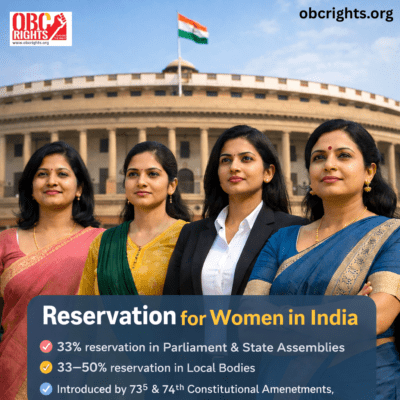
After the 73rd and 74th Constitutional Amendments introduced a 33% reservation in 1992, several states expanded the quota for women to 50% in local self-governing institutions to strengthen their role in decision-making.
Which states have 50 reservation for women?
- In 2006, Bihar became the first state to implement 50% reservation for women in Panchayats and urban local bodies.
- Sikkim (2007) – Followed Bihar with 50% reservation.
- Tamil Nadu, Rajasthan, Madhya Pradesh, Odisha, Kerala, Andhra Pradesh, Telangana, Chhattisgarh – Expanded reservation to 50% in rural and urban local bodies.
This higher quota strengthened women’s leadership roles and improved inclusive decision-making at the grassroots level.
Reservation for Women in Parliament
Women’s Reservation Act, 2023
Reservation for women in Parliament was formally introduced through:
The 106th Amendment to the Constitution, enacted in 2023
Commonly referred to as the Women’s Reservation Act, also known as the Nari Shakti Vandan Adhiniyam.
What the Act Provides:
- 33% reservation for women in Lok Sabha
- 33% reservation in State Legislative Assemblies
- The reservation applies to seats reserved for SC and ST as well
- Reserved constituencies will rotate after each delimitation
Constitutional Provisions Added by the Act
This amendment added new constitutional provisions:
- Article 330A – Provision for women’s representation in the Lok Sabha
- Article 332A – Allocation of seats for women in State Assemblies
- and Article 334A – Duration of reservation
How Much Reservation for Women in Parliament?
According to the constitutional amendment:
- One-third of seats in the Lok Sabha are reserved for women
- The same percentage applies to State Legislative Assemblies
- Reservation is designed as a long-term measure to improve representation
The Women’s Reservation in Parliament cannot be applied immediately. It depends on the latest census because:
- Reserved seats are assigned based on population and constituency boundaries.
- After the census, a delimitation process redraws constituencies to reflect population changes.
- Only after delimitation, the reserved seats for women can officially come into effect.
So in simple: the law exists, but actual seats for women are allocated only after the census and delimitation are completed.
Percentage of Reservation for Women In India?
- Lok Sabha: 33%
- State Legislative Assemblies: 33%
- Local Bodies: Minimum 33%, up to 50% in some states
| Aspect | Parliament | Local Bodies |
| Constitutional Entry | 106th Amendment | 73rd & 74th Amendments |
| Reservation Percentage | 33% | 33%–50% |
| Level | National & State | Grassroots |
What Is Horizontal Reservation for Women?
Horizontal reservation cuts across all categories, such as SC, ST, OBC, and General.
Example: If 33% horizontal reservation for women exists:
- SC women, OBC women, and General women all benefit within their own category
- It ensures women from every social group get representation
This concept plays a crucial role in jobs and education, and people often confuse it with vertical reservation.
Key Committees & Their Reports on Women’s Representation in India
1. 1971 Committee on Women’s Status in India
- Submitted the landmark report “Towards Equality”
- Found that constitutional equality had not translated into real political power for women
- Highlighted extremely low participation of women in decision-making bodies
- Became the first official push for reservations for women in local governance
2. National Perspective Plan for Women (1988–2000) – Margaret Alva Committee
- Recommended reservation for women in elected bodies at all levels
- Argued that participation in politics is essential for women’s social and economic empowerment
- Directly influenced the 73rd and 74th Constitutional Amendments (1992)
3. Joint Parliamentary Committee on Women’s Reservation Bill (1996)
- Supported 33% reservation for women in Parliament and State Assemblies
- Acknowledged concerns about the representation of OBC women
- Suggested periodic review of the reservation policy
4. Standing Committee on Law & Justice (2008)
- Examined the Women’s Reservation Bill passed by the Rajya Sabha
- Strongly endorsed reservation as a corrective measure, not a privilege
- Clarified that rotation of seats would prevent permanent exclusion
5. Committee on the Status of Women (2013)
Recommended at least 50% reservation for women in India across:
- Local bodies
- State legislatures
- Parliament
- Emphasized that women’s under-representation weakens democratic governance
6. Global Gender Gap Report (World Economic Forum)
- Consistently ranks India low in the political empowerment of women
- Used globally to highlight the gap between constitutional rights and actual representation
- Strengthened the case for a constitutional women’s quota in Parliament
Present Challenges in Women’s Reservation
- Exclusion of OBC Women
The 33% reservation for women in India under the Women’s Reservation Act does not have a separate quota for women from Other Backward Classes (OBCs). This leaves OBC women underrepresented, despite facing multiple social, economic, and political barriers.
- Implementation Delays
The Act’s enforcement depends on the census and delimitation of constituencies, which can take years. This causes a gap between law and actual practice, delaying women’s political empowerment.
- Unequal Benefit Distribution
Reserved seats may often go to women from socially and economically dominant groups, leaving marginalized women with limited representation.
- Rotation of Reserved Seats
Seats reserved for women rotate after each delimitation, making it hard for women to establish long-term political influence or leadership.
- Exclusion of Upper Houses
The Act does not include Rajya Sabha and state legislative councils, which leaves women underrepresented in these key decision-making bodies.
Way Forward: Ensuring Effective Women’s Representation
To make Reservation for women in India truly impactful, India must ensure fair inclusion of OBC and marginalized women, speed up the census-based delimitation to activate reserved seats without delay, and empower women through training, mentorship, and awareness programs so they can confidently participate in politics and leadership.