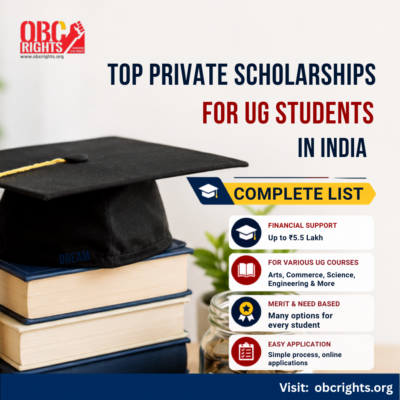
A private scholarship for UG students can help reduce the cost of undergraduate education, especially for students who need support with tuition and other study expenses. Companies, foundations, trusts and CSR organisations offer scholarships with different eligibility conditions. Some focus on academic performance, while others consider family income, course, gender or other factors.
Here are some notable private scholarships for undergraduate students in India, along with their key eligibility requirements, benefits and links to detailed application information.
Best Private Scholarships for Under Graduate Students in India
The scholarships below cover a range of undergraduate students, including those pursuing professional courses and students who need financial assistance.
| Scholarship | Who Can Apply? | Benefit |
| Reliance Foundation Undergraduate Scholarship | Eligible first-year UG students | Up to ₹2 lakh |
| HDFC Bank Parivartan ECSS Scholarship | Eligible UG students from general and professional courses | Up to ₹50,000 |
| Kotak Kanya Scholarship | Eligible girl students in professional UG courses | Up to ₹1.5 lakh/year |
| Tata Capital Pankh Scholarship | Eligible UG students meeting income and academic criteria | Financial assistance |
| Raman Kant Munjal Scholarship | Eligible first-year students in selected finance-related UG courses | ₹40,000–₹5.5 lakh/year |
| SBI Platinum Jubilee Asha Scholarship | Eligible UG students meeting programme conditions | Up to ₹75,000/year |
| Foundation for Excellence Scholarship | Eligible students entering selected professional courses | Financial assistance |
| FAEA Scholarship | Eligible first-year UG students from disadvantaged backgrounds | Education-related support |
Reliance Foundation Undergraduate Scholarship
Eligibility:
- Scored 60% or higher in Class 12.
- Must be studying in the first year of a regular, full-time undergraduate degree programme.
- Household income should be ₹15 lakh or less per year.
- Students from households earning below ₹2.5 lakh are given preference.
- Eligible students must complete the programme’s mandatory aptitude test.
Benefits: Selected students can receive financial support of up to ₹2 lakh during their undergraduate degree, along with opportunities connected with mentorship, leadership and development.
Read more: How to Avail Reliance Foundation Undergraduate Scholarship
HDFC Bank Parivartan ECSS Scholarship
Eligibility:
- Must be pursuing an eligible general or professional undergraduate course at a recognised college or university in India.
- Must have scored at least 55% in the previous qualifying examination.
- Annual family income should be ₹2.5 lakh or less.
- Preference is given to students who have experienced a personal or family crisis that may affect their ability to continue their education.
Benefits: The programme provides up to ₹30,000 for eligible general UG courses and up to ₹50,000 for professional undergraduate courses.
Kotak Kanya Scholarship
Eligibility:
- Open to girl students who have completed and secured at least 75% marks in Class 12.
- Must be admitted to the first year of a professional undergraduate degree.
- Eligible courses include fields such as engineering, medicine, law and other professional programmes.
- Annual family income should be ₹6 lakh or less.
Benefits: Selected students can receive up to ₹1.5 lakh per academic year for their professional undergraduate education, subject to the scholarship’s renewal requirements.
Read more: Kotak Kanya Scholarship for Girl Students
Tata Capital Pankh Scholarship
Eligibility:
- Must be an Indian national studying at a recognised institution in India. And enrolled in an eligible general or professional undergraduate programme.
- Students in general UG courses should have secured at least 60% marks in the preceding academic year, semester or qualifying examination.
- Students in eligible professional degree programmes may need at least 80% marks.
- Annual family income from all sources should be ₹2.5 lakh or less.
Benefits: The programme offers financial assistance towards education expenses, including tuition support for eligible students.
Read more: Tata Capital Pankh Scholarship
Raman Kant Munjal Scholarship
Eligibility:
- Must be an Indian national, studying in the first year of an eligible undergraduate programme.
- Students enrolled in programmes such as BBA, BFIA, B.Com. (H/E), BMS, IPM, BA Economics, BBS, and other related finance and business disciplines can apply.
- Must have scored at least 80% in both Class 10 and Class 12; the requirement is 70% for eligible PwD students.
- Annual family income should be ₹6 lakh or less.
Benefits: The scholarship can provide between ₹40,000 and ₹5.5 lakh per year for eligible students, subject to the programme’s award and renewal conditions.
Read more: Raman Kant Munjal Scholarship for Management Students
SBI Platinum Jubilee Asha Scholarship
Eligibility:
- Must be pursuing an eligible undergraduate course and have secured at least 75% marks or a 7.5 CGPA in the previous academic year.
- The minimum academic requirement is relaxed for eligible SC/ST and PwBD students under the programme rules.
- Gross annual family income should be ₹6 lakh or less.
- The student must be studying at a qualifying Top 300 NIRF institution or a NAAC ‘A’ and above accredited institution.
Benefits: Eligible UG scholars can receive financial support of up to ₹75,000 per year.
Foundation for Excellence Scholarship
Eligibility:
- Generally intended for students entering the first year of selected professional degree programmes.
- Eligible programmes include B.E./B.Tech, 5-year Integrated M.Tech, MBBS and 5-year Law, subject to the applicable scholarship cycle.
- Applicants must have the required 70% marks.
- Admission should be secured through general/open merit in a recognised state or national-level entrance examination or counselling process.
- The published income criterion has been a gross annual family income of up to ₹3 lakh.
Benefits: Selected students receive financial assistance to support their professional undergraduate studies.
Read more: Foundation for Excellence scholarships
FAEA Scholarship
Eligibility:
- Must have completed Class 12 through a recognised Indian board or be currently enrolled in the first year of an undergraduate programme.
- Eligible students can pursue Arts, Commerce, Science, Medicine, Engineering and other technical or professional disciplines.
- The programme primarily supports students from socially and economically disadvantaged sections.
- The scholarship is available for undergraduate study at eligible institutions across India.
- Certain need-cum-merit grants may also be available to eligible general-category students under the programme’s specific conditions.
Benefits: Depending on the applicable provisions, support may cover tuition, maintenance, hostel or mess expenses and other approved education costs.
Private Scholarship for UG Students Based on their Eligibility
The right scholarship can depend on more than academic marks. Students can use their course, financial circumstances or other eligibility factors to narrow down suitable options.
| Student category | Scholarships to explore |
| Merit-cum-means students | Reliance Foundation, HDFC Bank Parivartan ECSS |
| Students from low-income families | Tata Capital Pankh, Foundation for Excellence |
| Girl students | Kotak Kanya Scholarship |
| Engineering students | Foundation for Excellence, Reliance Foundation |
| Medical students | Foundation for Excellence |
| Students in finance-related courses | Raman Kant Munjal Scholarship |
| Students from disadvantaged backgrounds | FAEA Scholarship |
Documents Required for Private UG Scholarships
The documents requested can differ from one scholarship to another. Applicants may commonly need:
- Class 10 and Class 12 marksheets
- College admission or enrolment proof
- Family-income proof, when applicable
- Valid identity proof
- Bank account details
- Fee receipt or fee structure
- Admission or entrance examination documents, where required
- Category, disability or other supporting certificates, where applicable
Always check the individual scholarship’s document requirements before submitting an application.
What to Check Before Applying for a Private Scholarship for UG Students?
Before submitting your application, make sure you meet the following requirements:
- Eligibility: Check your course, year of study, academic record and other conditions against the official criteria.
- Family income: Confirm the applicable income ceiling and which documents are accepted as proof.
- Renewal: Find out whether the scholarship continues in later years and what students must do to retain it.
- Other scholarships: Check whether receiving another scholarship or financial aid affects your eligibility.
- Application status: Confirm the current opening and closing dates before preparing your application.
- Official portal: Apply through the provider’s authorised website or application platform and be cautious of anyone promising guaranteed selection for a fee.
FAQs About Private Scholarships for UG Students
The amount varies by scholarship and programme. For example, the Reliance Foundation Undergraduate Scholarship can provide up to ₹2 lakh over the undergraduate degree, while some private scholarships offer annual awards or support towards tuition fees.
Yes. Many private scholarships use family income as part of their eligibility criteria. Programmes such as HDFC Bank Parivartan ECSS, Tata Capital Pankh and Foundation for Excellence provide opportunities for students who meet their respective income and academic requirements.
Yes. The Kotak Kanya Scholarship is specifically designed for eligible girl students pursuing professional undergraduate courses. Other private programmes may also have scholarships or preference categories for female students.
Find the Right Private Scholarship for Your UG Course
The best private scholarship for UG students is not necessarily the one offering the largest amount. Compare the eligibility rules, course requirements, family-income criteria, renewal conditions and other terms before applying.
Most importantly, verify the latest information with the scholarship provider because eligibility, benefits and application dates can change between scholarship cycles.
Need help with scholarships or education-related concerns?
Connect with the OBC Rights People Centre for guidance and support.
CONTACT: +91 7598800123