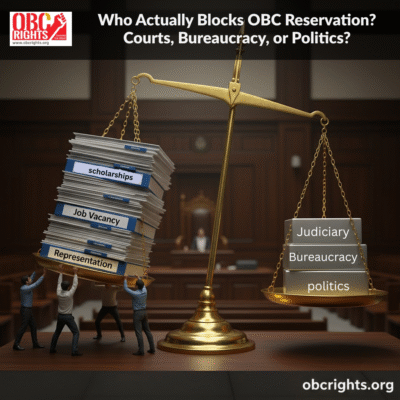
OBC Reservation was introduced to correct structural inequality and ensure representation in education, employment, and governance. Yet, decades after the Mandal Commission recommendations, the outcome does not match the promise. Despite forming around 52% of India’s population and 76% OBC population in Tamil Nadu, OBCs received only 27% reservation at the central level, and even that remains under-implemented. More than 91% of vacancies to be given to OBCs were not given. The problem is not just policy design, it is active resistance across three powerful institutions: the judiciary, bureaucratic machinery, and political leadership.
1. Judiciary: The Legal Wall Around OBC Reservation
The judiciary has played a defining – and often restrictive – role in shaping OBC Reservation. The 1992 Indra Sawhney (Mandal Commission) judgment introduced the now-controversial 50% cap on total reservations. This cap has prevented states from expanding quotas based on demographic realities. Ironically, the same judiciary approved the 10% EWS quota for upper castes in 2019, which allows reservation beyond 50%. This contradiction exposes how judicial interpretation is inconsistent and influenced by political agendas.
Recent examples:
- The Maratha Reservation was struck down by the Supreme Court in 2021.
- The Rohini Commission sub-categorisation report on OBCs has not been made public.
- Multiple state-level OBC Reservation policies remain stuck in litigation for years.
- The apex court could not or do not want to give any direction on Article 340 of the constitution of India.
Judicial delays do not just pause reforms, they effectively weaken OBC Reservation by pushing implementation into stuck without progress.
2. Bureaucracy: Delay by Design, Not Accident
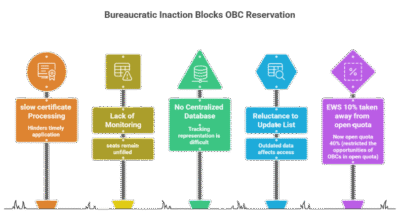
While courts shape constitutional limits, the bureaucracy silently blocks the OBC Reservation through inaction. Government reports show that more than 11,000 OBC posts in Central Government institutions remain vacant, even when reservation mandates exist. Ministries often mark vacancies as “unfilled” or “carried forward” rather than advertising them properly. Thousands of OBCs in the B, C, and D Categories of employment posts have not been given promotion.
Bureaucratic hurdles include:
- Slow and offline OBC certificate processing in many states.
- Lack of monitoring on advertised vs. filled reserved seats.
- Backlog vacancies are silently ignored.
- No centralized database to track OBC representation in recruitment.
- Reluctance to implement state-wise caste surveys or update OBC lists.
- EWS – 10% quota has taken away the opportunities of OBCs in the open quota.
Even in education, thousands of reserved seats go empty each year in IITs, IIMs, and central universities due to systemic neglect, limited outreach, and improper implementation.
3. Politics: Symbolism Instead of Structural Change
Every political party uses OBC Reservation as a slogan, but very few act beyond elections. The Rohini Commission, which was formed to examine the internal categorization of OBCs, submitted its report after four years of delay, and the government has still not released it.
Key political failures:
- No nationwide caste census despite repeated demands.
- No push for OBC Reservation in the judiciary, private sector, or higher judiciary appointments.
- Election manifestos mention OBCs but rarely allocate funds or create accountability mechanisms.
Even though over 200 MPs in Parliament claim OBC identity, actual policy influence for their communities is limited. Political tokenism replaces structural reform, leaving the community with promises, not results.
4. Data That Exposes the Real Story
Reliable data proves the gap between policy and practice in the OBC Reservation:
- Population Share: Mandal Commission and later surveys estimate OBCs at 52%+.
- Government Jobs: Less than 21% OBC representation in Central Government posts (DoPT data).
- Judiciary: Only 7% of judges come from OBC backgrounds (Law Ministry 2023).
- Parliament: Only 25% of Lok Sabha MPs are OBCs despite being 52% of citizens (PRS India).
- Education: NSSO reports show a 42% dropout rate among OBC students before higher education.
These numbers show that OBC Reservation exists more in policy documents than in actual institutions.
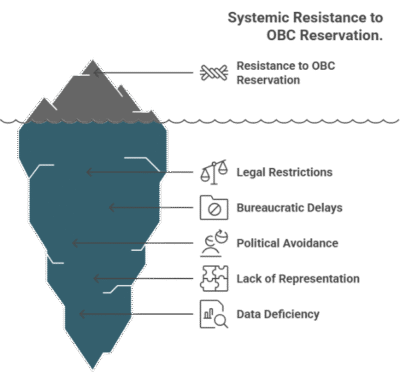
5. The Result: Rights Without Access
The resistance to OBC Reservation is not accidental, it is systemic. Courts restrict it with legal caps and contradictory verdicts. Bureaucrats delay implementation and hide accountability. Politicians talk about social justice but avoid decisions that challenge upper-caste lobbies.
The core issue is representation, not just reservation. Without a caste-based census, vacancy audits, judicial inclusivity, and enforcement mechanisms, OBC Reservation will remain an incomplete promise. Real social justice requires data, deadlines, and constitutional enforcement, not verbal promises without delivery.
OBC Reservation Needs Enforcement, Not Excuses
OBC Reservation is not failing because of policy design. It is being blocked, sometimes openly, sometimes silently, by judicial restrictions, bureaucratic inaction, and political unwillingness. The fight today is not for new rights, but for the implementation of existing constitutional guarantees.
Until representation matches population share, and courts, governments, and departments act with accountability, OBC Reservation will remain a right delayed, and rights delayed are rights denied.