The story of social justice in India has never been simple. It is a story written in court judgments, political manifestos, and the lived struggles of millions who still wait for equality to become real. The Reservation Policy in India, born as a moral promise to correct centuries of discrimination, has now become one of the most contested and reinterpreted ideas in our democracy. Every few years, the courts redefine their boundaries while political leaders reshape their meaning to suit their own goals. Somewhere between judicial control and political calculation, the idea of justice has lost its clarity.
The Judicial Hand: When Equality Meets Legal Boundaries
From the beginning, the judiciary has played a defining role in shaping how the Reservation Policy in India operates. The landmark Indra Sawhney case (1992), often called the Mandal judgment, upheld 27% reservation for OBCs but imposed a 50% cap on total quotas and introduced the concept of the “creamy layer.” This ruling became the foundation for how reservations would be understood in the decades to come—less as a tool of justice, more as a legal compromise.
Later cases deepened the court’s control. In M. Nagaraj (2006), the Supreme Court said that states must prove backwardness and inadequate representation before granting reservation in promotions. This turned social justice into a matter of evidence and documentation rather than lived experience. In Jarnail Singh (2018), the Court reaffirmed this data requirement, placing even more restrictions on states trying to extend benefits.
Strangely, when the EWS quota was introduced in 2019—benefiting upper-caste groups and crossing the 50% ceiling—the same judiciary found a way to justify it. The contradiction was stark. It revealed that the limits of justice often shift depending on whose interests are being served.
The Political Playbook: Votes Over Vision
If the courts have controlled how far reservations can go, politicians are controlling when and why they are expanded. The Reservation Policy in India often takes center stage only when elections approach. Promises of new quotas, revised lists, and expanded benefits are announced, but once the votes are counted, the pace of implementation slows. In a nutshell, the reservation policy is often used to catch votes rather than to ensure real social justice on inclusiveness.
Tamil Nadu’s 69% reservation model, Maharashtra’s Maratha quota movement, and Haryana’s Jat agitation all show how reservation becomes an instrument of electoral strategy. Political leaders use it to gain support rather than to build systems that deliver justice. This short-term approach has created a situation where policies are revised, but lives remain unchanged.
The result is a gap between promise and performance—one that leaves backward communities dependent on political timing rather than constitutional rights.
The 50% Ceiling: A Rule Without Reason
The 50% limit on reservations is not written in the Constitution; it was created through judicial interpretation. It has since been treated as an unquestionable truth, even though India’s social reality has changed drastically since the 1990s. Can equality really be restricted to a number when inequality has no such boundary?
States like Tamil Nadu have already challenged this limit, arguing that historical disadvantage cannot be measured by percentages alone. The Reservation Policy in India must respond to social facts, not fixed formulas. Justice, after all, cannot be achieved through arithmetic—it requires understanding who still stands outside the circle of opportunity.
Data Deficit: Policy Without Proof
No policy can succeed without accurate data. Yet India still does not have an updated caste census. Policymakers rely on outdated numbers from 1931 or on limited surveys that fail to capture the real picture of backwardness. Without data, how can the government decide who deserves what?
The National Commission for Backward Classes (NCBC), though made a constitutional body in 2018, has limited powers only. It can recommend changes to lists of backward classes, but cannot ensure that its findings are implemented. This weakens the entire system. A policy meant to deliver equality ends up functioning in the dark, with little accountability and almost no transparency.
Accountability Without Action
For all the debates around reservation, there is still no consistent way to measure its results.
- How many OBCs have entered higher education?
- How many have reached senior levels in the civil services or judiciary?
- How many welfare schemes actually reach their intended beneficiaries?
These questions remain unanswered because the government rarely conducts audits or publishes outcome reports.
The Reservation Policy in India thus survives as a headline rather than a working model. Everyone claims to defend it—politicians, courts, even administrators—but only a few ensure that it truly delivers. Social justice cannot thrive on symbolism alone; it needs systems that monitor, correct, and evolve.
The Way Forward: From Balance to Commitment
If India truly believes in equality and inclusivity, the future must look different from the past.
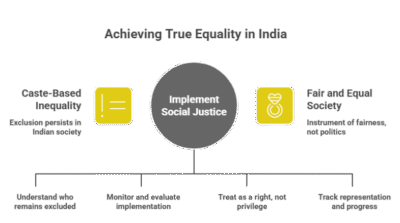
- A nationwide caste census is essential to understand who still remains excluded.
- The NCBC must be given authority to monitor and evaluate implementation.
- Promotion reservations for OBCs should be treated as a right, not a privilege.
- And every five years, the government should publish a Social Justice Report, tracking representation and progress.
The idea is not to expand the reservation endlessly, but to make it work as it was meant to—an instrument of fairness, not a political slogan.
Conclusion
The struggle over the Reservation Policy in India is not merely about seats or percentages. It is about whether a democracy built on equality can live up to its own promise. Courts speak of balance; politicians speak of votes. But for those who still fight for opportunity, the wait continues.
A vital requirement for the development of the Nation is “genuine Social Justice”