
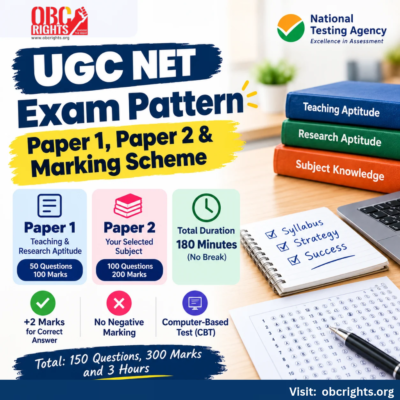
The UGC NET exam pattern consists of two papers with 150 multiple-choice questions carrying 300 marks. Paper 1 has 50 questions for 100 marks, while Paper 2 has 100 questions for 200 marks.
The National Testing Agency (NTA) conducts both papers in a single three-hour Computer-Based Test (CBT), without a break. Each correct answer carries two marks, and there is no negative marking.
UGC NET Exam Pattern: Paper 1 and Paper 2
According to the revised NTA December Information Bulletin, candidates must attempt both papers.
| Exam details | Paper 1 | Paper 2 |
| Subject | Teaching and Research Aptitude | Candidate’s selected subject |
| Total questions | 50 | 100 |
| Maximum marks | 100 | 200 |
| Question type | Multiple-choice | Multiple-choice |
| Marks per correct answer | +2 | +2 |
| Negative marking | No | No |
| Exam mode | Computer-Based Test | Computer-Based Test |
| Duration | 180 minutes combined, without a break |
Total: 150 questions, 300 marks and 3 hours.
Both papers are compulsory. Candidates can move between the two sections during the examination because there is no separate time limit for each paper.
UGC NET Paper 1 Exam Pattern
Paper 1 is common to all candidates and contains 50 questions carrying 100 marks.
The official UGC Paper 1 syllabus specifies five questions worth ten marks from each of its ten units.
| Unit | Subject | Questions | Marks |
| I | Teaching Aptitude | 5 | 10 |
| II | Research Aptitude | 5 | 10 |
| III | Comprehension | 5 | 10 |
| IV | Communication | 5 | 10 |
| V | Mathematical Reasoning and Aptitude | 5 | 10 |
| VI | Logical Reasoning | 5 | 10 |
| VII | Data Interpretation | 5 | 10 |
| VIII | Information and Communication Technology | 5 | 10 |
| IX | People, Development and Environment | 5 | 10 |
| X | Higher Education System | 5 | 10 |
| Total | 50 | 100 |
This allocation comes from the UGC Paper 1 syllabus. The December NTA bulletin confirms the overall 50-question paper but does not independently specify a fixed unit-wise split for every test.
UGC NET Paper 2 Exam Pattern
Paper 2 focuses on the subject selected by the candidate, such as Commerce, English, Education, Tamil or History.
It contains 100 questions carrying 200 marks.
The questions assess knowledge of the selected subject, including the concepts and areas covered in its official syllabus.
Unlike Paper 1, the content of Paper 2 differs from subject to subject. However, the number of questions and marking rules remain the same.
UGC NET Marking Scheme
NTA follows the same marking system for both papers.
| Response | Marks |
| Correct answer | +2 |
| Incorrect answer | 0 |
| Unattempted question | 0 |
There is no negative marking in UGC NET.
For example, if a candidate answers 80 questions correctly, 40 incorrectly and leaves 30 unanswered, the score will be 160 out of 300, assuming no answer-key adjustments.
What Happens to Questions Marked for Review?
The updated December NTA bulletin clarifies how these responses are evaluated:
- Answered and marked for review: Evaluated because an answer has been saved.
- Unanswered and marked for review: Not evaluated because no answer was selected.
Candidates should check that an answer has been recorded before moving to another question.
UGC NET Exam Duration and Language
UGC NET is conducted in online CBT mode.
Candidates receive 180 minutes for both papers together, with no scheduled break or separate paper-wise time limit.
The question papers are generally available in English and Hindi, except for language-subject papers, which use the concerned language.
Candidates must select their preferred examination medium when completing the application form, following NTA’s instructions.
Frequently Asked Questions
1. Is there negative marking in UGC NET?
No. Incorrect answers do not attract negative marks. Candidates receive two marks for each correct answer.
2. Is there a separate time limit for Paper 1 and Paper 2?
No. Candidates have a combined three-hour period and can move between the papers during the test.
3. Are both UGC NET papers compulsory?
Yes. Candidates must take both Paper 1 and Paper 2. Paper 1 assesses general aptitude, while Paper 2 tests subject knowledge.
Check the UGC NET Syllabus Before Preparing
Now that you understand the question pattern and marking scheme, explore the UGC NET Syllabus 2026: Paper 1, Paper 2 Topics & PDF guide to see the topics covered in each paper.
Official Sources
- NTA – Revised UGC NET December 2026 Information Bulletin
- NTA – Official UGC NET Website
- UGC – Official Paper 1 and Paper 2 Syllabus
Information verified against the NTA bulletin updated on 16 October 2026. Candidates should follow the latest official instructions applicable to their examination.


