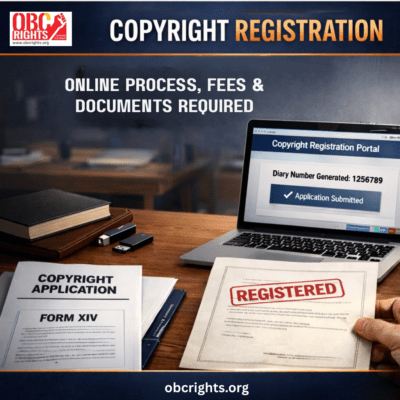
In today’s creative and digital world, protecting your original work is more important than ever. Whether you are an author, musician, artist, software developer, or filmmaker, your creations deserve legal protection. Copyright registration in India ensures that your intellectual property is safeguarded against unauthorized use and infringement.
This comprehensive guide covers everything you need to know about copyright, the copyright registration process, required documents, fees, and the steps to register your work online in India.
What is Copyright?
Copyright is a statutory right that gives creators exclusive control over the use of their original creations. It gives the owner exclusive rights to reproduce, distribute, perform, display, or license their work.
Copyright safeguards the specific way an idea is expressed, rather than the idea or concept in its abstract form. For example, a book, song, painting, or software code can be protected under copyright, but the underlying idea, theme, or concept cannot.
Is Copyright Registration Required in India?
While copyright protection automatically exists from the moment a work is created, registration provides legal evidence of ownership. This is especially useful in case of disputes or infringement.
Benefits of registration include:
- Legal proof of ownership in court
- Easier licensing, sale, or transfer of the work
- Stronger claims in copyright infringement cases
- Credibility and recognition for creators
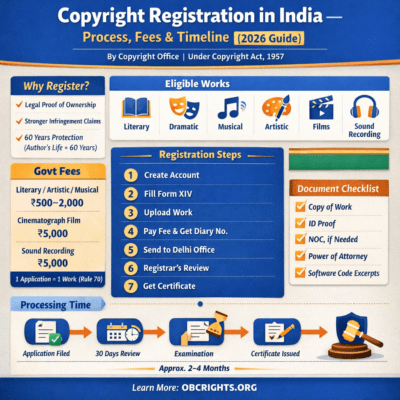
Works Eligible for Copyright Registration in India
As per the provisions of the Copyright Act, 1957, the categories listed below are eligible for copyright registration in India:
| Work Type | Examples |
| Literary Works | Books, articles, software, lyrics |
| Dramatic Works | Plays, scripts |
| Musical Works | Compositions, songs |
| Artistic Works | Paintings, drawings, photographs, sculptures |
| Cinematographic Films | Movies, documentaries, videos |
| Sound Recordings | Audio tracks, podcasts, music recordings |
Duration of Copyright:
- Literary, dramatic, musical, and artistic works: lifetime of the author + 60 years
- Cinematographic films, sound recordings, photographs: 60 years from publication
Is Copyright Registration Required in India?
No, copyright protection exists automatically when a work is created and fixed in a tangible form. However, registration is highly recommended because:
- It provides legal evidence of creation date and ownership
- Helps in resolving disputes efficiently
- Strengthens your rights for licensing, commercialization, or enforcement
Documents Required for Copyright Registration in India
The documents typically include:
- Copy of the original work (PDF, MP3, JPG, etc.)
- ID proof of the applicant
- No Objection Certificate (if applicable)
- Power of Attorney (if filed through an agent)
- For computer programs, you must submit excerpts of the source code, typically the first 10 and last 10 pages or provide the complete code if the program is relatively short.
- File size limits apply (generally under 10 MB for most works).
Copyright Registration Process in India: Step-by-Step Guide
The procedure for copyright registration in India is straightforward and can be completed online or offline. Follow these steps carefully:
Step 1: Create Your Account
- Visit the Copyright Official Portal.
- Click “New User Registration” to create an account if you don’t already have one.
- Note your User ID and Password for future logins.
Step 2: Start Your Application
- Log in using your User ID and Password.
- Click “Click for Online Copyright Registration” to start a new application.
Step 3: Fill the Form and Upload Your Work
- Statement of Particulars: Enter details about the work, authorship, and ownership. Save and continue.
- Statement of Further Particulars: Provide additional information (applies to Literary, Dramatic, Musical, Artistic, and Software works). Save and continue.
Upload Your Work:
- Artistic work: PDF or JPG
- Sound recordings: MP3
- Literary, Dramatic, Musical, Software works: PDF (<10 MB)
For software, include first 10 and last 10 pages of code (or full code if <20 pages). No redactions.
Step 4: Payment
Pay the registration fee.
The fees for copyright registration in India vary by category:
- Literary, artistic, musical works: ₹500 – ₹2,000
- Cinematograph films: ₹5,000
- Sound recordings: ₹5,000
After payment, you will receive a Diary Number for tracking.
Print the following hard copies:
- Acknowledgement Slip
- Filled Copyright Registration Form
Post the printed hard copies to the official copyright registration office in India.:
ADDRESS:
Copyright Office, Department for Promotion of Industry and Internal Trade (DPIIT)
Boudhik Sampada Bhavan, Plot Number 32, Sector 14, Dwarka, New Delhi – 110078, India.
Email: copyright@nic.in
Telephone: 011-28032496
Step 6: Examination by Registrar
- The Registrar examines the application.
- If there are objections, you’ll be notified digitally and must respond within 30 days.
Step 7: Receive Certificate of Registration
- Once approved, your work is entered in the Register of Copyrights.
- You will receive a Certificate of Registration digitally, which serves as legal proof of ownership.
Offline Copyright Registration
- Download Form from copyright.gov.in (Form IV or XIV).
- Fill the Form with details of your work and authorship.
- Attach Required Documents – copies of the work, ID proof, fee receipt, Power of Attorney (if any).
- Submit via post along with the prescribed fee.
Rule 70 of the Copyright Application Rules (India) – Key Points
Rule 70 under the Copyright Rules, 2013, lays down the main procedures for filing and processing copyright registration applications.
- Form XIV is Mandatory: All copyright applications must be submitted using Form XIV, covering literary, artistic, musical, dramatic works, software, films, and sound recordings. Changes to existing copyrights use Form XV.
- One Work per Application: Each application should cover only one work and include the correct registration fee.
- Applicant’s Signature Required: The form must be signed by the author or owner; agents or attorneys cannot sign on their behalf.
- Software Source Code: For software, a portion of the source code (first and last pages, or full code if small) must be submitted.
- Notice to Interested Parties: Applicants must inform anyone with a potential claim or interest in the work.
- Registrar’s Review: The Registrar examines the application, may ask for clarifications, and must provide a hearing if rejecting it.
- Registration Completion: Registration is finalized only when the Registrar enters the work into the Register of Copyrights and issues a certificate.
Key Tips for Copyright Registration in India
- Keep the creation evidence safe
- Choose the correct form based on your work type
- Clearly mention the author and ownership details
- Respond promptly to examination queries
- Retain the registration certificate securely
Conclusion
Copyright registration in India is a crucial step for creators to secure legal ownership of their work. While not mandatory, it provides irrefutable proof of creation and protects against unauthorized use. By following the copyright registration process, you can safeguard your intellectual property, license it, or use it commercially with confidence.
For more guides on certificates, legal documentation, and intellectual property rights, visit obcrights.org.