
India’s job landscape is undergoing a silent revolution. Across sectors—from IT parks in Bengaluru to textile hubs—technology is reshaping how work is done. Tasks that once relied on manual effort or repetitive skill are now being managed by intelligent software, automated systems, and digital platforms. The phrase “AI taking over jobs” isn’t just a headline anymore – it’s a defining force behind India’s new employment reality.
But this shift isn’t only about machines replacing people. It’s about how India’s workforce – especially its youth – responds, adapts, and prepares for a future where human ability must evolve faster than ever before.
The Changing Nature of Work in India:
Over the past decade, India’s workforce has seen a deep transformation. Routine and administrative jobs are declining, while roles that demand problem-solving, creativity, and digital awareness are expanding.
- Manufacturing and retail sectors are introducing automation to reduce errors and costs.
- Banking and insurance rely heavily on digital systems to manage customers and transactions.
- Education, healthcare, and logistics are moving toward hybrid, technology-driven operations.
In short, the future of employment is no longer about job security – it’s about skill security. Workers who can adapt to new tools, data-driven decision-making, and multi-tasking roles are the ones staying relevant.
The Sectors Most at Risk – and Those on the Rise
When people hear “AI taking over jobs,” they imagine total job loss. In reality, the pattern is uneven. Some roles will decline, but others will expand or evolve.
Jobs at risk:
- Data entry, clerical support, and repetitive back-office operations.
- Routine factory assembly and low-skill logistics functions.
- Simple customer support or telemarketing roles.
Jobs on the rise:
- Data analysis, cybersecurity, digital marketing, and process design.
- Healthcare, education technology, and sustainability management.
- Creative, managerial, and problem-solving professions require emotional intelligence.
- Sectors involving analytical skills.
The takeaway is clear: machines handle routine; humans handle reasoning. Those who invest in adaptive learning, creativity, and digital understanding will lead the next phase of India’s employment growth.
Education and Policy: The Missing Link
India’s education system still emphasizes theoretical knowledge over practical employability. Many graduates emerge with degrees that don’t match real-world needs.
To bridge this gap, policy must go beyond classroom education:
- Incorporate industry-led skill modules in colleges and government training programs.
- Expand access to micro-credentials and online certifications in regional languages.
- Promote equal opportunity through digital literacy programs in rural and OBC-dominated areas.
- Create internship pipelines that connect government colleges with private sector projects.
- Don’t create mere engineering graduates – create an engineer
Without these structural reforms, the digital transition may worsen inequality — benefiting urban youth while sidelining millions from smaller towns and rural backgrounds.
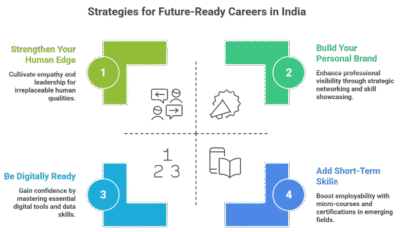
How to Stay Ahead When AI Is Taking Over Jobs
As technology transforms the workplace, these eight smart strategies can help you stay relevant, confident, and future-ready in India’s changing job market.
- Keep Learning, Keep Growing – Treat learning as a lifelong habit, not a one-time degree.
- Strengthen Your Human Edge – Build empathy, leadership, and creativity — skills no machine can copy.
- Be Digitally Ready – Understand digital tools and data to stay confident in a tech-driven world.
- Add Short-Term Skills – Use micro-courses and certifications to stay employable and updated.
- Build Your Personal Brand – Network smartly and make your skills visible in the professional world.
- Think Across Fields – Mix digital, technical, and social skills to stay flexible in your career.
- Adapt Fast, Learn Faster – Unlearn outdated habits and move with changing opportunities.
- Protect Your Mental Balance – Stay emotionally strong and resilient amid constant change.
Embrace Change, Shape the Future
“AI taking over jobs” is not an ending — it’s a transformation. Every industrial revolution has created new opportunities while replacing old ones, and this era is no different. The challenge for India lies in preparing its vast and diverse youth population to not just survive the shift but lead it.
By rethinking education, expanding skill access, and making digital growth inclusive, India can ensure that the future of work is not a story of exclusion — but of evolution.