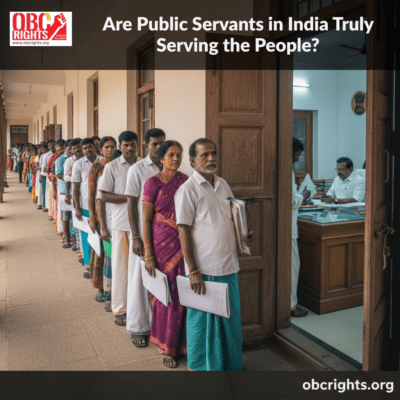
The term Public Servants in India is supposed to reflect service, responsibility, and unwavering commitment to citizens. But today, as people struggle with rising inequality, gaps in welfare delivery, and shrinking transparency in governance, a difficult question emerges: Are those holding public office genuinely serving the people, or merely occupying positions of power?
Who Exactly Is a Public Servant in India?
Legally, the answer is straightforward. A public servant includes:
- Government officials
- Administrative officers
- Public executives
- Elected representatives such as MLAs and MPs
In short, anyone who holds authority on behalf of citizens. But real life is not as neat as legal definitions.
The true debate begins after the appointment or election, how do they actually perform once they get the role?
- Do they carry the weight of public responsibility?
- Do they function with ethics and accountability?
- Do they still remember the promises they made during elections once they enter office?
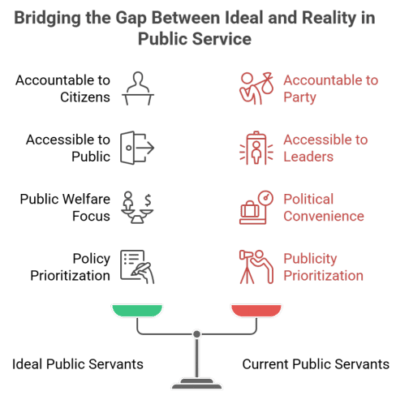
- Are they truly accessible to the people who elected them, or only to party leaders and power brokers?
- Do they feel accountable to citizens, or only to the political party that controls their ticket?
- Do they prioritise policy-making, or do they spend more time on publicity and political drama?
The Constitutional Duty of Our Representatives
India’s Constitution never imagined leaders as rulers. It designed MLAs and MPs as watchdogs of public welfare, not masters of public resources. Their responsibilities are simple but powerful:
- Make laws that shape millions of lives
- Bring people’s issues to the Assembly and Parliament
- Ensure welfare schemes reach the last person in line
- Keep the government answerable and transparent
On paper, it feels like a well-built machine.
In reality, it often works like a vehicle stuck on the roadside.
Because what do we see today?
- Legislative sessions running almost empty
- Constituencies waiting weeks, sometimes months, to meet their own representatives
- Public issues are being pushed aside for party meetings, political drama, or election strategy
When daily governance is overshadowed by noise, the purpose of public service begins to blur.
And that leads to a far more uncomfortable question:
Are our representatives still behaving like public servants, or have citizens silently become servants to those in power?
The Serious Problem of Accountability
In any democracy, accountability is supposed to be the backbone. But in India, it often survives only on paper.
So who actually questions our MLAs and MPs?
- Citizens? Most can’t even reach them.
- Bureaucrats? They run the system but ultimately follow political orders.
- Political parties? They decide what members say, how they vote, and even what they must stay silent about.
This hollow system breeds:
- Poor governance
- Negligence
- Misuse of power
- Corruption
- Silence on issues that matter
For marginalized communities, especially OBCs and other backward groups, the silence of elected representatives on issues like OBC reservation, caste census, access to education, and social mobility is deeply concerning. When leaders fail to defend the rights of these communities, the claim of being public servants becomes even more questionable.
Are Public Servants and Public Service Growing Apart?
India’s political structure still calls MLAs and MPs “public servants.”
But the ground reality raises difficult questions:
- Why do citizens struggle to meet their own representatives?
- Why are public issues replaced by party orders?
- Why is silence more common than accountability?
- Why do marginalized communities have to fight so hard just to be heard?
- Why do leaders remember people only during elections?
When those elected to protect public rights fail to stand up, the very meaning of the term public servant begins to crumble.
Why India Needs More OBC Representatives in Parliament, Judiciary, and Key Government Positions?
Representation is not just about numbers, it’s about ensuring that every community has a voice where decisions are made. For OBCs and other marginalized groups, meaningful participation in governance, policymaking, and justice systems can transform the way public issues are addressed.
Here’s why stronger OBC representation matters:
- Policies Reflect Ground Realities
- Judicial Fairness
- Breaking Power Monopolies
- Role Models for the Youth
- Strengthening Democracy
Who Must Bring Change?
Real change will not come from leaders who simply warm their seats.
India needs representatives who show up, listen, debate, question, and deliver, leaders who remember that public service is a duty, not a privilege.
But here’s the truth we often avoid:
Change doesn’t start only in Parliament. It starts with us. Especially the youth.
- If the next generation stays silent, the same old politics will keep deciding our future.
- If young people don’t question, leaders will never feel the pressure to answer.
- If we don’t demand accountability every day, not just during elections, nothing will shift.
A democracy survives not because people vote once in five years, but because citizens stay alert the other 1,825 days. The youth of India must choose whether to watch from the sidelines or step forward and claim their space in public debate, policy conversations, and representation.
Because if we don’t raise our voice now, others will continue deciding what our future should look like. And silence, today, is the biggest favour we can give to bad governance.