
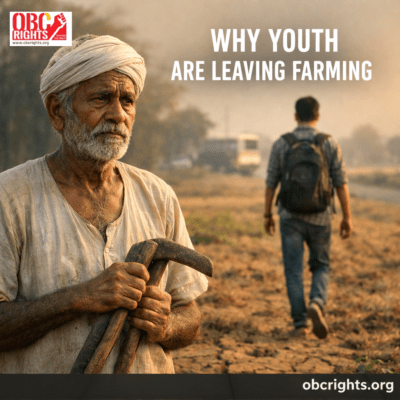
Indian agriculture has been studied more than almost any other sector in the country. From colonial Commissions to modern expert Committees, the problems of farming have been clearly identified. Yet, the crisis continues. Farmers struggle to survive, and young people are walking away from agriculture. This raises a fundamental question: if the problems are well known, why are they not addressed or why is no remedy given?
Warnings That Were Never Acted Upon
The crisis in Indian agriculture is not new. As early as 1928, the Royal Commission on Agriculture warned about rural debt, unequal markets, and low farm income. After Independence, several committees repeated the same concerns. The most significant among them was the Swaminathan Commission (2004–2006).
Its key recommendation was simple:
- Farmers must receive at least 50% profit over the total cost of production (C2 + 50%)
This was meant to ensure farmers survival, not luxury. Yet, this recommendation was never fully implemented nor were even right attempts made in this direction.
MSP: A Promise Without Protection
Minimum Support Price (MSP) is often presented as proof of government support, but its design exposes serious weaknesses:
- MSP is limited to very few crops
- It applies unevenly across regions
- There is no legal guarantee
- Farmers are often forced to sell below MSP
- It’s the order of the day.
Without enforcement, MSP becomes a statement, not protection. Markets remain controlled by traders and large buyers, leaving farmers with little bargaining power.
Rising Costs, Falling Security
While policies remain weak, farming costs continue to rise:
- Seeds, fertilizers, and pesticides have increased sharply
- Diesel, electricity, and labor costs keep growing
- Crop prices do not rise at the same pace
- Wages of agri labours
Despite increased production, farmer income has declined in real terms. This imbalance explains why distress deepens even during years of record harvests.
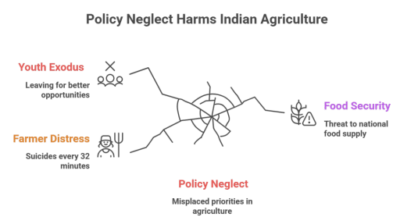
A stark indicator of this failure is the human cost. In India, a farmer dies by suicide every 32 minutes. If agricultural growth were truly inclusive, such extreme distress would not persist.
Economic Shift That Abandoned Agriculture
India’s development model has steadily moved away from agriculture:
- 1950–51: Agriculture contributed about 55% to the national income
- 2011–12: This dropped to nearly 13%
However, nearly 50% of the population still depends on farming. This mismatch means farmers support the economy, but economic growth does not support farmers.
Every sector has an association or a forum to represent their grievances. But the most important sector i.e. the farming sector does not have a strong association or forum.
Policies increasingly favor industry, services, and corporate efficiency, while agriculture is treated as a residual sector.
Why Youth Are Leaving Farming
The failure of policy has consequences beyond today’s farmers. It shapes how the next generation sees agriculture.
Young people leave farming because:
- Income is uncertain
- Debt risk is high
- Social respect has declined
- There is no long-term security
- Paucity of Agri labors
Farming is no longer viewed as a profession with dignity. It is seen as a struggle passed from one generation to the next.
This silent exit is dangerous. When youth leave agriculture, food security itself comes under threat.
Key Structural Failures in Indian Agriculture
- Policies focus on production, not farmer income
- Reports are acknowledged but not implemented
- Markets reward intermediaries, not producers
- Welfare schemes offer short-term relief, not stability
- Farmers bear all the risk, with little protection
- Uncertain climatic conditions
Indian agriculture does not fail due to a lack of effort or knowledge. It fails due to policy neglect and misplaced priorities.
The Unanswered Question
Even after 100 years of repeated reports, no serious attention was given to the Farming sector. Since the farming community does not have an association or a formidable forum, they are always neglected.
Until farmer income, dignity, and security become central to agricultural policy, growth will remain hollow.
The question remains unavoidable:
Who gains from Indian agriculture when farmers and youth are forced to walk away?
Please offer your comments on its : www.obcrights.org and social media