

India produces millions of graduates every year. But an important question remains: Are we creating enough quality jobs for them to build their futures in India?
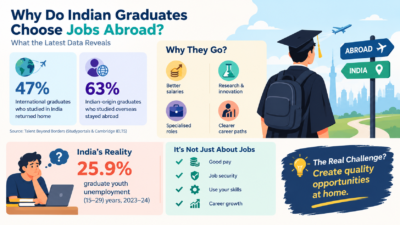
A report titled Talent Beyond Borders, by Studyportals and Cambridge IELTS, highlights an interesting contrast. Around 47% of international graduates who studied in India returned to their home countries, while 63% of Indian-origin graduates who studied overseas remained in their host countries.
These figures raise a bigger question: why do some Indian graduates see better career opportunities abroad, and what does this mean for India’s future?
A Degree Is Not the Same as a Career
For many young Indians, graduation represents years of hard work, family investment and the hope of financial independence. Yet a degree does not guarantee a suitable job, a fair salary or career growth.
These challenges can be even harder for young people in rural areas who lack career guidance and awareness of available opportunities. Read more about why rural OBC youth are hit hardest by unemployment in India.
The challenge is not just whether jobs exist, but whether graduates can find work that matches their qualifications and skills.
Do You Know?
India’s unemployment rate among young people aged 15–29 was 10.2% in 2023–24, according to the Periodic Labour Force Survey.
Source: Annual Report by Periodic Labour Force Survey
This raises an important question: if young people invest years in education but still struggle to find work, are we doing enough to connect education with employment?
India Needs More Than Jobs. It Needs Quality Jobs.
Getting a job is important, but does every job offer the opportunity to build a better future?
Graduates also need:
- Fair salaries that reflect their skills and qualifications.
- Job security and decent working conditions.
- Career growth through training and promotions.
- Relevant work that allows them to use their education.
- Research opportunities to develop specialised knowledge.
When these opportunities are limited, overseas careers may become more attractive. Graduates may find better-funded research facilities, specialised roles or clearer career paths in other countries.
However, this is not just an employment issue. It is also a national development issue.
India’s growth depends on skilled people who can strengthen industries, improve public services, develop new technologies and build successful businesses. When education does not translate into productive employment, both individuals and the wider economy risk losing out on their potential contribution.
Can India achieve its full economic and development potential if its educated workforce cannot find enough opportunities to use its skills?
Is India Losing Talent – or Failing to Retain It?
When skilled graduates leave India to build careers abroad, it is often described as brain drain. But blaming young people for leaving does not solve the problem.
Instead, India needs to create stronger reasons for skilled people to build their careers at home.
What could help?
- Stronger university–industry connections to prepare students for real employment.
- Greater investment in research and innovation to support scientific and technological progress.
- More specialised career opportunities for graduates in growing industries.
- Support for entrepreneurship so skilled people can create businesses and jobs.
- Better-quality employment that offers fair pay, security and professional growth.
These changes can help turn education into innovation, innovation into productivity, and productivity into economic growth.
At the same time, graduates working abroad can contribute through investment, research partnerships, entrepreneurship and knowledge sharing. Migration does not always mean a permanent loss for India.
India’s Growth Depends on Its People
A nation’s progress is not measured only by how many students graduate or how many jobs are created. It also depends on whether people can use their knowledge to improve industries, strengthen communities and solve national challenges.
India needs to focus on both creating employment and improving its quality.
The real question is not why Indian graduates want to succeed abroad.
It is whether India can create enough quality opportunities for them to succeed here – and contribute to the nation’s growth.