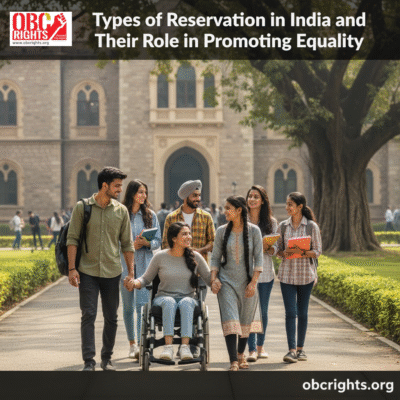
India’s reservation system stands as one of the most significant tools of social justice in the modern world. Designed to uplift historically marginalised communities, it ensures fair representation and equal opportunities in education, employment, and political participation. Understanding the types of reservation in India helps us to see how the nation balances merit with social equity.
The Purpose Behind the Reservation
The Indian Constitution recognizes that centuries of caste-based discrimination and social exclusion cannot be erased by equality on paper alone. Real equality demands affirmative action — measures that enable the disadvantaged to compete on equal footing. Hence, types of reservation in India were introduced to correct historical injustices and empower marginalised groups to access opportunities once denied to them.
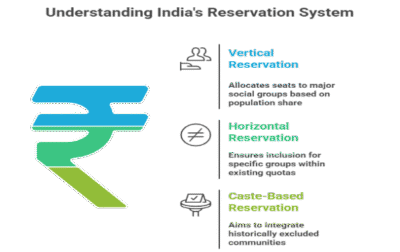
1. Vertical Reservation: Representation for Major Social Groups
Vertical reservation forms the foundation of India’s quota system. It allocates seats in education and jobs to major social groups such as
- Scheduled Castes (SC)
- Scheduled Tribes (ST)
- Other Backward Classes (OBC)
This system reflects their population share in a state or the country. It ensures that representation in public institutions mirrors India’s diverse social fabric. Without vertical reservation, the majority of administrative, educational, and political positions would still remain concentrated in a few privileged sections.
2. Horizontal Reservation: Ensuring Inclusion Within Inclusion
While vertical reservation covers caste and community lines, horizontal reservation cuts across these categories. It guarantees opportunities for specific groups such as:
- Women
- Persons with Disabilities
- Ex-servicemen
For example, within the OBC or SC quota, a certain number of seats are reserved for women or differently-abled individuals. This structure ensures that equity reaches every intersection of disadvantage — gender, disability, and social status. Such inclusivity makes the types of reservation in India more comprehensive and humane. But the only question is: “Are these reservations implemented in letter and spirit”.
3. Caste-Based Reservation: Correcting Historical Injustice
Caste-based reservation remains the cornerstone of India’s social justice movement. Centuries of caste discrimination excluded millions from education, employment, and dignity. The reservation policy aims not to divide, but to integrate — to give voice to those silenced for decades. By granting fair access, it dismantles the legacy of untouchability and empowers backward communities to rise through education and public service.
To give a voice to those who are silenced for decades.
4. Gender-Based Reservation: Towards Equal Representation
Women constitute nearly half of India’s population but remain underrepresented in governance and employment. Through gender-based reservation, the Constitution mandates one-third of seats for women in local bodies under Articles 243D and 243T. Several states are also pushing for similar provisions in legislatures and public offices. Including women in decision-making is not charity — it’s a necessity for balanced, inclusive development.
5. Income-Based Reservation: The Rise of the EWS Category
Recognizing that poverty cuts across caste lines, India introduced the Economically Weaker Section (EWS) reservation in 2019. It offers a 10% quota in education and jobs for economically poor citizens from the general category.
6. Reservation for Differently-Abled Persons: Inclusion Through Accessibility
Under the Rights of Persons with Disabilities Act, the government ensures 3% reservation in jobs for persons with disabilities. This reflects a broader shift from welfare to empowerment — ensuring that physical or mental disability does not become a barrier to opportunity.
The Broader Impact
The types of reservation in India were designed to promote equality, but their implementation often falls short. While many have benefited, the most marginalized still struggle to access real opportunities. Political misuse, lack of review, and unequal distribution have limited the true impact. Reservation must move beyond paper promises — reaching those who need it most, ensuring empowerment over entitlement.
A Step Towards Real Equality
India’s reservation system continues to evolve with its democracy. As the nation debates reform and expansion, one must remember — equality cannot exist without equity. The types of reservation in India remind us that justice is not achieved by ignoring differences but by addressing them.
Until every citizen — regardless of caste, gender, or economic status — gets an equal chance to rise, the journey toward equality remains unfinished.
Real equality begins with awareness — and action.
Join obcrights.org to learn, voice, and fight for fair implementation of the types of reservation in India.
Together, let’s ensure that social justice reaches every deserving citizen.