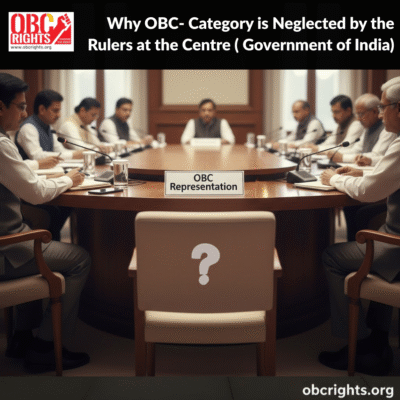
For decades, India has celebrated its commitment to social justice. Yet one uncomfortable reality remains: the OBC category continues to receive Poor attention from the Centre, despite being one of the largest sections of India’s population. This silence raises a serious question — why is the OBC category still politically invisible when it should be at the centre of national policy?
The answers are complex, but they point to a long-standing pattern of neglect that India cannot afford to ignore anymore.
1. Uneven Population: Why Numbers Shape Political Power
One major reason is the uneven population share of the OBC category across states.
In almost twenty-four North Indian states, the OBC community percentage is below 50%. This demographic pattern weakens their bargaining power at the national level.
In states like Bihar and Tamil Nadu, OBCs and EBCs form a clear majority. But in many northern states, political parties do not see the OBC category as a decisive vote bank. This uneven spread makes it difficult to create a strong, united, pan-India movement for OBC rights and OBC reservation. In addition to that the awareness on the constitutional rights to OBCs is almost absent in most of the North Indian States. There are no strong OBC leaders.
Without a large, uniform population share across states, national leaders feel less pressure to prioritise the concerns of the OBC category.
2. Low Awareness: Rights Exist, but Many Don’t Know Them
Another major reason for neglect is the lack of awareness about rights and constitutional protections among many OBC families. Even today:
- Many students do not apply for the scholarships available under the OBC schemes.
- Many job applicants do not know how to challenge violations in the OBC reservation.
- Many families are not aware of their rights under Articles 15(4), 16(4), and 340 of the Constitution.
When people don’t know their rights, they cannot demand accountability.
This silence makes it easier for governments to ignore gaps in OBC reservation, unfilled OBC seats, and poor implementation in central institutions.
In simple terms, awareness is power — and the OBC category has been denied this power for decades.
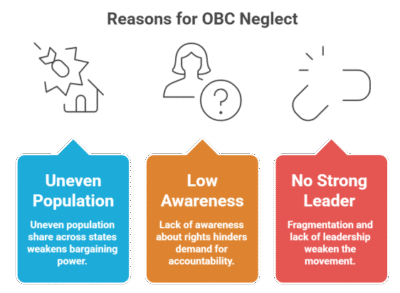
3. No Strong National Leader: Fragmentation Weakens the Movement
The OBC category is extremely diverse — hundreds of castes and thousands of sub-castes, each with different socio-economic positions. This huge internal diversity becomes a weakness in national politics.
The biggest issue: there is no strong national-level leader who represents the entire OBC category. Even in Parliament, the presence of OBC MPs is far lower than the population share the OBC category represents. This weak parliamentary voice reduces the pressure on the Centre.
What happens because of this?
- Different sub-castes focus only on local issues, not collective national demands.
- Regional leaders represent narrow groups, not the whole OBC category.
- No unified voice consistently demands the strict implementation of OBC reservation at the Centre.
This fragmentation makes it easier for the Central Government to remain silent. When the community is divided and under-represented in Parliament, the rulers simply do not feel the political urgency to prioritize OBC issues.
The Result: Weak Representation and Delayed Justice
These three reasons together explain why the OBC category remains neglected:
- Low population share in many states
- Low awareness about rights
- Lack of strong national leadership
Because of this, major national issues remain unresolved:
- OBC reservation seats in central jobs and universities often remain vacant
- There is no updated nationwide caste data
- Important decisions affecting the OBC category are slowed, diluted, or avoided
These are not small issues – they affect millions of families and the future of equality in India.
What India Must Ask Now
If the OBC category is such a large and important part of society,
- why doesn’t the Centre treat OBC reservation as a national priority?
- Why is there still no caste census almost for 94 years? (After 1931)
- Why are thousands of OBC seats unfilled every year?
These questions must be asked — loudly and repeatedly.
India cannot move forward while leaving the OBC category behind.
It is time to speak clearly, ask tough questions, and ensure that OBC reservation becomes not just a policy on paper, but a tool for real equality.