For years, Tamil Nadu has been celebrated as the “Model State” for social justice. But behind this powerful image lies a quiet, uncomfortable reality: OBCs in Tamil Nadu are slowly losing the priority that rightfully belongs to them.
How is this happening?
Not through open denial.
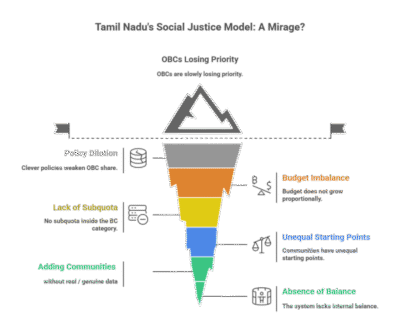
But through clever policies, expanding lists, budget imbalance, and political cover-ups that slowly weaken OBC share in education, jobs, and scholarships.
This article breaks down how the system works, why OBCs are being sidelined, and what the numbers reveal.
The Real Issue: A Growing BC List With No Category Balance
Tamil Nadu’s Backward Class list has grown year after year. New communities are added for various social, economic, and political reasons. Adding communities is not wrong. No community should be denied support if it truly needs help.
The real problem is something else:
- One large category.
- One fixed reservation percentage.
- No subquota inside the BC category.
- No real datas after 1931. The Ambasankar Commission data taken in 1983-85 was declared as unreliable.
This means all communities – old, new, strong, weak – fight for the same limited space.
So even though the list grows, the priority does not grow for those who are historically and educationally weaker.
In simple terms:
A bigger umbrella without extra space only squeezes the ones inside.
Education: Why OBC Students Lose Out Without Sub-Classification
When thousands of students from varied backgrounds enter the same BC quota, the outcome becomes predictable:
- Students from educationally advanced communities do better.
- Students from educationally backward OBC communities fall behind.
- Merit inside the quota shifts in favour of already-advantaged groups.
- Without subcategories, all students compete on the same level, which is unfair.
This is why true OBC groups — many of whom historically struggled with education — lose priority in professional courses, hostels, and scholarships.
This is not due to inclusion. This is due to poor structure and vote bank politics.
Jobs: Equal Rules, Unequal Starting Points
In government jobs, the same pattern repeats.
Inside the BC quota:
- Some communities have long histories of government employment.
- Some have better coaching access.
- Some have political influence.
- Others, especially rural OBC communities, start at a lower base.
- No backlog vacancies for BCs.
But all of them share the same seats.
Without subquota, the gaps widen every year. Communities with stronger foundations naturally secure more jobs, while weaker OBC groups remain underrepresented. This is not injustice caused by new additions. This is an injustice caused by no internal balance or real commitment of its ruled and rulers to uplift the real Socially and Educationally Backward classes.
Scholarships: One Budget, Too Many Beneficiaries
Scholarship funds often look large on paper.
But the moment you divide them among lakhs of students from dozens of communities, the amount per student drops sharply.
Because:
- Beneficiaries increase every year.
- Schemes do not expand accordingly.
- Budgets do not grow in proportion.
- Stronger groups take a larger share due to better access and awareness.
- OBCs at the bottom of the educational ladder lose the most.
- Most of the self-financed colleges are not even forwarding scholarship applications.
Not because someone else entered the list, but because the system doesn’t protect those at the weaker end.
The Budget Story: The Core of the Dilution Problem
Tamil Nadu’s Backward Classes Welfare budget has not increased at the same rate as the demand.
This creates three major problems:
- Per-student benefit falls.
- Scholarship distribution gets thinner.
- Hostel and welfare infrastructure cannot expand.
Without proportional budget growth or sub-category allocation, the weakest OBC communities get overshadowed. The state proudly highlights schemes, but does not adjust funds based on category needs. This is the real dilution—not the BC list itself. As far as OBCs are concerned, both State and Central Governments do not have any real concern.
Why the Current System Hurts OBCs the Most
Because OBCs usually:
- have lower educational base,
- belong to smaller communities,
- lack political influence,
- depend more on government support,
- and face competition from multiple sides.
- Divisions – self-styled leaders among every community, without real concern for the respective community.
When the BC category has no layers, OBCs end up competing with communities that are far ahead in education, urban access, workforce presence, and resources. The weaker OBCs slowly disappear from top colleges, government jobs, and major schemes. Not because they are less capable.
But because the rules treat unequal groups as equal.
What Tamil Nadu Should Actually Do
To restore balance and protect OBC interests, the state must adopt a fair structure by getting genuine caste census datas:
1. As per the mandate of the Constitution of India and directions of the Supreme Court in various judgements, take genuine caste survey datas as done in Telangana and Bihar etc.,
2. Introduce sub-classification within the BC category.
Separate the most backward from the moderately backward and advanced groups.
3. Create community-wise reporting.
Publish transparent yearly data on:
- BC admissions
- BC job selection
- BC scholarship benefits
This will reveal who is left behind.
4. Allocate percentage-based subquota.
Ensure every layer gets its fair share.
5. Expand the budget proportionally.
If beneficiaries grow, the funds must grow too.
6. Protect historically backward communities.
Give priority to groups with the lowest education and income indicators.
These steps will strengthen the BC category without excluding anyone.
Final Thought
Tamil Nadu does not fail because it adds more communities to the BC list.
It fails because it refuses to restructure the system to protect those who need help the most.
The real question is:
Why does a state that speaks loudly about social justice stay silent when it comes to subquota, fair allocation, and genuine OBC protection?
Until this question is answered honestly, OBCs will continue to lose their rightful space, not because of inclusion, but because of the absence of balance.