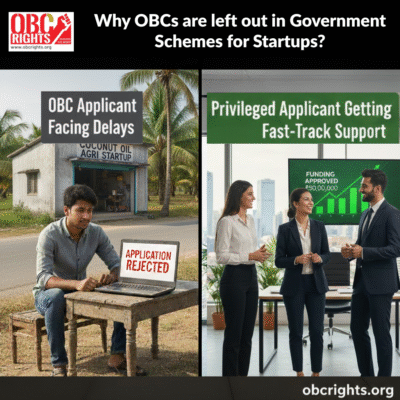
India proudly advertises dozens of government schemes for startups, but when it comes to OBC entrepreneurs, the ground reality tells another story. Despite forming a large section of the country’s self-employed population, their representation in funded startups and enterprise schemes remains disproportionately low. The issue is not the absence of policy, it is the way the system blocks those it claims to uplift.
A Promise That Doesn’t Reach the Ground
Most government schemes for startups are structured with good intent, but overlook the basic realities of OBC entrepreneurs. The Stand-Up India scheme, meant to provide loans to SC/ST and women, has sanctioned over 2 lakh loans, but reports show that only a small fraction went to OBC-linked ventures through indirect categories.
Schemes like PMEGP, Startup India, MUDRA, and CGTMSE have thousands of sanctioned projects, but access is heavily tilted toward urban, networked, and politically connected candidates.
Structural Barriers
Several deeply rooted issues stop OBC entrepreneurs from benefiting from government schemes for startups:
1. Collateral and Banking Bias
SBI’s 2022 credit outreach review notes that applicants from backward communities are more likely to be rejected due to a lack of collateral or land documents. Most first-generation OBC entrepreneurs do not have inherited assets, making even collateral-free loans difficult as banks add informal conditions.
2. Awareness and Access Gap
A NITI Aayog report revealed that over 70% of rural and semi-urban OBC applicants are unaware of the very schemes meant for them. Information stays within cities, startup hubs, and elite networks.
3. Urban-Centric Design
States like Karnataka and Maharashtra have incubator-linked assistance, but they are based in Bengaluru, Mumbai, Pune, and Hyderabad. As a result, rural and tier-3 town aspirants rarely make it past the first stage.
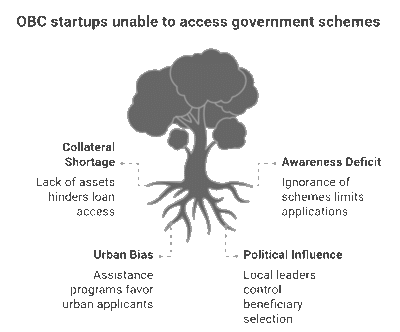
4. Political Gatekeeping
A silent but powerful barrier is political filtering. In many states, local leaders influence which beneficiaries get recommended under schemes like PMEGP or state subsidies. Instead of reaching genuine first-time entrepreneurs, benefits go to relatives of panchayat members, district board leaders, or party workers.
5. Middle Reality: When Policy Meets Power
The MUDRA scheme claims to have given over ₹24 lakh crore in loans, but parliamentary questions reveal that the majority went to existing traders and urban service providers. For first-generation OBC entrepreneurs, even opening a GST-linked account or navigating digital portals becomes a roadblock. Studies by IIM Bangalore and the Dalit Indian Chamber of Commerce show that less than 4% of beneficiaries from startup incentives come from backward caste backgrounds.
Meanwhile, in Tamil Nadu and Bihar, subsidy-linked entrepreneurship schemes often favour those with political backing. This is where the implementation of government schemes for startups collapses—not due to policy flaws on paper, but because of the political economy that shapes access.
What Must Change
To make entrepreneurship truly inclusive, India needs structural reform, not just announcements. The focus should shift to:
- Reservation or sub-quota within startup financing
- District-level entrepreneurship cells for OBC applicants
- Mandatory disclosure of caste-wise loan data
- Penalties for political interference in beneficiary selection
- Local language startup support centres
- Mentorship networks beyond metro cities
Without redesigning eligibility and implementation, government schemes for startups will continue helping those already privileged.
Inclusion Cannot Be an Afterthought
If policymakers continue assuming that a universal model will work for an unequal society, real entrepreneurs will remain invisible. Until caste-aware reforms, local support, and accountability mechanisms are enforced, OBC founders will keep standing outside the doors of schemes built in their name. True progress will begin only when government schemes for startups are not just announced—but made accessible to those who have been historically excluded.
For more output or information, visit obcrights.org.
Please express your views or experience mail to obcrights.sfrbc@gmail.com.