Higher education shapes a country’s talent, confidence, and social mobility. But the rapid growth of Private Colleges in India has created an uneasy question: are these institutions truly delivering education, or simply manufacturing degrees without substance? The scale of privatization is enormous over 78% of India’s colleges are private, according to AISHE 2023. Yet the quality outcomes do not match this explosion. Unless the education/graduation or post-graduation contributes knowledge, it may not be helpful for the employees as well as the nation.
Below is an analytical look at the deeper issues that rarely enter public debate.
1. The In-House Hiring Culture:
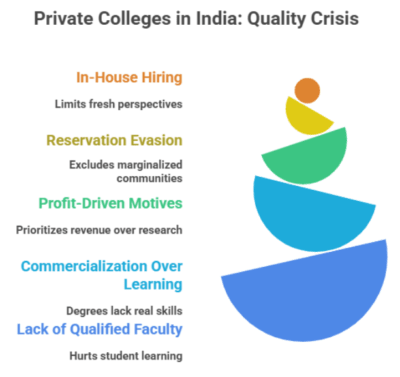
One of the most troubling patterns inside many Private Colleges in India is the “closed-circle recruitment model.”
Instead of conducting open recruitment, many institutions hire their own former PG students as lecturers, often immediately after graduation.
Why does this happen?
- They are easy to control.
- They accept low salaries (₹10,000–₹18,000 per month in many states).
- They won’t demand transparency or academic freedom.
- They won’t insist on reservation norms.
This practice leads to academic inbreeding the same notes, same outdated methods, same narrow exposure. Research publications, industry experience, or pedagogical training become optional rather than essential. The result is a campus full of teachers who have never stepped outside the environment they are teaching in. When such people are not imparted quality education and they are half–leaked, how could they impart – provide quality education.
This directly affects quality and kills innovation.
2. Reservation Evasion: The Silent Violation No One Talks About
Many private institutions bypass the constitutional spirit of social justice.
Even though government-funded colleges follow strict reservation norms in faculty hiring, Private Colleges in India frequently avoid:
- Public advertisements for faculty posts
- Reservation-based recruitment
- External subject expert panels
Entire departments end up with zero representation from OBC/SC/ST communities.
This means thousands of eligible scholars are excluded, not because they lack talent, but because the system is closed, informal, and unregulated.
This has long-term consequences:
- Students don’t see representation in academic spaces.
- Social mobility gets blocked.
- Higher education becomes less inclusive and more elitist.
- When there is no OBC / SC / ST, faculty members, they don’t understand or appreciate the unborn/in built problems of such reserved category people.
The absence of regulation allows institutions to run like private clubs rather than centers of learning.
3. Power, Profit, and the Private College Network:
A significant number of private institutions are owned or controlled by businessmen, political families, MPs, or MLAs having no idea or interest of providing quality education.
This shapes how decisions are made:
- Administration prioritizes revenue, not research.
- Appointments favor loyalists, not qualified professionals.
- Courses expand for profit, not based on regional skill demand.
- Campus culture mirrors political networks rather than academic merit.
- If understanding on the need of either quality education or knowledge-based education.
When higher education becomes a business empire, the priority shifts from knowledge creation to money generation. Fees rise, quality stagnates, and students become customers instead of learners.
4. Quality of Education: The Reality
Prospectuses promise “excellence,” “world-class teaching,” and “industry-ready curriculum,” but the reality is far more uneven. The aforesaid words or phrases are often market-oriented.
Key issues include:
- Lack of qualified faculty in core subjects
- Very low investment in laboratories, research, or innovation
- Minimal industry exposure
- Copy-paste assignments instead of critical thinking
- Outdated syllabi not aligned with current job markets
- Examination practices focused on marks, not skills
- No one to test or update the knowledge and skills of faculty members.
Even the UGC has previously noted that fewer than 5% of private colleges have significant research output, showing how poorly the system supports academic inquiry.
5. Commercialization Over Learning: Degrees Without Depth
Many Private Colleges in India have adopted a volume-based model more admissions, more fees, more branches, more courses.
But without corresponding investment in:
teacher training, updated curriculum, student support, academic infrastructure, job-oriented learning, the degree becomes a certificate rather than a skill-building experience.
This is how institutions slowly transform into degree factories: high output, low substance.
6. Impact on Students and Society: The Hidden Cost
The weakest link in the system is the student, who:
- One faculty member works in three or four colleges
- pays high fees
- receives average teaching
- lacks real-world exposure
- graduates with a degree but not with confidence
- struggles in competitive exams and job markets
India’s skill gap—over 65% of graduates considered “not job-ready” by employers is tied directly to the uneven quality of private education.
This not only hurts individuals but also slows national progress.
7. The Central Question We Must Ask
If private institutions dominate the higher-education landscape, then they must be held to higher standards of transparency, quality, representation, and accountability. Without open recruitment, qualified faculty, research culture, reservation compliance, and strong academic leadership, the promise of “excellence” remains only a promotional slogan.
As long as unchecked commercialization continues, society must keep asking:
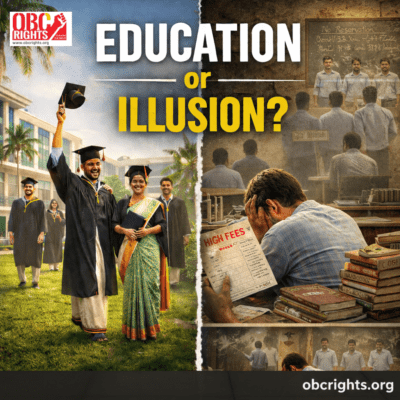
Are we paying for education, or for an illusion of it?
For India’s youth to move forward, Private Colleges in India must evolve from profit-driven entities into genuine centers of learning, innovation, and equal opportunity.
For genuine, fair analysis over education and Job related : www.obcrights.org