
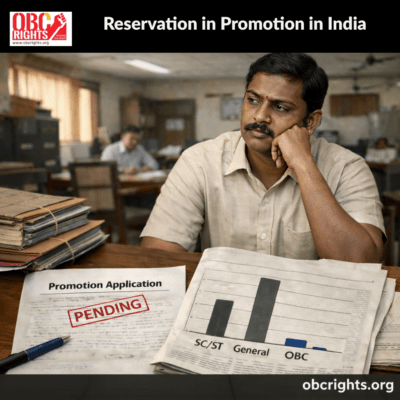
Reservation in promotion in India plays a crucial role in determining who reaches positions of authority in government service. While reservations have improved access to public employment, true representation depends on whether employees can also advance to higher decision-making roles. Over the years, constitutional provisions and Supreme Court judgments have shaped how promotion reservation works and who benefits from it.
This raises important questions: who receives reservation in promotion, why it exists, and why some communities, such is OBC – Classification, are not currently included?. Understanding this requires examining the constitutional framework, legal developments, and the present status of reservation in promotion in India.
What is Reservation in Promotion in India?
Reservation in promotion in India refers to providing reserved opportunities to eligible employees from certain communities when they are promoted to higher posts in government service. This means reservation does not stop at the recruitment stage but can continue during career advancement.
The main objectives of reservation in promotion include:
- Improving representation in senior government positions also
- Ensuring fair career progression for disadvantaged communities
- Addressing structural barriers that affect upward mobility
- Promoting inclusive and representative administration
Government jobs are structured in multiple levels, and promotions determine who moves into supervisory and leadership roles. Without promotion-level reservation, representation may remain limited to entry-level positions.
This is why reservation in promotion in India became an important legal and policy issue.
Article 16(4): Constitutional Foundation of Reservation in Public Employment
The legal basis for reservation in public employment originates from Article 16(4) of the Constitution of India.
Article 16(4) states that:
The State may provide reservation in appointments or posts in favour of any backward class of citizens that is not adequately represented in public services.
This provision gave the government the constitutional authority to provide reservation in recruitment.
Key features of Article 16(4):
- It enables reservation in public employment
- This focuses on improving representation
- It applies to socially and educationally backward classes
- It primarily addresses reservation at the recruitment stage
However, Article 16(4) did not specifically mention promotion. This created legal uncertainty about whether reservation could be extended beyond initial appointments.
This question was later examined by the Supreme Court.
Indra Sawhney Judgment (1992): Turning Point in Reservation in Promotion
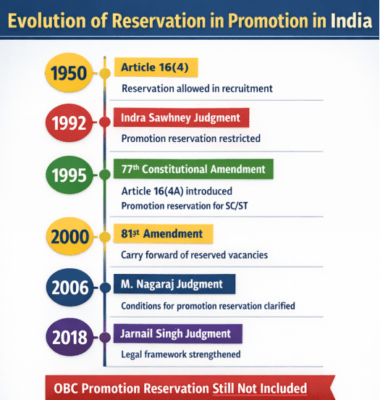
One of the most important cases related to reservation in promotion in India is the Indra Sawhney vs Union of India (1992), also known as the Mandal case.
In this judgment, the Supreme Court ruled that:
- Article 16(4) allows reservation in recruitment
- Reservation in promotion was not automatically covered under Article 16(4)
- This decision meant that reservation in promotion required a separate constitutional provision.
As a result, the government introduced a constitutional amendment to address this issue.
Article 16(4A): Constitutional Provision for Reservation in Promotion
To restore reservation in promotion, the Constitution was amended through the 77th Constitutional Amendment Act, 1995, which introduced Article 16(4A).
Article 16(4A) states that:
The State may provide reservation in promotion in favour of the Scheduled Castes and the Scheduled Tribes if they are not adequately represented in public services.
Important features of Article 16(4A):
- It provides constitutional authority for reservations in job promotion in India
- It applies specifically to Scheduled Castes (SC) and Scheduled Tribes (ST)
- This focuses on improving representation at higher levels
- It gives power to the State, but it is not mandatory
This amendment created the constitutional foundation for reservation in promotion as it exists today.
Article 16(4B): Carry Forward of Unfilled Reserved Promotion Vacancies
- The 81st Constitutional Amendment Act, 2000 introduced Article 16(4B).
- This provision allows the government to carry forward unfilled reserved promotion vacancies to future years.
- This ensures that reserved promotion opportunities are not lost due to temporary unavailability of eligible candidates.
- This strengthened the implementation of reservation in job promotion in India by ensuring continuity of representation.
Article 335: Balancing Representation and Administrative Efficiency
Another important constitutional provision related to reservation in promotion in India is Article 335.
Article 335 states that the claims of Scheduled Castes and Scheduled Tribes must be considered while maintaining administrative efficiency.
This provision ensures a balance between:
- Improving representation
- Maintaining efficiency in administration
It serves as a guiding principle in implementing promotion reservation policies.
Supreme Court Judgments That Shaped Reservation in Promotion
Several Supreme Court judgments have clarified how in promotion reservation in India should be implemented.
1. M. Nagaraj vs Union of India (2006)
In this case, the Supreme Court upheld the validity of reservation in promotion but introduced conditions.
The Court ruled that the government must ensure:
- Inadequate representation of SC and ST
- Maintenance of administrative efficiency
This judgment ensured that reservation in promotion is implemented with constitutional balance.
2. Jarnail Singh vs Lachhmi Narain Gupta (2018)
- In this case, the Supreme Court clarified that states must ensure representation requirements while implementing reservation in promotion.
- This judgment further strengthened the legal framework.
- These decisions continue to guide reservation in promotion policies in India.
Current Legal Status of Reservation in Promotion in India
Based on constitutional provisions and Supreme Court interpretation, reservation in promotion in India currently applies to:
Communities eligible:
- Scheduled Castes (SC)
- Scheduled Tribes (ST)
Communities not currently covered:
- Other Backward Classes (OBC)
OBC reservation exists under Article 16(4), which applies to recruitment. However, Article 16(4A), which enables reservation in promotion, applies only to SC and ST communities.
Key Legal Gap in Reservation in Promotion in India: OBC Representation
OBC employees receive reservation when entering government jobs, but not during promotions. This raises important questions about equal opportunity and representation in career advancement.
This creates several concerns:
- OBC representation may decrease at senior levels over time
- Promotions depend only on general competition
- Reservation benefits remain limited to entry-level posts
- Leadership roles may not fully reflect backward class representation
Example (real-life situation):
An OBC employee join government service as a junior officer through reservation after overcoming social and educational barriers. After 15–20 years of service, when promotion to senior administrative posts is considered, reservation no longer applies. Despite years of experience, reaching top leadership positions becomes significantly more difficult.
This raises a key constitutional question: should equality in public employment apply only at recruitment, or also in promotions? Since promotions decide authority and leadership, the absence of promotion reservation for OBC remains an important legal and policy issue.
Frequently Asked Questions (FAQs)
Q1. Is there reservation in promotion in India?
Yes, In promotion reservation in India exists for Scheduled Castes (SC) and Scheduled Tribes (ST) under Article 16(4A).
Q2. Is reservation in promotion applicable in central government jobs?
Yes, central government jobs provide reservation in promotion for SC and ST employees.
Q3. Is there reservation in promotion for OBC?
No, OBC employees currently receive reservation only in recruitment, not in promotion.
Q4. Which article allows reservation for employees in promotion?
Article 16(4A) allows reservations in promotion for SC and ST in public employment.
Important fact:
- It is a fact that 27% OBC Reservation has not been filled even after 32 years of Mandal Implementation.
- Advanced Communities occupy about 54% of Central Government post and SC/ST occupy around 28% posts, leaving OBCs at lurch!
For more Detailed analysis on reservation, especially for OBCs Visit: obcrights.org.