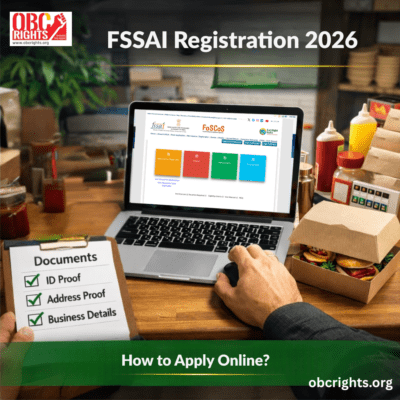
Starting a food business in India requires more than good recipes and quality ingredients. One of the most important legal requirements is obtaining an FSSAI registration or license. This certification ensures that the food you sell meets safety and hygiene standards.
The Food Safety and Standards Authority of India (FSSAI) regulates food businesses and ensures that consumers receive safe and high-quality food products.
Whether you run a small home kitchen, a restaurant, or a food manufacturing unit, completing FSSAI registration online is essential before starting operations.
This guide explains everything you need to know about food licence registration, including eligibility, fees, documents required, and how to check your FSSAI registration status.
What is FSSAI Registration?
FSSAI registration is a government certification required for Food Business Operators (FBOs) in India. It allows businesses to legally manufacture, store, distribute, or sell food products.
The registration is issued by the Food Safety and Standards Authority of India, which operates under the Ministry of Health and Family Welfare.
The main objective of issuing FSSAI certification is to:
- Maintain food safety standards
- Ensure hygiene in food production and distribution
- Protect consumers from unsafe food products
- Regulate food businesses across India
Once approved, businesses receive a 14-digit FSSAI license number, which must be displayed on food packaging and at the business premises.
Who Needs FSSAI Registration?
Any individual or organization involved in food-related activities must obtain an FSSAI license or registration.
Common examples include:
- Home-based food businesses
- Restaurants and cafes
- Food stalls and street vendors
- Catering services
- Bakeries and cloud kitchens
- Food manufacturers
- Food wholesalers and distributors
- Online food sellers
- Food storage or transportation businesses
Even small home businesses selling snacks, pickles, or homemade meals online require food licence registration.
Types of FSSAI Licenses
| License Type | Annual Turnover Limit | Suitable For | Examples | Government Fee |
| Basic FSSAI Registration | Up to ₹12 lakh | Small food businesses and startups | Street food vendors, home kitchens, small retailers | ₹100 per year |
| FSSAI State License | ₹12 lakh – ₹20 crore | Medium-scale food businesses operating within a state | Restaurants, medium food manufacturers, food distributors, catering companies | ₹2,000 – ₹5,000 per year |
| FSSAI Central License | Above ₹20 crore | Large food businesses operating across states or internationally | Large food manufacturers, import/export food companies, national food chains, e-commerce sellers | ₹7,500 per year |
Note: All licenses are issued by the Food Safety and Standards Authority of India, and businesses must choose the license based on their expected or actual turnover and scale of operations.
FSSAI Registration Fees
The FSSAI registration fees depend on the type of license required for the food business.
For example:
- Basic FSSAI Registration: ₹100 per year
- FSSAI State License: falls between ₹2,000 to ₹5,000 per year
- FSSAI Central License: ₹7,500 per year
The exact fee may vary depending on the business category and the validity period selected during application.
Documents for FSSAI Registration
Applicants must submit certain documents while applying for an FSSAI license.
Basic Documents for FSSAI Registration
Small food businesses applying for Basic FSSAI Registration generally need the following documents:
- Identity proof of the applicant, such as Aadhaar Card or PAN Card
- A recent passport-size photograph of the applicant
- Business name and basic business details
- Address proof of the business premises or a rental agreement
- Basic contact details such as a phone number and email ID
- Information about food products that will be manufactured or sold
These documents are usually sufficient for small businesses such as home kitchens, street vendors, and small retailers.
Additional Documents for State and Central License
Medium and large food businesses applying for State or Central FSSAI licenses may need to submit additional documents depending on their operations.
Commonly required documents include:
- Completed Form B, which is the official application form for State and Central licenses
- Food Safety Management System (FSMS) plan describing food safety practices followed by the business
- Detailed list of food products that will be manufactured, processed, or distributed
- No Objection Certificate (NOC) from the local authority or municipality, if required
- Water testing report from a recognized laboratory (especially for manufacturing or processing units)
- List of directors or partners along with their identity proof in case of companies or partnership firms
- GST registration and PAN details of the business entity
- Blueprint or layout plan of the kitchen or manufacturing unit showing equipment and processing areas
- Import Export Code (IEC) issued by the Directorate General of Foreign Trade if the business is involved in food import or export activities
Note: Authorities may request additional documents depending on the type of food business and the scale of operations.
How to Apply for FSSAI Registration Online?
The process for obtaining an FSSAI license has been simplified through the FoSCoS online portal.
Follow these steps:
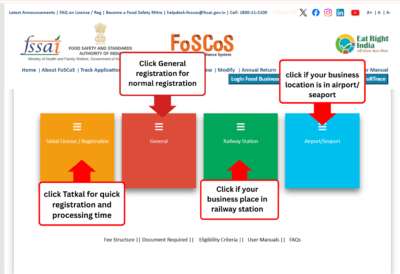
Step 1: Visit the FoSCoS Portal and create an account.
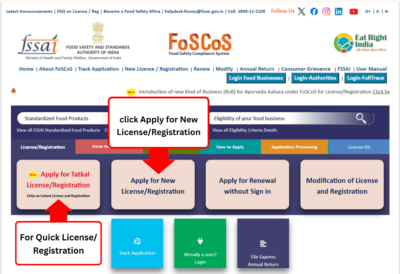
Step 2: Select Apply for New License/Registration
After logging in, choose the option to apply for a new food license.
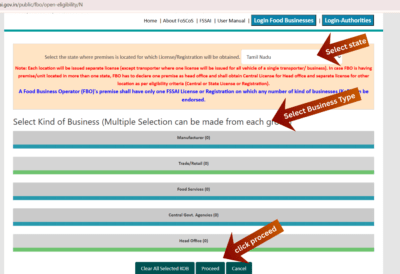
Step 4: Select Your State and Business Type
Choose your state and the category of your food business.
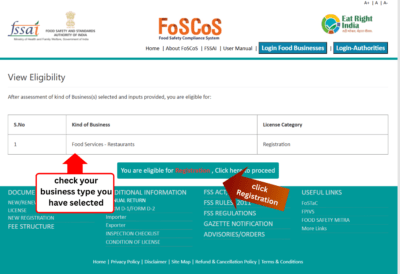
Step 3: check your selected business details and click Registration.
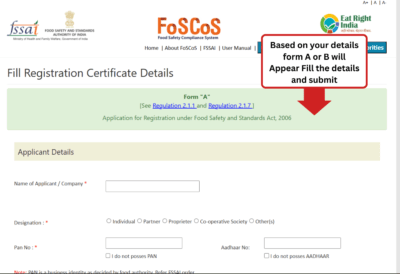
Step 5: Fill the Application Form
You must fill:
- Form A for Basic Registration
- Form B for State or Central License
Provide business details, owner information, and food product information.
Step 6: Upload Documents
Upload the required documents such as ID proof, address proof, and business details.
Step 7: Pay the Registration Fee
Complete the payment through online methods such as net banking or card payment.
Step 8: Submit the Application
Once the application is successfully submitted, you will receive an application reference number to monitor the status of your request.
FSSAI Tatkal License
The FSSAI Tatkal License is a fast-track facility that allows certain food businesses to get their license issued instantly or much faster through the FoSCoS portal.
Key points:
- Available for selected food business categories like retailers, distributors, and transporters
- The license is issued quickly after online verification
- Authorities may inspect the business later for compliance
- Normal FSSAI fees still apply
- Applicants can use the “Apply for Tatkal License/Registration” option available on the FoSCoS website to submit a fast-track application.
How to Check FSSAI Registration Status
Once the application is submitted, applicants can easily check the FSSAI registration status online.
Steps to check status:
- Visit the FoSCoS portal
- Click on Track Application Status
- Enter your application reference number
- View the current status of your license application, if approved you can now download the certificate now.
Read our complete step-by-step guide about how to download FSSAI License Certificate?.
Processing Time for FSSAI License
The approval time depends on the license category.
Typical timelines:
- Basic Registration: 3 to 7 days
- State License: 15 to 30 days
- Central License: Up to 60 days
In some cases, authorities may conduct an inspection of the food premises before approval.
Benefits of FSSAI Registration
Obtaining FSSAI certification provides several advantages for food businesses.
Key benefits include:
- Legal authorization to run a food business
- Improved credibility and customer trust
- Compliance with food safety regulations
- Easier expansion and partnerships
- Required for selling food on online platforms
Displaying the FSSAI license number on packaging also increases transparency and consumer confidence.
Penalty for Running a Food Business Without an FSSAI License
Operating a food business without proper registration is a violation of food safety laws.
- Possible penalties include:
- Fine of up to ₹5 lakh
- Business closure
- Legal action in serious cases
For this reason, obtaining FSSAI registration online is one of the first steps before launching a food business.
Common Mistakes to Avoid During FSSAI Registration
- Choosing the wrong license type based on business turnover or scale of operations
- Providing incomplete or incorrect business details in the application form
- Uploading unclear or invalid documents, such as blurred ID proof or address proof
- Selecting the wrong food business category during the application
- Not submitting Form B for State or Central license applications
- Ignoring food safety compliance requirements, such as a proper Food Safety Management Plan
- Failing to renew the license before expiry
The license must be renewed before its expiry to continue operating the food business legally. For the complete renewal procedure, see our guide on FSSAI License Renewal Online.
Frequently Asked Questions
1. How much time does it typically take to obtain an FSSAI registration?
Basic FSSAI registration is generally approved within about 3 to 7 days. However, applicants who need faster processing can use the Tatkal option available on the FoSCoS for quicker registration.
2. Can a home-based food business apply for FSSAI registration?
Yes. Small home kitchens and homemade food sellers should apply for basic FSSAI registration.
3. Is FSSAI license mandatory for online food businesses?
Yes. Any business selling food online must obtain a valid food licence registration.
4. For how many years does an FSSAI license remain valid?
An FSSAI registration or license issued by the Food Safety and Standards Authority of India is usually valid for 1 to 5 years, depending on the period selected during the application. The license must be renewed before its expiry to continue operating the food business legally.
Conclusion
Obtaining an FSSAI license is a crucial step for anyone planning to start or operate a food business in India. The process of FSSAI registration online has become simple through the digital application system, making it easier for entrepreneurs to comply with food safety regulations.
By completing proper food licence registration, submitting the required documents for FSSAI registration, and paying the applicable FSSAI registration fees, businesses can legally operate while ensuring safe and hygienic food for consumers.
For more schemes related to business visit our website: obcrights.org.