

If you are planning to start a business and belong to the SC, ST, or women category, the Stand-Up India Scheme can help you secure funding from a bank. This government-backed loan program supports first-time entrepreneurs who want to build a new business from scratch.
What is Stand-Up India Scheme?
The Government of India introduced the Stand-Up India Scheme on 5 April 2016 to promote entrepreneurship among eligible communities. The scheme provides bank loans ranging from ₹10 lakh to ₹1 crore to SC, ST, and women entrepreneurs for starting a new business.
The main objective is simple:
Encourage entrepreneurship among underrepresented communities and create employment at the local level.
Every bank branch in India is expected to support at least:
- One SC/ST entrepreneur
- One woman entrepreneur
The scheme focuses only on greenfield projects, which means the business must be newly started.
Who is Eligible?
You can apply if:
- You are SC, ST, or a woman entrepreneur
- You are at least 18 years old
- You are starting a new business
- You are not a loan defaulter
- In case of partnership/company, 51% ownership must belong to eligible category
The scheme supports manufacturing, services, trading, and agriculture-allied activities.
Stand-Up India Scheme for Women
Women entrepreneurs can apply even if they do not belong to SC/ST categories.
To qualify:
- The business must be 51% owned by a woman
- The applicant must be above 18 years
- The business must be newly established
This scheme helps women start:
- Manufacturing units
- Beauty parlours
- Boutiques
- Food processing units
- Retail stores
- Service businesses
Many women use this loan to become financially independent and generate local employment.
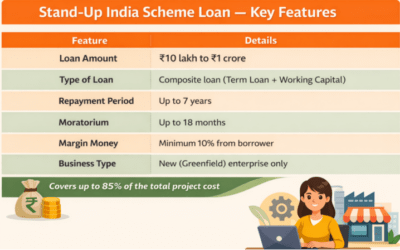
Stand-Up India Scheme Loan – Key Features
Stand-Up India Scheme Loan Amount
Under this scheme, entrepreneurs can obtain loans starting from ₹10 lakh up to a maximum limit of ₹1 crore.
Example:
- If your project cost is ₹25 lakh:
- Your contribution (10%) = ₹2.5 lakh
- Bank loan = ₹22.5 lakh
The amount depends on your business plan, repayment capacity, and bank evaluation.
Stand-Up India Scheme Loan Interest Rate
The interest rate is not fixed. Banks decide it based on guidelines.
Generally:
- Interest Rate = MCLR + up to 3% + tenure premium
- Average range: 8% to 12% per annum (varies by bank and profile)
You should compare rates from different banks before applying.
Documents Required for Stand-Up India Scheme
Banks may ask for the following documents:
- Aadhaar Card
- PAN Card
- Caste Certificate (for SC/ST applicants)
- Business Plan or Project Report
- Address Proof
- Bank Statements
- Income Tax Returns (if available)
- Quotation of machinery or equipment
- Business registration documents (if applicable)
A strong project report increases your approval chances.
How to Apply for Stand-Up India Scheme
You can apply online or offline.
1. Online Application Process
Visit the official portal of Stand Up Mitra Portal.
Steps:
- Register as a borrower
- Fill in personal and business details
- Upload required documents
- Select preferred bank branch
- Submit application
The portal also connects you with support agencies for training and project preparation.
2. Offline Application
You can visit any scheduled commercial bank such as:
- State Bank of India
- Bank of Baroda
- Canara Bank
- Indian Bank
Meet the loan officer and submit your business proposal.
Stand-Up India Scheme vs Startup India Scheme
Many people confuse these two schemes. They are different.
| Feature | Stand-Up India Scheme | Startup India Scheme |
| Purpose | Bank loan support | Startup recognition & tax benefits |
| Target Group | SC/ST & Women | Any eligible startup |
| Loan | Yes (₹10 lakh – ₹1 crore) | No direct loan |
| Focus | New small/medium businesses | Innovative startups |
The Startup India mainly provides tax benefits, recognition, and easier compliance. It does not directly give bank loans like Stand-Up India.
Collateral and Guarantee
Banks may ask for collateral. However, loans can also be covered under a credit guarantee mechanism, which reduces the risk for banks.
Approval depends on:
- Project feasibility
- Credit history
- Repayment capacity
- Market potential
Repayment Terms
- Maximum repayment period: 7 years
- Moratorium: Up to 18 months
- EMI begins after moratorium period
You should plan cash flow carefully before taking the loan.
Advantages of Stand-Up India Scheme
- High loan amount (up to ₹1 crore)
- Special focus on women and SC/ST
- Long repayment period
- Encourages first-time entrepreneurs
- Supports job creation
Tips to Increase Approval Chances
- Prepare a clear and realistic project report
- Show market demand for your product/service
- Maintain a good CIBIL score
- Contribute margin money from genuine sources
- Keep documents complete and updated
- Banks prefer applicants who show commitment and clarity.
Final Words
The Stand-Up India Scheme offers a real opportunity for women and SC/ST entrepreneurs who want to start a business but lack financial support. With loan amounts between ₹10 lakh and ₹1 crore, flexible repayment options, and nationwide availability, this scheme can turn your business idea into reality.
Before applying, compare bank interest rates, prepare a strong business plan, and understand repayment terms carefully.
If used wisely, this scheme can help build sustainable businesses and create long-term financial independence.
Frequently Asked Questions (FAQs)
1. What is Stand-Up India Scheme loan amount?
The Stand-Up India Scheme offers loans from ₹10 lakh to ₹1 crore to eligible SC, ST, and women entrepreneurs for starting a new business.
2. Who is eligible for Stand-Up India Scheme?
SC, ST, and women entrepreneurs above 18 years starting a new business with at least 51% ownership are eligible.
3. What is Stand-Up India Scheme interest rate?
The interest rate is decided by banks and usually ranges between 8% and 12% per annum.
4. How to apply for Stand-Up India Scheme online?
You can apply online through the Stand Up Mitra Portal by registering and submitting your business and personal details.
5. Is collateral required for Stand-Up India loan?
Collateral may be required, but many loans are covered under a government credit guarantee scheme.
For more such schemes, visit obcrights.org.