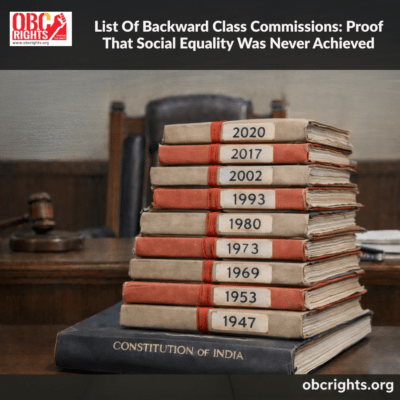
If social equality had truly been achieved in India, the country would not have needed dozens of Backward Class Commissions over more than seven decades. Yet, from 1947 to 2020, governments, both at the Centre and in the states, kept appointing one commission after another to study the same question: Who remains socially and educationally backward, and why? They never bother to comply with Article 340, which mandates periodical investigation on the reservation.
The very existence of this long list of commissions is not a success story. It is an admission of failure. Each backward class commission stands as evidence that caste-based inequality did not disappear with independence, constitutional promises, or economic growth.
What Is a Backward Class Commission?
A backward class commission is a government-appointed body tasked with identifying socially and educationally backward communities and recommending measures such as reservation, welfare schemes, and legal safeguards. These commissions rely on data related to caste, occupation, education, income, and social discrimination. They have to find the communities that benefited from the reservation and which were not.
Why Were Backward Class Commissions Repeatedly Formed?
The repetition itself tells the story:
- Earlier commissions failed to capture the full depth of caste inequality
- The benefits of reservation were cornered by dominant groups
- Many genuinely backward communities remained invisible
- States had social realities very different from the Centre’s assumptions
- Political reluctance delayed or diluted implementation
- The elected representative’s ignorance over the vision of reservation mandated by the provisions of the constitution.
Instead of eliminating backwardness, the system often managed it without resolving it.
A Complete Timeline of Backward Class Commissions in India
1. 1940s–1950s: Early Attempts After Independence
- Criminal Tribes Inquiry Committee (1947)
- B.G. Kher Committee (1949)
- Ayyangar Committee (1949)
- Committee on Backward Classes, Punjab (1951)
- Kalelkar Commission (1953)
- Thate Committee, Maharashtra (1959)
These early efforts struggled with a basic question: should backwardness be defined by caste, class, or occupation?
2. 1960s: States Take the Lead
- Dr. R. Nagappa Gowda Committee – Karnataka (1960)
- V.K. Iyer Commission – Kerala (1961)
- B.D. Deshmukh Committee – Maharashtra (1961)
- G. Kumara Pillai Committee – Kerala (1964)
- Lohkar Committee – Central Government (1965)
- M.P. Damodaran Committee – Kerala (1967)
- Gajendragadkar Commission – Jammu & Kashmir (1967)
- Anantha Raman Commission – Andhra Pradesh (1968)
- Andhra Pradesh Backward Classes Commission (1968)
- Brish Ban Committee – Punjab (1969)
- J.N. Wazir Committee – Jammu & Kashmir (1969)
- Sattanathan Commission – Tamil Nadu (1969)
This decade proved that states understood social inequality better than the Centre.
3. 1970s: Expansion Without Resolution
- Mungil Lal Commission – Bihar (1971)
- Ak Bakshi Committee – Gujarat (1972)
- L.G. Havanur Committee – Karnataka (1972)
- Punjab Vidhan Sabha Committee (1975)
- Chhed Lal Sathi Committee – Uttar Pradesh (1975)
- Justice Adarsh and Anand Committee – Jammu & Kashmir (1976)
- Agisam Veerappa Committee – Andhra Pradesh (1977)
Backwardness was now widely acknowledged, but political hesitation slowed real reform.
4. 1980s: Mandal and Its Aftermath
- West Bengal Backward Classes Committee (1980)
- Mandal Commission – Central Government (1980)
- Ambashankar Commission – Tamil Nadu (1985)
The Mandal Commission did not create division. It exposed inequality that had always existed. The backlash it faced revealed how deeply caste privilege was protected.
5. 1990s–2000s: Unequal Distribution Within OBCs
- D.C. Vaidya Committee – Maharashtra (1993)
- Kirloskar Committee – Maharashtra (1993)
- Venkat Chalaya Commission – Central Government (2002)
- Bapat Commission – Maharashtra (2004)
By now, a new truth had emerged: even within OBCs, inequality was severe.
6. 2010–2020: Correcting Internal Injustice
- Rane Commission – Central Government (2008)
- Tag Commission – Maharashtra (2010)
- NAC Report – Central Government (2011)
- Prof. Virginius Xaxa Committee (2014)
- Bhurani Ji Idare Commission (2015)
- Justice Rohini Commission – Central Government (2017)
- Adulya Mishra IAS Committee (2019)
- Justice Kulasekaran Commission – Tamil Nadu (2020)
These commissions acknowledged a hard fact: reservation benefits were unevenly monopolized, leaving the most backward behind.
What This Long List Actually Proves
- Social equality was never achieved, only claimed
- Caste continued to shape access to education and power
- Reservation without reform created new layers of inequality
- Data was delayed, diluted, or ignored for political convenience
Every backward class commission is proof that the problem persisted.
The Uncomfortable Truth
Reservation was never a temporary measure. It was a constitutional repair mechanism for centuries of exclusion. Expecting it to disappear without dismantling caste privilege is not optimism, it is denial.
Conclusion: Why Injustice Still Prevails
Injustice persists because reform was negotiated, not enforced. Recommendations were filtered through political convenience, electoral calculations, and social pressure. What survived was compromise, not justice. Until implementation becomes non-negotiable and accountability replaces tokenism, backward class commissions will remain necessary, and inequality will remain real.
Backwardness continues because accountability is missing. Follow obcrights.org for research-backed analysis that challenges power and demands implementation, not symbolism.